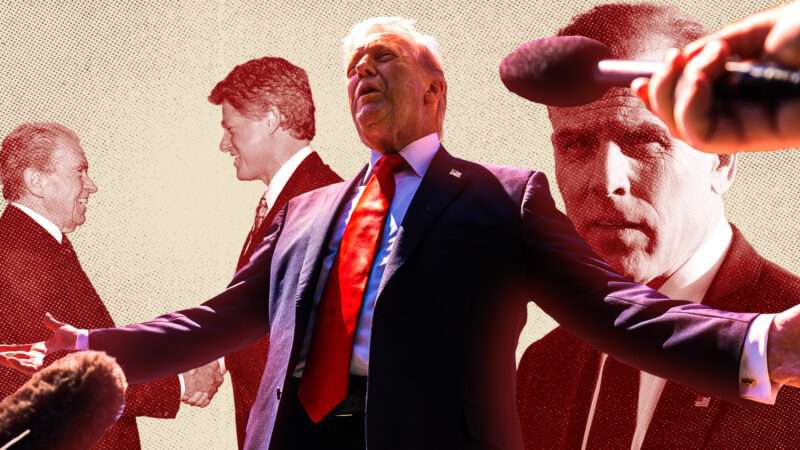
Ask historians or laymen to name the most blatantly corrupt pardon over the first 230 years or so of American presidenting, and most will likely arrive at the same answer: Marc Rich.
Rich, a multiple-passport-holding, proudly amoral oil trader who specialized in sanctions-circumventing commerce with the likes of Nicolae Ceaușescu and Ayatollah Ruhollah Khomeini, fled to Switzerland in 1983 rather than face a potential life sentence and $1.6 million in fines on 65 counts of wire fraud, trading with the enemy, and tax evasion. (It was the biggest tax evasion case to date in U.S. history, at $48 million—around $150 million today.) Yet Bill Clinton, in the final minutes of his presidency, gifted Rich a midnight pardon.
All normal pardon protocols had been circumvented. The Justice Department was blindsided, and the longtime fugitive—a veteran of the FBI's Most Wanted List—had never expressed the customary remorse. Reporting soon revealed that Rich's ex-wife, the songwriter Denise Rich, had donated $1.1 million (roughly $2.3 million in 2026 dollars) to Democratic causes during the Clinton presidency, including (in nominal dollars) $450,000 to the Clinton Library, $120,000 for Hillary Clinton's Senate race, and $25,000 to Al Gore's Florida recount effort. "Not just a large donor," Sen. Russell Feingold (D–Wisc.) noted at the time, but "a huge donor."
Rich's last-ditch clemency drew widespread bipartisan condemnation. "Disgraceful," judged former President Jimmy Carter. Added New York Mayor Rudy Giuliani: "The fact that Bill Clinton and Eric Holder engineered a pardon for him—without input from me, as the U.S. Attorney who prosecuted him, or Janet Reno, as Attorney General, will forever be a blemish on our justice system."
You have likely never heard the name Trevor Milton, yet in a couple of key respects his 2025 pardon by President Donald Trump was worse. The founding CEO of the electric vehicle manufacturer Nikola Corporation, Milton in 2022 was convicted on three counts of investor fraud that could have brought him four years in prison and a staggering $676 million worth of mandated restitution to shareholders. Among his more notorious stunts was a 2018 promotional video of a supposedly functional prototype Nikola truck that was not in fact operational but had instead been rolled down a desert hill. Milton, represented in court by the brother of then–Attorney General Pam Bondi, was still awaiting final sentencing when he got the call from Trump announcing an unconditional pardon, no restitution (or remorse) required. When asked about the clemency, the president said: "They say the thing that he did wrong was he was one of the first people that supported a gentleman named Donald Trump for president….He supported Trump. He liked Trump." Milton and his wife, The Wall Street Journal reported, had donated "at least $3.2 million to Trump's 2024 election and to political groups and people in Trump's orbit." The couple had not previously demonstrated a financial interest in politics.
Milton's family paid more in political donations than Rich's. He had exponentially more in fines and restitutions taken off the table, and he has spent his post-clemency life not in humiliated exile but in lavish Washington excess, hobnobbing with the president and Cabinet members at investment conferences and black-tie events to gin up interest in his latest schemes. Such is the rule, not the exception: When it comes to plausibly pay-for-play pardons, Trump in his second term makes Bill Clinton and every other president look like pikers.
Paul Walczak, a nursing home executive who'd pled guilty to spending his employees' federal tax withholdings on such baubles as a $2 million yacht, was in May 2025 on the verge of commencing an 18-month sentence and paying $4.4 million in fines when Trump issued his get-out-of-jail-free card. On his pardon application, Walczak made the explicit pitch that his mother, Elizabeth Fago, had raised millions of dollars for Trump and the GOP in 2024 campaigns, and additionally assisted the president by publicizing embarrassing revelations from the diary of President Joe Biden's daughter Ashley. Less than three weeks before the pardon, Fago accepted an invitation to attend a million-dollar-per-head fundraiser at Mar-a-Lago, crowned by a one-on-one with the president.
Trump's second-term pardons and sentence commutations have wiped away more than $2 billion in fines and restitutions. The Wall Street Journal reported in December 2025 that the president's forgiveness spree "has spawned a pardon-shopping industry where lobbyists say their going rate is $1 million." The Atlantic in June 2026 set the updated price at $2 million. Whereas Bill Clinton conceded within 15 months that the Marc Rich clemency had been a mistake (even while hotly denying that political donations had anything to do with it; he claims to have been persuaded by testimony from high-profile Israelis such as Ehud Barak), the always-unapologetic Trump barely feigns interest in the process, even while his family and Cabinet members forge business deals with the ex-cons and their companies.
Queried by 60 Minutes in October 2025 as to why he had just pardoned Changpeng Zhao—the founder of the cryptocurrency exchange Binance, who had already served four months in prison and had his company pay $4.3 billion for money laundering—Trump said: "I have no idea who he is." The president might have asked his son Don Jr., who had recently introduced his dad to Zhao's pardon lobbyist and in the preceding months had contracted Binance to exclusively host and build the blockchain technology for the Trump family crypto trading platform World Liberty Financial. (That company's stablecoin, USD1, was used in May 2025 as the currency for a $2 billion investment into Binance by the United Arab Emirates company MGX, a transaction that, according to The Wall Street Journal, "rocketed USD1 up the rankings of largest stablecoins," thereby "pushing its market capitalization up from $127 million to over $2.1 billion.") When asked about the controversial clemency, White House Press Secretary Karoline Leavitt issued a one-size-fits-all denial: "Neither the president nor his family have ever engaged, or will ever engage, in conflicts of interest."
Say what you will about Clinton's skeevy pardon of Marc Rich, at least it wasn't preceded by Rich forging billion-dollar partnerships with a company owned by the president and managed by his daughter. Yet here we are in Trump's second term, so overwhelmed by dodgy-sounding deals that any attempt to measure or characterize the scope of corruption can seem preemptively futile. The numbers are too big, the conflicts too brazen, the examples too numerous.
In a companion piece to this one, Senior Editor Jacob Sullum drills down into the tawdry details of the president's most audacious self-dealings, from having the federal government settle his own lawsuits to selling access to himself and his memecoin in a dinner that raised an estimated $148 million. Here, to visualize the contours of the overall problem, we work backwards from whataboutism, dividing up the greatest scandals in American history by category, then checking in on Trump 2.0 to see how he compares. The results reveal a pattern: The 47th president has serially exceeded the most infamous corruptions in U.S. history while generating a fraction of the outrage.
Molehills Out of Teapot
At its heart, the otherwise complicated and multi-stage Teapot Dome affair of the 1920s, which until Watergate was considered the greatest federal government scandal of all time, was about secret bribes to an administration official that lubricated lucrative regulatory outcomes. In 1921, Interior Secretary Albert Fall clandestinely accepted $404,000 ($7.6 million in today's money) in cash and no-interest loans from two oil executives, who then became recipients of no-bid leases to exploit oil fields in California's Elk Hills and Wyoming's Teapot Dome. As part of the scheme, Fall had previously convinced the secretary of the Navy to transfer authority over those lands to the Department of the Interior. The no-bid contracts were legal (at the time, anyway); the bribes were not, and the secrecy exploded upon revelation.
Fast forward a century. Four days before Trump's second inauguration, a company called Aryam Investments 1 signed a deal with the president-elect's son Eric to buy a 49 percent stake in World Liberty Financial for a reported $500 million, half of it in cash up front. The Trump family received $187 million overnight, and the family of World Liberty Financial co-founder Steve Witkoff, who by then was already conducting sensitive Middle East diplomacy on behalf of the incoming president, received an additional $31 million, according to The Wall Street Journal. Amazingly, the transaction was made in secret, revealed only one year later.
Did Aryam Investments have any pressing regulatory business in front of the U.S. government? Quite a bit, yes. The firm is owned by Sheikh Tahnoon bin Zayed Al Nahyan, the national security advisor for the United Arab Emirates (UAE), brother of the nation's president, and head of the country's $800 billion sovereign wealth fund. Tahnoon's artificial intelligence company G42 had been prevented by the Biden administration from acquiring advanced Nvidia AI chips over national security concerns that it might share the technology with China. That was reversed with a bang in May 2025, when Tahnoon received what The Wall Street Journal described as "a coup for the U.A.E.'s ruling family"—an agreement from Washington to send the UAE 500,000 high-powered AI chips per year, including to the previously verboten G42. "Enough to build one of the world's biggest AI data center clusters," the Journal noted.
So a foreign government official's secret $500 million deal that personally enriched the president and his family, plus a key Mideast diplomat and his family, preceded by six months a massive regulatory reversal that will further enrich said official and his country. But that's not all. In December 2024, Tahnoon's asset management firm Lunate was one of two entities to inject $1.5 billion into the investment firm owned by Trump's son-in-law, Jared Kushner (who has co-led Mideast diplomatic initiatives with Witkoff). And we are still not done. Remember that aforementioned $2 billion Trumpcoin-denominated investment into Binance by the UAE company MGX in May 2025, just prior to the UAE chip deal? MGX is owned by none other than Sheikh Tahnoon bin Zayed Al Nahyan.
Albert Fall was found guilty of bribery and served a year in prison. The Supreme Court nullified the no-bid oil leases on the grounds that they had been corruptly obtained. President Warren G. Harding had been oblivious to the Teapot Dome scheme, yet he nonetheless was tarred from his 1923 death onward as an enabler of corruption. The Trump family net worth increased by more than $1 billion as a direct result of Sheikh Tahnoon's frenetic and sometimes secret investments in the six-month run-up to producing a long-sought diplomatic and economic victory for his country. Will school children 100 years hence know the name World Liberty Financial?
From Billy Beer to Burisma to Billions
In 1938, The Saturday Evening Post published an exposé of James Roosevelt, son of President Franklin Delano, under the headline "Jimmy's Got it." What Jimmy had was a family name and connections he could leverage by selling insurance policies to prominent individuals (such as oil magnate Harry Sinclair) and corporations (such as CBS), even while holding a number of key positions in the White House. "My name got me into a lot of places I might not have got into if my father hadn't been President," he acknowledged in response, while releasing tax returns showing annual compensation from 1933–1937 that averaged an inflation-adjusted $850,000 per year. "And that's all right, too….If you want to do business with a man you get in to see him by whatever legitimate means you can." Defiance notwithstanding, Roosevelt resigned from government by the end of 1938.
Billy Beer was more punchline than scandal, but it was still seen as unseemly that the shambolic brother of the rectitudinous Jimmy Carter lent his name in 1977 to a low-rent lager that quickly went bankrupt.
Hunter Biden was shambolic too, but also brazen enough to serially cash in on his father's name and office, including $4 million in compensation (around $5.5 million in 2026 money) to work for the Ukrainian oil company Burisma from 2014 to 2019, and another $4.8 million ($6.5 million) from a Chinese energy tycoon seeking to expand U.S. operations. These malodorous foreign dealings, which would not have been imaginable had Joe Biden not served as vice president, then leading presidential candidate, then president, became the subject of congressional hearings and Justice Department investigations that started under Trump's first presidency and continued under Hunter's father. Until the moment that a lame-duck Joe Biden issued a blanket pardon of all his son's activities from 2014 through 2024, Hunter faced prison time, further prosecutions, and a seemingly permanent stink of scandal.
These three most famous examples of familial influence-peddling are dwarfed to the point of miniaturization by the business Donald Trump's heirs conduct on a daily basis, right out in the open.
Jared Kushner, as Jacob Sullum recounts, has amassed north of $6 billion in his Affinity Partners private equity firm since launching in 2021, the bulk of which has come from the leadership of the same Middle Eastern countries he has been a senior negotiator with during both of his father-in-law's presidencies. Companies owned by Eric Trump and Donald Trump Jr. have forged deals with Dad's government in the hundreds of millions. Eyebrows barely get raised anymore when the president, during official overseas trips, cuts ribbons on his latest golf course.
A financial disclosure report released June 30 showed just how good it is to be the president: "Trump's revenue in 2025 jumped to at least $2.2 billion, compared with a minimum of $622 million in 2024 before he returned to office," The New York Times noted. "It is," All the Presidents' Money author Megan Gorman told the Times, "completely unprecedented."
Richard Nixon Wasn't That Bad
"I'm actually fascinated by [Richard] Nixon as a character in history," Vice President J.D. Vance said at the Nixon Library in June. "His historical legacy is enjoying a bit of a renaissance, but I think deservedly so….[I]f Watergate happened tomorrow, it would be like a 12-hour news story. Like, the idea that it would have taken down a presidency is crazy. And, by the way, if you look at the story of how the Deep State took down Richard Nixon, it's not all that different from what the same groups of people, the same institutions tried to do to Donald Trump in the first Trump administration."
Watergate, the only Washington scandal that impelled a president to resign and the English language to add a suffix, was a 26-month news story, stretching from the break-in at the Democratic National Committee by Nixon loyalists through President Gerald Ford's pardon of his predecessor. One of the reasons the saga lasted so long is that the perpetrators, employers, and intended beneficiaries of the burglary—very much including Richard Nixon, beginning immediately after the initial arrest—could not stop lying their faces off about it, destroying evidence, concocting schemes to quash the resulting investigations, and (if they had the power) just straight-up firing the most nettlesome investigator. Nixon attempted to use the Deep State to make it all go away, ordering the CIA to tell the nosy FBI that its inquiry would jeopardize national security. In the end, 48 people were convicted or pleaded guilty, including Nixon's attorney general, chief domestic advisor, and chief of staff.
Still, you could see why Vance might want to minimize Nixon's transgressions. Each of the 37th president's most notorious Watergate-related infractions have analogue comparisons unflattering to Vance's boss.
In the "Saturday Night Massacre" of October 20, 1973, Nixon ordered Attorney General Elliot Richardson to fire Watergate special prosecutor Archibald Cox over the latter's court-backed insistence that the president hand over tapes from a secret White House recording system. Richardson refused, then resigned; his deputy, William Ruckelshaus, also refused, then resigned. Only third-in-command Robert Bork was willing to carry out the defenestration. Trump's obvious first-term comp was when he fired FBI Director James Comey for investigating links between Russia and the Trump 2016 election campaign.
But there have been massacres aplenty during Trump's second term, albeit without the added frisson of a president fighting for his political life. Not one, not two, but 10 federal prosecutors resigned in 2025 rather than carry out an order from acting Deputy Attorney General Emil Bove to dismiss federal corruption charges against then–New York City Mayor Eric Adams, in part because the "prosecution has unduly restricted Mayor Adams' ability to devote full attention and resources to illegal immigration and violent crime." The first resignation, from Danielle Sassoon, the Trump-appointed acting U.S. attorney for the Southern District of New York and a longstanding member of the Federalist Society, was withering: "The reasons advanced by Mr. Bove for dismissing the indictment are not ones I can in good faith defend as in the public interest and as consistent with the principles of impartiality and fairness that guide my decision-making," Sassoon wrote. The mayor's lawyers, she added, "repeatedly urged what amounted to a quid pro quo, indicating that Adams would be in a position to assist with the Department's enforcement priorities only if the indictment were dismissed."
One of the bombshell moments in the Watergate hearings was the revelation of a Nixon administration "enemies list," upon whom (in the contemporaneous words of then–White House counsel John Dean) "we can use the available federal machinery to screw our political enemies." Suggested punishments included Internal Revenue Service audits and the manipulation of "grant availability, federal contracts, litigation, prosecution, etc." The very concept and name was shocking enough to those who expect presidents to faithfully and impartially execute federal law, even if no corresponding audit activity was ever detected.
Trump, on the other hand, nominated as FBI director a man who vowed in 2023 that a second MAGA administration "will go out and find the conspirators—not just in government, but in the media. Yes, we're gonna come after the people in the media who lied about American citizens, who helped Joe Biden rig presidential elections. We're gonna come after you." Jacob Sullum details the results of the president going after his enemies; one new wrinkle this time is how open he is about it. Trump in September 2025 mistakenly posted on Truth Social what was intended to be a private excoriation of then–Attorney General Pam Bondi for not going hard enough after his enemies: "all talk, no action. Nothing is being done. What about Comey, Adam 'Shifty' Schiff, Leticia??? They're all guilty as hell, but nothing is going to be done," he wrote. "We can't delay any longer, it's killing our reputation and credibility. They impeached me twice, and indicted me (5 times!), OVER NOTHING. JUSTICE MUST BE SERVED, NOW!!!"
Nixon incurred a generation's outrage and mockery for insisting to interviewer David Frost that, "When the president does it, that means that it is not illegal." Trump, within the first month of his second term, asserted on social media that, "He who saves his Country does not violate any Law," a formulation frequently attributed to Napoleon. When asked the previous month by The New York Times whether there were any constraints on his power, he said: "Yeah, there is one thing. My own morality. My own mind. It's the only thing that can stop me." These statements are much closer to reality than they were during his first term, thanks to a 2024 Supreme Court decision, Trump v. United States, granting presidents absolute immunity from criminal prosecutions for the exercise of "core constitutional powers," plus lesser forms of immunity for "official acts."
Greenwater All the Way Down
John J. Cafaro looks like a mafia don from a bad TV movie. Hefty frame crammed into a double-breasted suit, thick shock of black hair with matching mustache, giant cigar as often as not. Cafaro, a longtime Republican and friend of Trump (who calls him a "fantastic man"), lives next door to Mar-a-Lago and was previously best known for pleading guilty to bribing the former Ohio congressman James Traficant. Until now: Cafaro's company, Greenwater Services, received a $1.7 million no-bid contract from the Department of the Interior this spring, at the suggestion of the general manager of Trump's Bedminster, New Jersey, golf club, to renovate the water purification system of the Lincoln Memorial Reflecting Pool. Twinned with another no-bid contract for $14.7 million to paint the bottom of the pool a fetching "American-flag blue," Cafaro's rush job was touted by the president as a historic fix to a longstanding eyesore on the National Mall, just in time for America's 250th birthday.
Things did not turn out that way. Within days, the blue water bloomed with greenish-brown algae, clumps of new sealant splintered off, and a furious Trump blamed antifa vandals and other n'er-do-wells for a construction project gone horribly wrong. Some political metaphors are a bit too perfect to ignore.
Americans have cycled in and out of corrupt eras: the blatant patronage of Tammany Hall, the lobbying Christmas trees of President William McKinley's tariffs, the '60s–'70s outrages from the security/surveillance state. These rotted systems never self-corrected with a collective national shrug.
Donald Trump and his family are executing corruption at a scale never previously contemplated in the American experiment. If we are to ever graduate from this era of brazen graft, the first step is to notice.
The post The Most Corrupt Presidency in American History, by the Numbers appeared first on Reason.com.