Once relegated to secondary status in the modern art world, handicrafts are making a comeback. In Morocco, a new generation of artists are reworking inherited techniques using recycled and natural materials, giving old practices new meaning.
Ghizlane Sahli's latest project, called "Les flux qui nous tissent" (The flows that bind us), illustrates this creative collaboration between artists and artisans.
Born in Meknes, Sahli is now based in Marrakesh, where she works with local artisans who use the famous sabra silk thread made from the fibres of desert cactus plants.
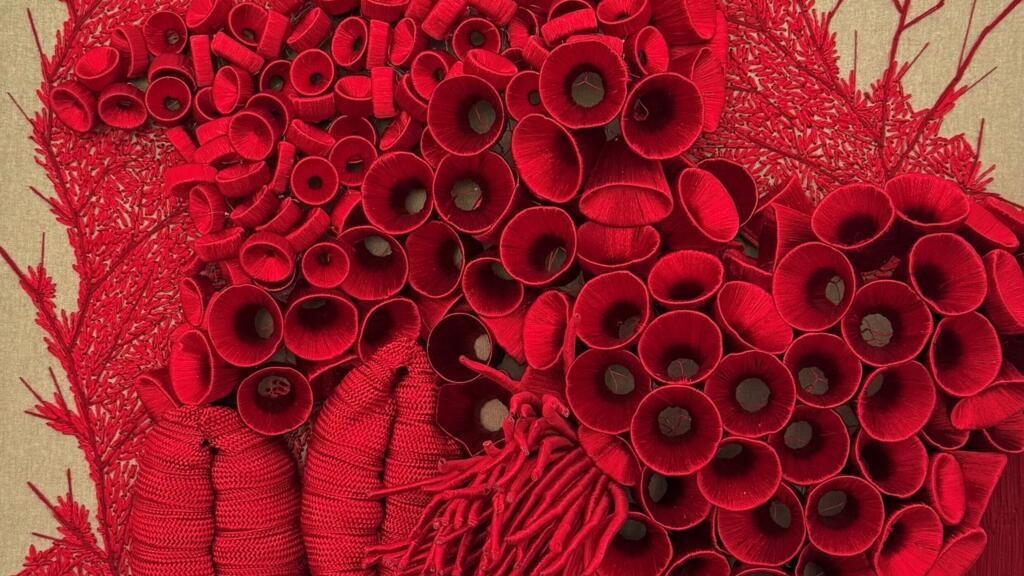
Her exquisite wall hangings of three-dimensional organic shapes are made from recycled waste such as plastic bags, caps and bottles, delicately embroidered together with strands of sabra and wool.

Shedding pollution
She finds inspiration in the magical, regenerative capabilities of nature as well as the intricate workings of the female body – capable of giving and sustaining life.
"I always wanted to talk about the pureness and the essence of us as human beings. And for me, it's talking about nature," Sahli told RFI in Paris, where she was taking part in the Also Known as Africa contemporary art fair (AKAA) in October.
The rich reds and whites of the shapes in her works are reminiscent of alveoli – the tiny air sacs of the lungs. But from another angle, they look like coral reefs, shells or algae. The works appear to be alive, moving, breathing.
Paris fair celebrates modern African artists reinventing traditional crafts
Sahli explains that she came to the art scene late in life, after a career as an architect and raising four children. She used to make clothes for them, decorated with embroidery.
As well as a commentary on waste and the need to recycle, there is a secondary layer of meaning in Sahli’s work. It’s a subtle metaphor of humanity that absorbs pollution, albeit of a different kind.
"I really want to talk about universal things, as I always had that idea of a big hand taking our body and shaking it and cleaning it from all the pollution that we have during our life," she says.
"By pollution, I mean the things that we learn through our education, through culture, through religion."
Nature the creator
Nature is also at the heart of Zineb Mezzour's creative universe.
Water in all its forms is a constant inspiration in her work, especially the way it interacts with different materials and transforms them. The 28-year-old artist loves to experiment with fractals, geometric patterns with endless tiny repetitions and variations, like snowflakes.
In her workshop in Marseille, she spends time recreating these natural patterns using ceramic, paper and fabric.
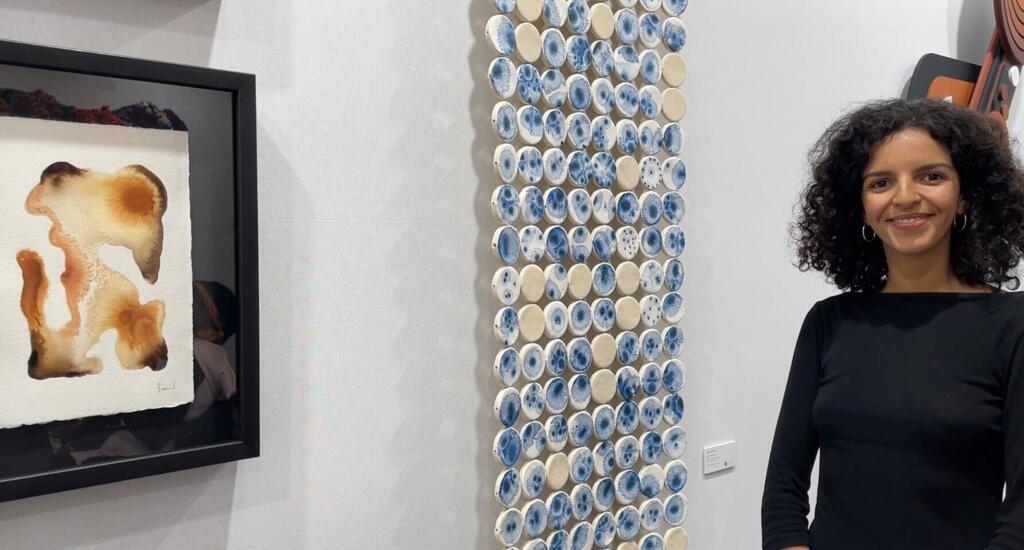
One of the works is a long wall hanging made up of dozens of small ceramic disks, each handmade and woven together. Each one has a pattern in blue made from a drop of cobalt oxide which disperses differently depending on the surface where it lands.
Morocco: bridging Africa and the world through contemporary art
Nearby is a long, flowing curtain in earthy tones that resembles the inside of a cave lined with stalactites and stalagmites, grown over centuries one drop at a time.
Mezzour describes her work as in "symbiosis with nature, arriving at this little moment of magical creation".
Like Sahli, Mezzour draws parallels with human beings and their life experiences: like snowflakes, no two people are alike.
"Over time, a tiny drop of water will create something majestic," she says. "I think each of us has our inner world with our stories, our wounds, our successes, which create something quite unique."
Circle of life
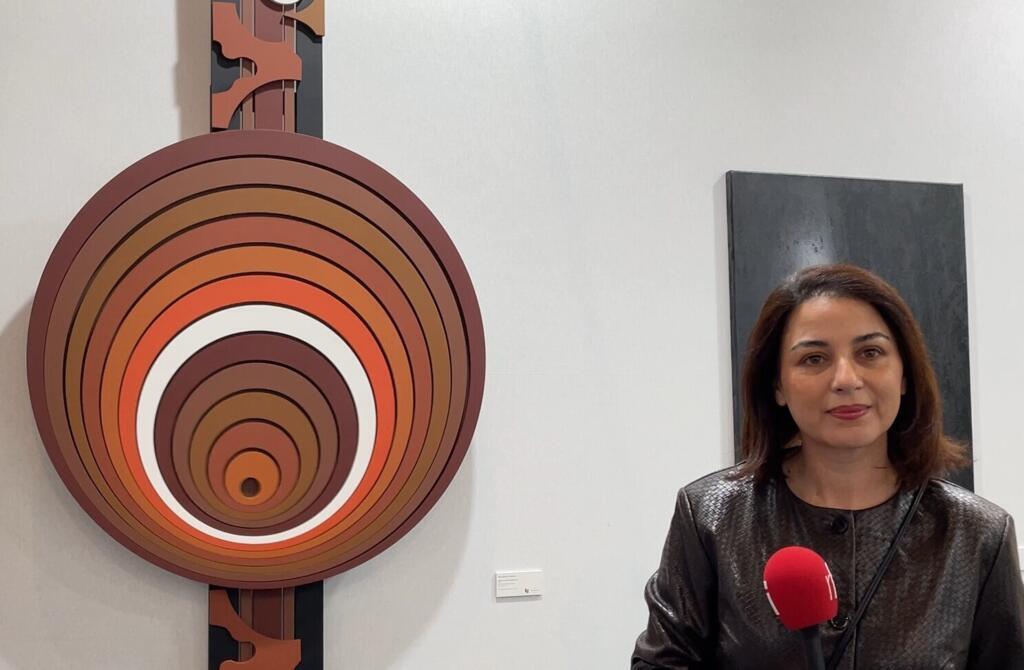
Kinetic energy fills the wooden sculptures of Bouchra el Menjra, an artist from Casablanca who discovered woodwork about five years ago and hasn’t looked back.
Spectators seem intrigued by her pieces that sway, rock or spin gently, unsure if they’re allowed to touch them or not (they are).
Moroccan artist’s fusion of heritage and herbalism provides soft return to earth
The sculptures represents the circular pattern of life and its challenges, el Menjra explained. "The colours are earth colours, colours of fire – precisely to speak of this fire that is within us, that pushes us to create, to rise again, to always remain in motion."
Their hypnotic movements reflect a philosophy.
"It's a metaphor to express that in life, to move things forward, we need to get our hands dirty, we need to act so that things can evolve and things can be in motion," the artist said.
Fun fashion
The lesson is borne out in the playful designs of Sophia Kacimi, who turned to her Moroccan roots for inspiration after a career in the French fashion industry.
Having spent years working in Paris, she was looking for a new project that could incorporate traditional artisanal skills and bring an aspect of her family’s homeland into the limelight.
That’s how Zoubida was formed. It’s a creative, collective platform where she sources fabric traditionally used for upholstery in Morocco.
Kacimi works hand in hand with local artisans to transform this colourful fabric into clothing such as jackets and dresses, as well as home accessories and furniture pieces.
"I feel as an artist, we have a duty to engage and to bring something to the world that is positive," she told RFI. "I think it's an extension of who I am in the end. I'm a very adult child, and I like to see people playing with my pieces and not be serious with it."
She agrees that a new generation of artists is emerging, with women like herself at the forefront: unafraid to experiment, to fuse cultural backgrounds and turn traditions in the art world on their head.