

It's been 50 years since humanity last visited the Moon, and we're planning on returning to our celestial friend in the sky pretty soon. And this time, we'll have a better understanding of what makes up this rocky body's nooks and crannies.
Using data from Apollo missions, as well as recent satellite missions to the Moon, a team of scientists from the United States Geological Survey has created the first-ever comprehensive geological map of the Moon that can serve as a handy lunar blueprint for future missions.
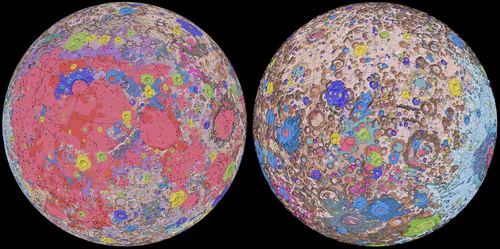
The map -- titled the "Unified Geologic Map of the Moon" -- charts the entire lunar surface on both sides of the Moon, the near side that faces Earth and the far side that faces away from our planet.
"People have always been fascinated by the Moon and when we might return," Jim Reilly, director of USGS and former NASA astronaut, said in a statement. “So, it’s wonderful to see USGS create a resource that can help NASA with their planning for future missions.”
A jawbreaker in space — In the map, the Moon appears as a delicious, sugary jawbreaker candy with details of the Moon's dark and bright spots. The Moon is a rocky object, covered with impact craters from asteroids and other celestial bodies crashing into the lunar surface, as well as ancient volcanoes and dried-up streams of lava.
Aside from impact craters, the Moon is also made up of light-colored and darker colored material. The lighter material represents the Moon's earlier crust, which is mainly composed of a type of rock called anorthosite, which contains the white mineral anorthite or plagioclase, according to NASA.
Meanwhile, the darker material is a result of erupting lava. During its early history, the Moon's interior was made up of molten, which would sometimes rise up and erupt on the surface, filling hollow impact basins.
Therefore, when observing the Moon, scientists often see impact crater basins that are outlined by a ring of white mountains and have floors of darker-colored basalt that flooded the craters, according to NASA.
In order to create the recent, most detailed map of the Moon's geological features, the team of researchers used the regional maps created by the Apollo missions to the Moon, as well as more recent data collected by satellite missions such as SELENE (Selenological and Engineering Explorer) mission led by the Japan Aerospace Exploration Agency.
The new geological map basically merges the old and new data sets, redrawing the Apollo-era maps to realign them with the more recent ones. The result is a geological map with unprecedented detail, measuring a t1:5,000,000 scale.
“This map is a culmination of a decades-long project,” Corey Fortezzo, USGS geologist and lead author behind the map, said in a statement. “It provides vital information for new scientific studies by connecting the exploration of specific sites on the moon with the rest of the lunar surface.”
The map can be accessed and downloaded here.