The next month or so will show just how far the vibrant new England have come: whether the cultural transformation infused in the team (and through it, the cricket-following public) during the first part of the summer is a permanent marking or whether it will be washed away under a pace-bowling onslaught.
The Test series against New Zealand, and the white-ball matches that followed, were a revelation, the counterpunching partnership at Lord’s between Joe Root and Ben Stokes, where the side were in dire trouble at 30 for four, something that may be looked on in time as a watershed. It had strong overtones of the manner in which Michael Vaughan’s team hit back at Edgbaston in the 2005 Ashes, in the aftermath of the heavy defeat in the first Test at Lord’s, and the message was clear. There is always talk of brave new worlds when it comes to the fortunes of England cricket but here was a side adding strong deeds to the rhetoric.
The new head coach, Trevor Bayliss, enters an environment that is certainly different to that which he would have found a couple of months ago. The wounds from the World Cup and all that prefaced it (including the rescheduling of the previous Ashes series to accommodate a more thorough preparation period – that went well) were deep, the fallout had already started with the sacking of Paul Downton, and Peter Moores’ days were numbered no matter what happened on the Test tour of the Caribbean.
It might have seemed a daunting challenge but Bayliss actually arrives with the foundations already laid by Paul Farbrace, who has done an outstanding job as interim coach. In this Bayliss is fortunate, for Farbrace has learned some of his trade with Bayliss and will almost certainly carry with him a similar ethos.
One significant reason Farbrace got the job as understudy with the Sri Lanka team was that Bayliss saw in him a kindred spirit, who saw the game in simple terms, and with whom he could share a beer and just talk cricket. It may seem old fashioned but in such an environment are ideas and relationships forged. The success of the previous partnership will have formed part of the thinking of the director of cricket, Andrew Strauss, when he decided to approach Bayliss.
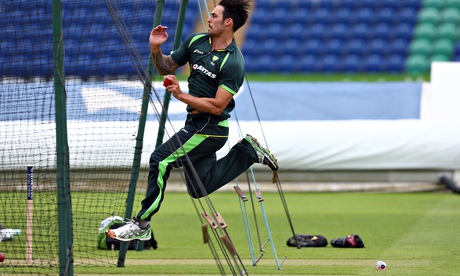
It will be a tough start, though, even if the teams are a lot closer in potential than many want to give credit. The Australia captain, Michael Clarke, freely admits that his team have not been the best of travellers, although they have just beaten West Indies comfortably enough.
But conditions in England, and of course Wales, tend to be considerably different to those in Australia, where pitches generally are faster and bounce more. Cricket in this neck of the woods requires an adjustment in length for the pace bowlers, who must pitch the ball further up (not that easy to do when a default length is shorter), and batsmen who must learn to cope with lateral movement, and to play with softer hands at times. It is part of the reason that the Australians have not won, or even drawn, an Ashes series here since 2001.
The use of the Dukes ball should be less of an issue given that West Indies use a specially manufactured version of it rather than the more familiar (to Australians) Kookaburra these days. There may be some senior England players who could bear scars from the mauling of the winter before last, but equally there are Australians – Clarke, Brad Haddin, Shane Watson – who have lost three and, in Clarke’s case, four Ashes series.
If they can say that the knowledge of this only acts as a spur to do better next time, then the same can be said for Alastair Cook, Jimmy Anderson, Stuart Broad and Ian Bell.
Whether conditions in Cardiff will be conducive to providing some high-octane cricket is open to question. The Ashes opener in 2009 was largely a turgid affair on a slow, unresponsive pitch, enlightened only by a dramatic final hour. There was little in it for pacemen, and while the Australian offspinner Nathan Hauritz did manage six wickets in the two England innings, Graeme Swann and Monty Panesar, playing together in anticipation of a turning pitch, managed combined figures of one for 246 in Australia’s only innings.
The memory of that will surely be a factor when England come to select their final XI. Any grass this pitch had was removed on the eve of the game, probably more to the chagrin of Clarke than Cook, and it sounds as if it will end up as a sluggish, low surface that offers little to anyone. The low, slow part England will not mind but a little help laterally would not go amiss, even if the pitch itself does not prevent the ball from swinging.
The only debate the England selectors will have had would have concerned the inclusion of Adil Rashid as a second spinner, probably in place of Mark Wood rather than a batsman.
There has been a groundswell of opinion which urges the promotion of Rashid but it seems to be based largely on his bowling in the recent one-day series against New Zealand. There is, though, a considerable difference between bowling with fielders out, to batsmen with a time constraint, and to Test players who are able to play the ball on merit and wait for the inevitable bad delivery. Cook would not be able to trust Rashid to do the necessary stock job that a spinner must do when there is no help and the seamers need a break. Moeen Ali, however, does need to rediscover the consistency that brought his success against India last summer.
So unless the pitch suddenly looks as if it will transform into a big turner, Wood will have an important part to play, with his skiddy pace and potential for reverse swing. England are likely to remain unchanged from their previous Test.
Australia, too, should be unchanged from their success in Jamaica, particularly now that Ryan Harris is out of the equation. There has been debate as to whether Mitchell Marsh could replace Watson, but the feeling is that the senior player will be chosen.