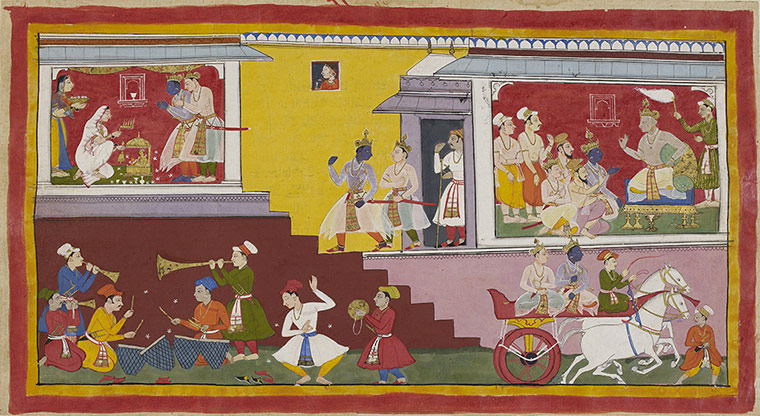
On the right, Daśaratha again tells Rāma he will make him king, with Vasiṣṭha, Lakṣmaṇa, another Brahmin and ministers in attendance. Rāma and Lakṣmaṇa then leave the king to call on Kausalyā on the left, who, dressed in white, is worshipping a small, gold image of Viṣṇu, with Sumitrā beside her. As a portent of impending disaster, their meeting is spied on by Kaikeyī’s maid Mantharā from a window in the high wall. Below, Rāma and Lakṣmaṇa then depart to their palace in a chariot to prepare for the ceremony amid general rejoicing, and to the accompaniment of the drums and trumpets that announce royal arrivals and departures Photograph: British Library
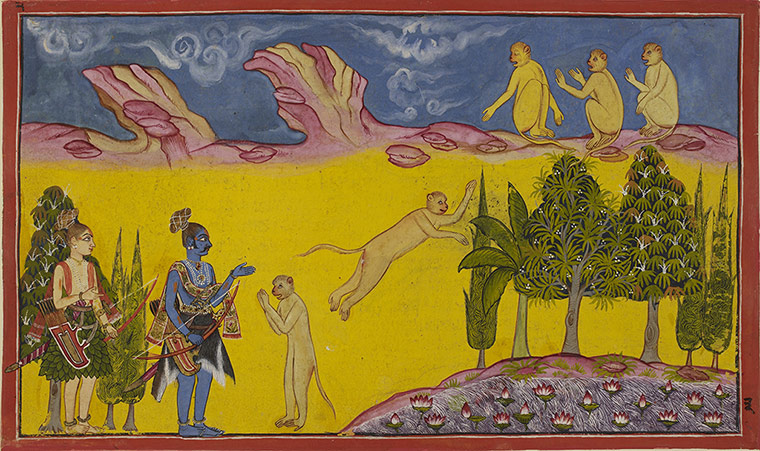
Ugrīva is at first frightened, thinking that these armed warriors have been sent by his usurping brother Bāli to destroy him. He sends Hanumān, his wise minister, to find out more about the two strangers. Having introduced himself, Hanumān learns that the two brothers are looking for his master to help recover Rāma’s abducted wife. He decides an alliance would be of mutual benefit, and bounds back to the crag where the others await him Photograph: British Library
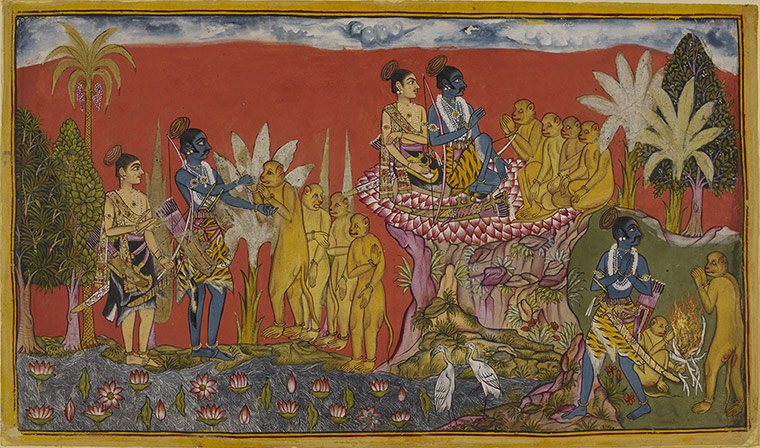
Hanumān now brings Rāma and Lakṣmaṇa into the presence of Sugrīva on the mountain. Rāma and Sugrīva clasp hands in token of their vow of friendship, watched by Lakṣmaṇa and the other monkeys; then, in a similar spirit, the pair walk round a fire kindled by Hanumān. Branches of flowering trees are spread on the mountain top, where the two brothers together with Sugrīva and his advisers promise each other help: Sugrīva to recover his kingdom and wife, both stolen by Bāli, and Rāma to recover his own abducted wife Photograph: British Library
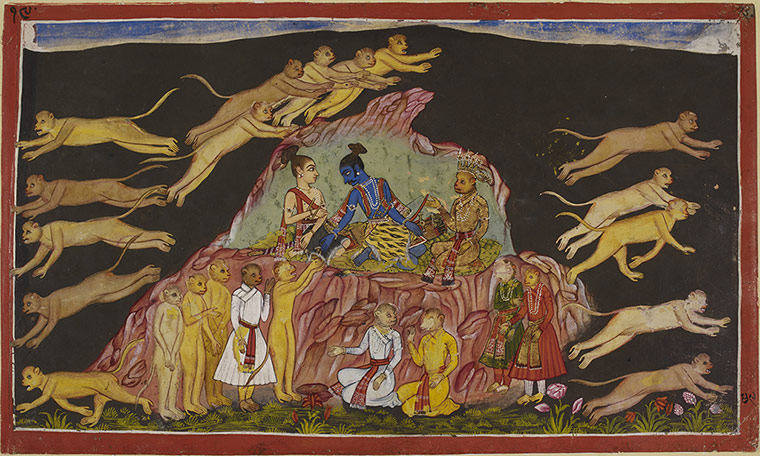
Rāma, Lakṣmaṇa and Sugrīva are seated on a rocky eminence. Sugrīva divides his vast forces into four and sends them out to search the four quarters for Sītā. He describes to each troop leader the terrain they will encounter. Sugrīva sends Hanumān, along with his nephew Aṅgada and Jāmbavān, the king of the bears, to search the southern region, which is the most promising quarter. Sure that the sagacious and mighty monkey Hanumān will locate Sītā, Rāma gives him his ring as a token signifying that Hanumān is his messenger. Around them, monkeys spring towards the other three quarters Photograph: British Library
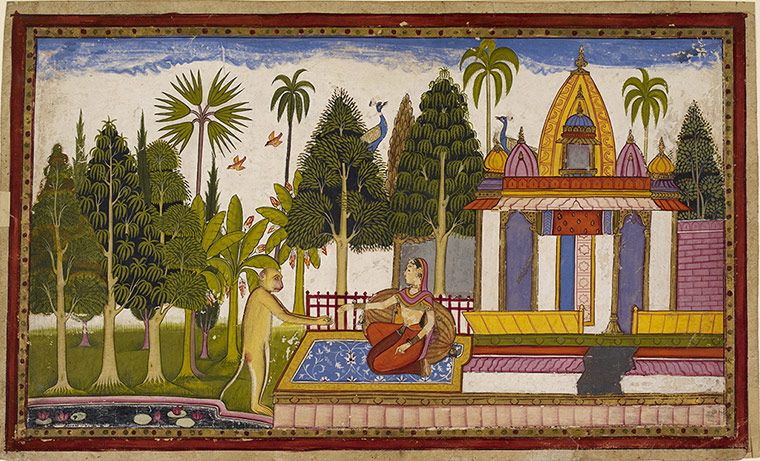
Hanumān is perplexed as to how he can speak to Sītā, surrounded as she is by demon guardians. Perched in his tree, he begins to recite Rāma’s praises. Sītā is at first confused by him and thinks he might be Rāvaṇa in one of his disguises. But she is comforted by Hanumān, who reveals himself to her as Rāma’s messenger and gives her Rāma’s ring, offering to take her with him back to Rāma. Sītā replies that she cannot allow herself to be rescued by him: that right, and the glory it will bring, belongs to her husband alone. She does, however, give Hanumān a jewel as a token for Rāma Photograph: British Library
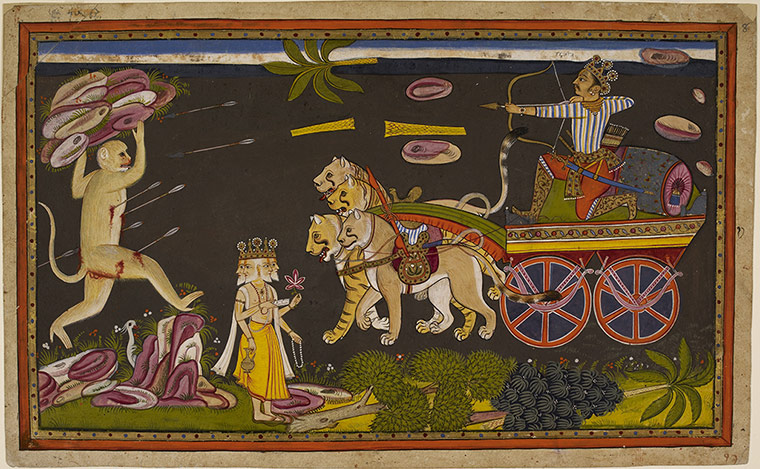
Having finally realised that this great monkey is far from ordinary – he has managed to slay all the ministers and generals sent to capture him – Rāvaṇa summons his son, Indrajit, and asks him to battle Hanumān. Indrajit has previously acquired great magical powers and many of the celestial weapons presided over by the gods. He rushes to meet Hanumān in his battle chariot, which is drawn by four tigers. He then fires his magic arrows at Hanumān, who manages to evade the worst and retaliates by hurling rocks and trees at his opponent. Indrajit finally unleashes the weapon that is under the power of the creator god Brahmā, represented here by the presence of the god himself. Hanumān allows himself to be captured, as he wants to meet Rāvaṇa. He knows, in any case, that he is under the protection of the gods, so he falls on the ground, motionless Photograph: British Library
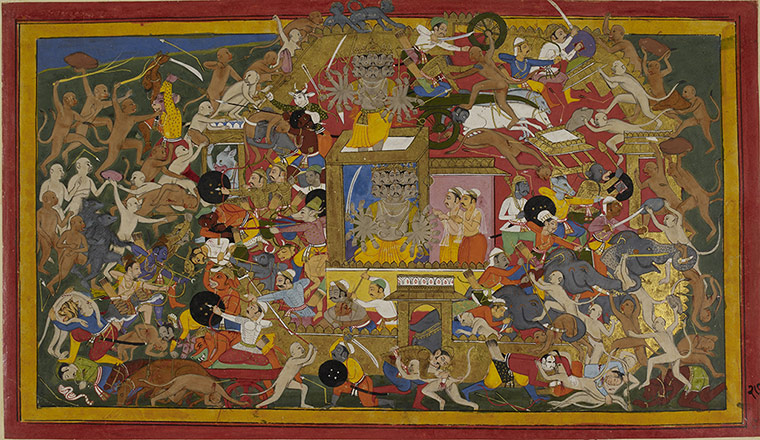
The allies launch a general attack on Laṅkā, in which many marvellous feats of skill and daring are performed. Rāma divides his forces, sending the monkey chiefs with their separate armies to invest each of the city's four gates. Nīla attacks Prahasta at the eastern gate, Aṅgada attacks Mahāpārśva and Mahodara at the southern gate, Hanumān attacks Indrajit at the western gate, while Rāma, Lakṣmaṇa and Sugrīva attack the northern gate, where Rāvaṇa is stationed. Rāvaṇa ascends to the roof of his palace before ordering a sortie Photograph: British Library
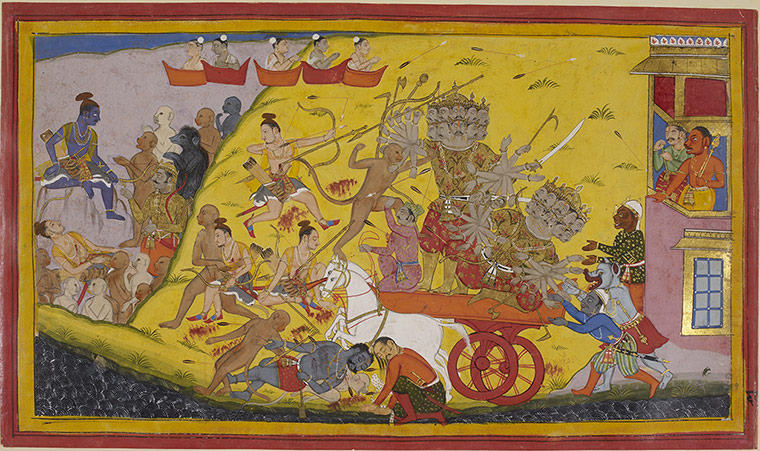
Pierced in the breast by Rāvaṇa's spear, Lakṣmaṇa falls swooning to the ground, the spear breaking behind him. Meanwhile, Hanumān rushes onto Rāvaṇa's chariot and strikes him with his fist. Rāvaṇa, reeling from this great blow, is rendered unconscious and falls into the arms of other demons. Celestial beings in aerial chariots above are joyful at Rāvaṇa's downfall. Hanumān picks up Lakṣmaṇa and carries him tenderly off the battlefield to Rāma, at the feet of whom he lays him down Photograph: British Library
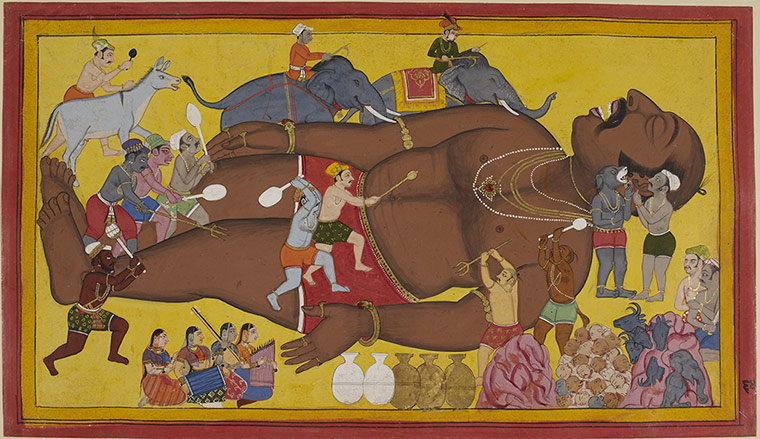
Rāvaṇa has a brother, the giant Kumbhakarṇa, whom Brahmā had cursed to spend most of his life asleep. Rāvaṇa decides that he needs him to fight Rāma and sends an army of his demons to waken the monster. The demons try to rouse the prostrate Kumbhakarṇa by making an enormous din; when that fails, they hit him with weapons and clubs and shout in his ear. Women play musical instruments, a donkey brays and elephants trumpet. Piles of food, dead animals and monkeys, and jars of liquid – blood, wine and fat – lie around him, awaiting his wakening Photograph: British Library
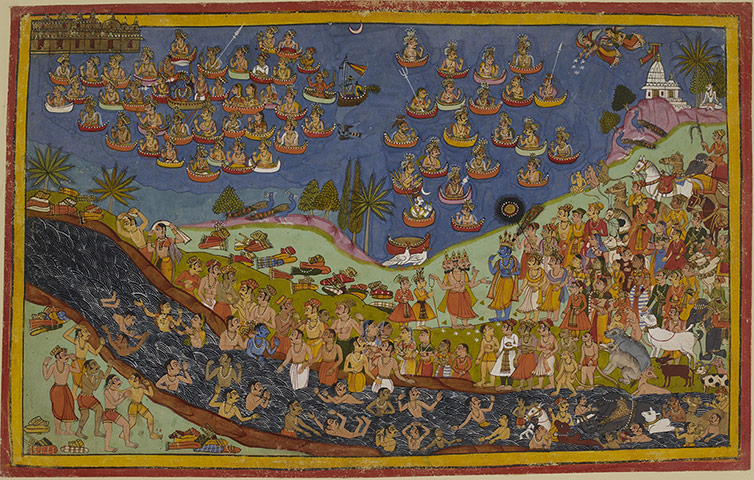
As Rāma and the procession reach the banks of the river Sarayū, Brahmā and the gods appear to witness Rāma’s ascent and light the sky with an effulgent glow. Accompanied by chants of ‘Hail Viṣṇu’, Rāma enters the waters and ascends to heaven. He is accompanied by Sugrīva, his brothers, monkeys, bears and other humans. They willingly sacrifice their lives in order to ascend to heaven with him. The entire populace of Ayodhyā witnesses the heavenly event, some plunging into the waters in order to attain mokṣa (release from rebirth). They are shown ascending to the celestial realm with Rāma Photograph: British Library