There was something a little jarring about Mauricio Pochettino when he first arrived in England as the Southampton manager in January last year. He looked … healthy. Vigorous. Oddly unmarked. So much so it was almost something of a relief to see him looking reassuringly wounded and fraught again on Thursday night at White Hart Lane, stalking the touchline with the familiar frozen, nobly resigned expression of a man emerging from the tree line, hoisting his backpack, and gazing up hopefully across the fields just in time to see his tent blow away. And looking, above all, like a football manager.
There has always been something extreme about British football managers, a sense of a group of men hammered thin by circumstance. We know what to expect. Managers are fretful. Managers are easily startled. Above all managers never have enough time. This is the essence of the job, fortunes tied to the endless variables of a sport that basically never end, that just keep on coming back day after day, unresolved, unfixed, inexhaustibly chaotic.
This week Pochettino asked once again for more time, on this occasion – and reasonably enough – an extra day to rejig his team after playing in Europe on a Thursday night. Previously the request had been for time generally, time to instil his high-grade pressing game, his well-grooved combinations, his … well, whatever it was he was doing before the vertiginous horror of trying to make all this work within a matrix of irreconcilable pressures began to bite.
It has been a recurrent theme of late. Brendan Rodgers has also complained of being rushed, startled by the sheer relentlessness of preparing his Liverpool team for two matches a week. In contrast to last season, when he appeared on the touchline each week spruced and burnished like a man constantly on his way to a wedding, Rodgers has also begun to show some of the familiar ancestral tics and scars of the managerial caste, the hollow eyes, the frown lines, the face behind the face.
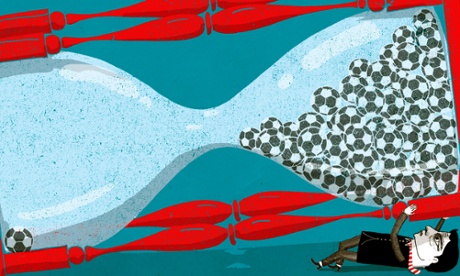
Pochettino wants more time. Rodgers wants more time. And yet if one thing is clear it is that managers are by definition people who have no time, who spend their entire professional life on a permanent countdown. This is simply the job, a sense of basic transience that goes right back to the manager’s watch‑chained Victorian forbears. From the start the manager was born to fail, born to be sacked, introduced by club owners as a layer of disposable ballast, a patsy to the ire of the crowds.
There is an air of sadness about those early secretary-managers, ghosts at the edge of the team photograph, reduced by distance to no more than a moustache, a high collar, a hat. Death on the job was surprisingly common in the early days. John Hacking of Barrow died of a heart attack moments after he was sacked. The great Herbert Chapman died of a chill contracted watching Charlton reserves during the great freeze of 1934.
More often managers simply wore themselves out. Bill Nicholson, Spurs great transformative workaholic manager of the double-winning years, was one of the first to take European competition seriously, heading off on his own into the heart of darkness to fill in the blank squares on the map. When Spurs were drawn against Gornik Zabre in the European Cup Nicholson flew out on reconnaissance, trudging the dingy lanes and the freezing squares, rejecting bug-ridden hotels, tasting the water. “There was no milk or sugar for the tea, no jam or butter for the toast,” he later wrote. “The next day I asked for rice pudding. It came in cold slabs and the players couldn’t eat it.” Nicholson was in his early forties at the time. Within 15 years he’d retired from football for good, beaten down once too often by a sport of constant industrial strains.
More commonly, of course, and built into the rhythms of the sport as a necessary narrative arc, managers are sacked. In the 1920s, top-flight managers lasted an average of four years. By 1992-93 this had become 2.7 years. Currently we’re down to 1.7. This is simply what managers are for, a profession that is in effect a kind of karaoke interlude, a cabaret turn, a busker’s pitch.
Which brings us back to Pochettino, and an apparently irresolvable tension. Management may be a less physically dangerous business but it has instead become a horribly gruelling mental challenge. Modern football tends towards perfectibility: there is a dizzying amount of information available now, an over-gorge of massed and conflicting methodologies. Sports science. Big data analysis. State of the art physical engineering. As the space on the pitch has become more cramped, as players have tended to become both fitter and more transitory, bolt-on all-purpose athletes, so football management becomes a high intensity, hugely reactive reading of the algorithms, a weekly PhD-level exercise in calculus-on-the-hoof.
At the same time patience has grown thinner, the business model more panic‑stricken. The job may be more complex but there is also less time in which to do it. As a result there is a theory football generally is contracting, that team building is less robust, patterns less ingrained, the texture of what we’re seeing physically impressive and technically high grade, but in terms of patterns and hard-honed internal coherence less refined, the flavours shallow and hastily infused.
Hence what we might call the Pochettino paradox: here is a thoroughly modern “systems manager” trying to make his way at a thoroughly modern club gripped with its own rotational hysteria, where seven managers have left in the past 10 years, and where tactical rejigs come and go like a discarded goose-down gilet. Pochettino may have a set of disciplines, a way of playing to exploit the tiny margins available on the pitch; but not, so far, the patience, the rest periods, the continuity to make it work.
He will, of course, survive the clanking of the gears, and perhaps with time this repeatedly reconditioned squad can be bent to his will. All that seems certain, until then, is that he will continue to fret and suffer, as managers must fret and suffer. And that above all – and indeed more than ever – there is simply no time.