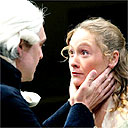
No theatre does more to explore the byways of English drama than the Orange Tree, and Sam Walters has once again come up trumps by reviving Harley Granville Barker's first solo play. It may not have the power of later works like Waste and The Voysey Inheritance, but Barker pins down a moment of social transition in an utterly new theatrical language.
Written in 1899, the play deals with events a century earlier - in particular, the attempt by a parliamentary turncoat to engineer a politically convenient marriage for his younger daughter. But Barker is more interested in the upheavals of Victorian England than in the machinations of Georgian politics. Ann Leete, who spurns a shifty aristocrat to marry the family gardener, clearly represents the "new woman". Less neurotic than Strindberg's Miss Julie and less cold-blooded than Shaw's Vivie Warren, she embodies the sexual self-determination and downright candour of a pioneering female sensibility.
To accompany a new movement, Barker also invents a wholly new theatrical idiom: one that anticipates Coward (born in 1899) and Pinter in its mixture of clipped, oblique statements with sudden blunt truths. "The homely Saxon phrase is our literary dagger," someone remarks, and Barker constantly reminds us that behind the mannered facade of polite conversation lurk basic needs and desires. "I take an interest in my wife," says Ann's republican brother. "We all do, sir," replies the gardener, who was once the wife's ardent wooer.
Barker's attitude to character is profligate, not least in a wedding scene that introduces a surfeit of family relations. But Walters deploys no fewer than 16 actors in a tiny space with prodigious skill. He also never lets us forget that this is an English country-house play that is subversive in both style and content. Octavia Walters as the bright-eyed Ann, Miranda Foster as her mismatched elder sister, David Antrobus as their radical brother and Jack Sandle as the rising gardener (symbolically named John Abud) all give impeccable performances.
The real delight, however, lies in the rediscovery of a major play by what is, in effect, the National Theatre of Surrey.
· Until October 2. Box office: 020-8940 3633.