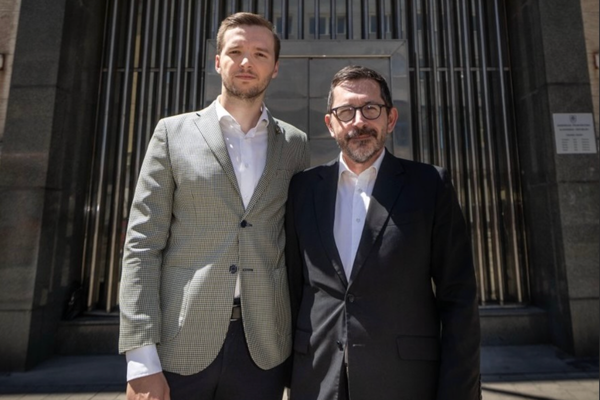
When Jonathan Ramalho set out to investigate the healing potential of psychedelic drugs he found himself lured into a world whose dangers he underestimated.
An ayahuasca trip in South America pushed him into a five-month-long psychosis which led to hospitalisation and a diagnosis of schizophrenia. As he explains in one particularly moving part of his new documentary, Beyond the Pill, “it feels like discovering the darkest area of your mind and not being able to close the door on the way out… I started to lose my focus, my grounding…”
It’s only afterwards, the 35-year-old filmmaker and founder of the The Longevity Network tells me from his garden in Harrow, that he realised how psychedelics had been “glorified”, how “the sex appeal around it, and [the sense that] everyone’s doing it” had created a dynamic in which the risks were minimised.
“I went out to South America, but then I came back and I was diagnosed with schizophrenia”
“I just wanted to highlight the dangers to [this] solution — because I thought it was a solution. I went out to South America, but then I came back and I was diagnosed with schizophrenia, lived on a psychiatric ward and had to negotiate my way out of that psychiatric ward.”
This story alone is worthy of an hour-long documentary. The psychedelics industry is only now, and still very slowly, embracing its responsibilities towards people who suffer difficulties after participating in drug sessions.
Beyond the psychedelic hype
Generally, the advice was that adverse events — such as anxiety, depersonalisation, intrusive imagery or full psychotic breaks of the kind Ramalho describes — were rare and manageable within a proper setting, with proper support from trained experts; or they were confined to people with pre-existing conditions that careful screening could identify in advance. And yet, a growing body of survey data — from the Challenging Psychedelic Experiences Project, among others — has begun to show that the number of people reporting psychological difficulties after psychedelic experiences is larger, and harder to predict in advance, than previously admitted.
“Psychedelics can be amazing, but can also be disastrous”
A film that sits in the gap between the promise of psychedelics and the lived experience of those who’ve been harmed by the drugs would be fascinating and necessary — but Beyond the Pill is not quite that film. Partly, Ramalho says, this is a function of the fact that his experience with psychosis has brought him to a place of greater compassion and equanimity. “It took a couple of years to process, but I’ve become a much better person based on that experience. And I think that’s the beauty of post-traumatic growth that doesn’t get highlighted.”
He is also careful to note that he is not opposed to psychedelics in principle: “I’m in a neutral position… what happens with psychedelics can be amazing, but can also be disastrous. [It’s] exactly the same with pharmaceutical drugs, and exactly the same with longevity.” His interest, he stresses, is in exploring the best outcomes, finding and presenting the best research, regardless of hype.
Ramalho, who grew up in South Tottenham until the age of nine before his parents decamped to Harrow, worked in marketing before he “fell down the rabbit hole” looking for solutions to what he calls the “$1 trillion problem of anxiety and depression”, which brought him to psychedelics in the first place. And in a way Beyond the Pill feels more like a marketing film for the Longevity Network, which he founded. He calls the Network an “ecosystem to help educate people” and through it, he brings together experts from different disciplines in a bid to offer a rounded look at the longevity space.
And so after exploring his post-psychedelic difficulties and the limits of Western medicines in dealing with psychosis, the documentary pivots into a broader survey of longevity. Ramalho speaks to the heavyweights we’ve come to associate with optimised health: Professor Tim Spector espouses on the gut microbiome and the 30-plants-a-week gospel he has done so much to popularise; Wim Hof talks cold therapy. In one alarming sequence, Ramalho lies on the ground and holds his breath for — according to Hof, who is acting as a sort of grizzled spirit guide — more than two minutes. Even Hof appears to be worried at one point, as Ramalho enters a trance-like state and has to be coaxed back into the room.
In search of the good life
The longevity space is easy to satirise, but its growth reflects broader legitimate fears: that we are getting sicker younger, that the healthcare systems we grew up trusting are buckling, that the food we eat and the hours we keep and the screens we surround ourselves with are extracting a price, the bill for which has not yet fully arrived.
And so too, Beyond the Pill seems to be straining towards genuine questions about the world and our place in its accelerating disrepair. Whether it provides any truly satisfying answers is debatable. At the centre of it, though, is Ramalho, a genuinely remarkable person who has clearly overcome the kinds of difficulties we too rarely get to hear spoken about with this much candour.
His hope is that the film will spark new conversations about what it means to live a good life — particularly after something as life-changing as psychosis. “It’s one of these experiences that you realise you still probably need to process, especially when you’re finding it difficult to articulate — but it’s been very humbling to see how many people open up and need this narrative. And I’m feeling a lot of gratitude for the conversations my story has sparked already.”