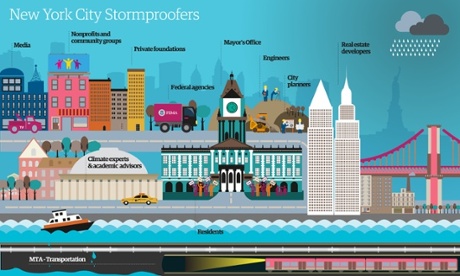
New York City has 520 miles of coastline. For a stormproofer, that’s 520 winding miles of risk: an 18-marathon-length boundary to protect against coastal surges like the ones we faced during hurricane Sandy. Managing that takes a lot of people.
First, there are the thousands of people and organizations that own the waterfront – like homeowners, family businesses, real estate developers and big corporations. Then there’s the slew of city, state and federal agencies that regulate the waterfront. Equally important are the civic associations, neighborhood groups and local residents who have a vested interest in the waterfront’s wellbeing – groups like the Coalition for Healthy Ports and Harlem River Community Rowing.
Luckily, this crowd of disparate players with disparate needs and incentives has a connector.
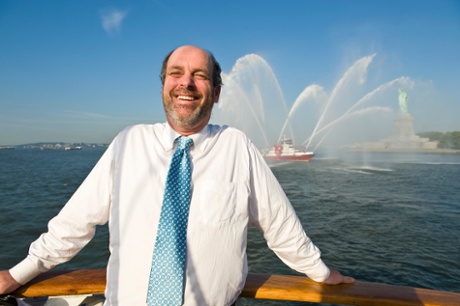
Meet Roland Lewis, the president and CEO of the Metropolitan Waterfront Alliance, a nonprofit community organization that brings together over 800 of those stakeholders and regulators with what he calls “the brainiacs” – engineers, architects and ecologists – to communicate, pass laws and create best practices for using and building on our city’s coastal border. Lewis worries about the United States’s fundamental federal commitment to protecting our cities from natural disasters.
“At one time, when there were national needs or threats, we did something – we built a highway system, we took people to the moon, we found resources to conquer. Our government needs to understand that this underinvestment in our infrastructure is penny-wise and pound-foolish. It will absolutely hurt us.”
Lewis took some time between sustainability conferences to discuss how to boost political will, what building smart on the waterfront looks like, and the danger of Seaport City for this series, Stormproofing the City.
What keeps you up at night?
What worries me the most is our federal government’s inability to lead. Protecting our cities? That should be a national priority. Nature will have its way, but the reactive, dysfunctional nature of our government, that’s a man-made danger. If we don’t have the money to intelligently plan, shame on all of us. That’d be the greatest tragedy.
Readers would be pleasantly surprised by the good work that the city and Army Corps of Engineers are doing to help plan for a better and more resilient waterfront. I think they’d be horrified to realize what the price tag is, and that there’s no realistic way to pay for it now. There needs to be tens of billions more invested.
Where are the tens of billions of dollars that still need to be invested supposed to come from?
At the end of the day it’s got to come from the federal government. There is power in the mayor’s office, but New York City has limited resources. It still has to balance the budget and pay attention to schools, police and all its other systems. There’s enormous capital demand on the city.
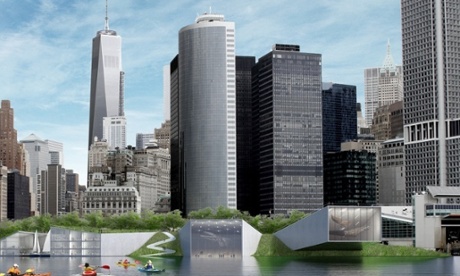
And for extraordinary multimillion-dollar projects like Rebuild by Design’s Big U [a 10-mile protection system that encircles lower Manhattan’s waterfront], or the hardening of Hunts Point’s infrastructure, this is not small potatoes. I don’t see the political will, budget or incentive on a national level to do that right now.
So if you were a journalist investigating how prepared New York is for future natural disasters, what would you want to know?
If I was in your shoes, I’d be very curious about exactly that – the political will for building these big resiliency measures. How are they really going to build the Big U over the next 20 years? Where specifically is the money and political will that will be necessary to actually reshape huge parts of our city?
It was instructive to see Copenhagen’s response to a huge climatic event – they had multiple experiences with rapid rainfall called cloudbursts, which come out of the blue and cause millions of dollars of damage to the city. After the biggest cloudburst in 2011, the city did a huge public outreach and financing exercise to get civic and political support and consensus on a plan forward. I just don’t see that happening here.
If I was with [New York] Governer Cuomo, Mayor de Blasio, or his guy Dan Zarrilli, I’d want to know the gameplan. Who’s figuring that out? Who’s doing the politics on it? This is a multidecade movement that has to be engineered.
Do you think the federal government will ever make stormproofing our cities a national priority? What would have to change?
Yes. I’m an optimist. The pendulum swings. There are calamities yet to come. At a certain point, I think the federal government will realize they have to start investing in our infrastructure to protect themselves.
Hopefully it won’t take another Sandy. Maybe a bridge will fall down. There is undeniable bad stuff happening already, like seawater coming up through the drains in Miami. More of those events will impel our elected leaders to get real.
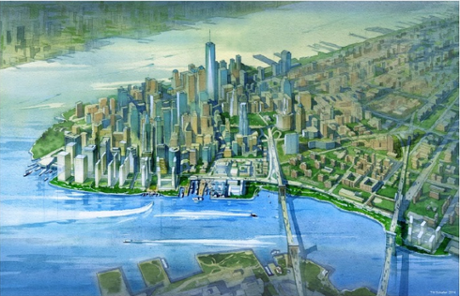
In my interview with scientist Klaus Jacob, he expressed concern about the Seaport City initiative [which proposes luxury housing on the Brooklyn Bridge waterfront], and suggested it’s because the mayor’s office is in many ways beholden to the real estate sector. Does this concern you, or not?
I’m known for questioning the utility and wisdom of Seaport City. Besides very problematic maritime, environmental and historic issues, the most maddening thing about Seaport City is that it became the poster child for [then-mayor Michael] Bloomberg’s entire 2013 storm protection plan. The city’s plan was remarkably democratic: it covered every part of the city and had a lot of innovative proposals; it was a remarkable achievement. Unfortunately, it was overshadowed by this one proposal.
I think this was just as much a real estate proposal as a protection proposal. I’m with Klaus on that one. And the city will admit as much: they felt it would create revenue to fund other parts of the plan. But they hired an outside firm, Arcadis, to conduct a feasibility study for Seaport City, which came out in May – the study didn’t call it by any stretch an economic or ecological slam dunk. The amount of revenue they’d create is questionable, and the time frame [10 years to fully implement] is realistic and horrendous.
I’m surprised by your clear position against this project, as your alliance has members with so many different incentives – including, probably, real estate developers. Do you feel a tension there?
A little bit. Let me be clear that we as an organization are certainly not anti-development – we just want smart development where it’s appropriate. When you have an alliance this large, you can’t agree on everything, and we have to have opinions about certain things. Building a whole new city at the water’s edge is, in my opinion, not the best idea.
How does the Waterfront Alliance share best practices with its people? Does it say somewhere on your website, “Don’t build a new city at the water’s edge”?
Our Waterfront Edge Design Guidelines (WEDG) initiative is our most important resiliency program. In the simplest terms, WEDG is LEED for the waterfront. It’s not the government but us, a nonprofit, providing a set of guidelines for what should and shouldn’t be built. It says, for example, that building a marina is a good thing, as is building a wetland – but not in the same place. It scores people as a way to incentivize them to do better.
There’s nothing like this in other cities. That really surprised us. We think it has the potential to expand nationally and even internationally.
Open contributions: know something about this topic?
So can this really be done? Can we really stormproof this city or this country?
Absolutely! It’s mitigating risk. You’re not going to prevent the next Sandy, but you can lessen its impact. For instance, you can wetproof – let water come in and out. Along the Hudson River, you can raise MTA train lines’ critical infrastructure higher so when storms hit, the trains won’t run and the tracks will flood, but the systems needed to get them running again is still safe. That’s the general idea.
Softer edges like parks at the water’s edge is a fabulous example of wetproofing. So is a parking garage on the first floor of an at-risk building: cars are moved, water comes in and out, cars go back. We can also create absorbent places that will soak up storm water so the sewer system isn’t overloaded. There are hundreds of different ideas.
In your opinion, if Sandy were to happen tomorrow, would it be any different?
Surely. Con Ed and the MTA have done a lot of work, sand has been moved, and building codes are being adjusted. Would it still be a calamity? Yes. Would there still be billions in damage? Yes. I don’t think we’re by any stretch prepared for the next Sandy, but we’ve certainly made progress and are much better off than we were in 2012.