The first time I found myself in a deserted mall was in 2001, in Louisville, Kentucky. I bought a chocolate milkshake for 90 cents from a donut shop in an otherwise empty mall from a little old lady behind her cash register.
I was 20 years old and really liked chocolate milkshakes, so I was pretty well aware that 90 cents was no longer the going rate for milkshakes – three dollars was more like it. A friend remarked: “Well, this is the mall that time forgot.”
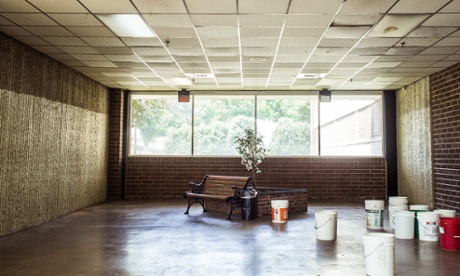
Raised in a small North Carolina tobacco town, I lived down the street from a mall that time would eventually forget, too. The Pennrose mall was where my mom bought me my first pair of Velcro shoes. It was where men bought women engagement rings. It employed a security guard with one arm. The Ku Klux Klan marched passed it during parades in the 1980s. Now it’s just a polished cement hallway lined with buckets.
A lot of towns have similar malls. Asheville, where I live, has one. It’s called the Innsbruck mall. It has an escalator, fake trees and a rent-to-own furniture store – and not much else.
The Signal Hill mall in Statesville, North Carolina, is another. On Sunday mornings a pencil-thin man with a thick mustache unlocks the doors. His name is Joe and he has two children in college. When the last one graduates he’ll retire, again, he says.
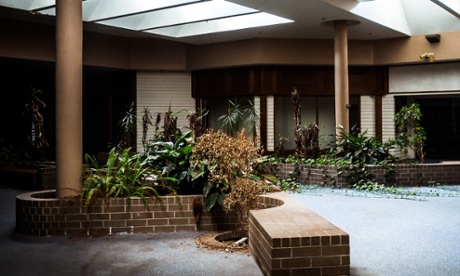
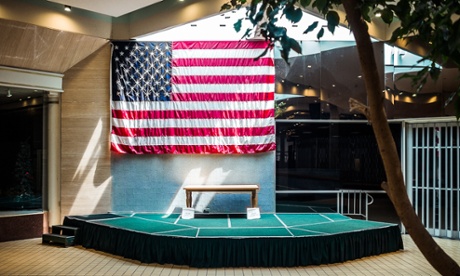
Inside, plants thrive thanks to the skylights above them, and an American flag hangs on a wall next to a shuttered JC Penney, which closed in April. Only a few coins remain tossed in the fountain in front of the store, though a similar fountain in the mall’s center is flush with change thrown by people making a wish as they throw their spare coins.

Signal Hill was built in 1973. Today it’s a good place to see what 1973 looked like – minus people and thriving stores.
Back in Pennrose mall, I have memories of a judge’s son who was caught shoplifting and sent home without the police being called – a store manager confident a more lasting punishment would be handed down by the boy’s father. The Peanut Shack, where I used to buy snacks, is now closed, and so is JC Penney. Belk and Roses are still open.
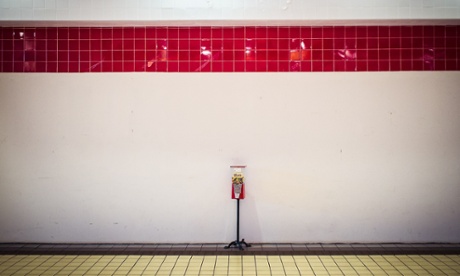
Buckets are strategically placed along the mall’s polished concrete floor to catch water, which drips for days from the ceiling following a rainstorm. The jewelry store is closed and the space that was formerly home to an arcade is still unoccupied; many of the overhead lights are turned off.
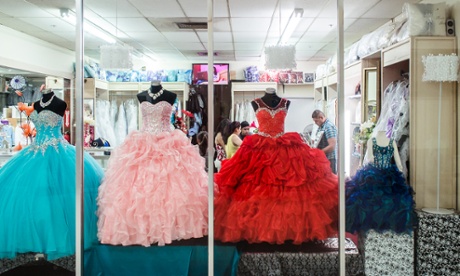
In Asheville, we also have the Innsbruck mall, the interior of which is anchored by the license plate agency and a retail store specializing in formalwear for first communions and quinceañeras.
It’s where I go to renew my car’s tags. The rest is just empty storefront, dying, but not dead. And not far to the east in Lenoir, there’s the Lenoir mall, which has a sole retail tenant, a Christian bookstore.
It appears malls don’t turn to their creator before death – they turn to their creator’s creator.