Every culture, in its oldest stories, sends someone into the dark for love. The Greeks had Orpheus, who descended through Tartarus armed with nothing but a lyre. The Egyptians had Isis, gathering up the scattered pieces of her murdered Osiris. The Sanskrit tradition gave us Savitri, who followed the god of death himself -- Yama -- step by relentless step, until her devotion wore him down. Cultures that never traded a word with one another somehow reached the same dream: that grief is strong enough to open a door the dead have closed behind them.
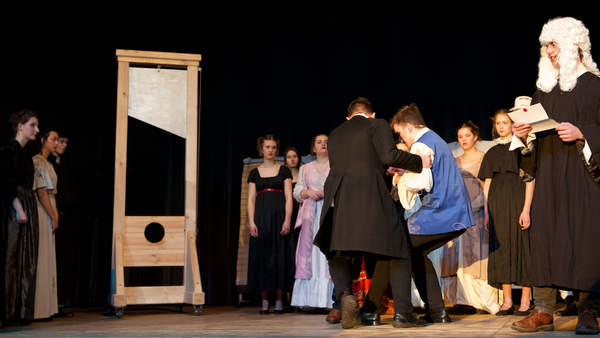
That shared human hunger is where Opera Siam's new production of Orfeo Ed Euridice begins too -- and then it takes you somewhere you have never been before. The underworld their Orfeo enters is not a shadowy Greek cavern but the hell realms of Thai Buddhist cosmology. Those realms, as it happens, are also presided over by Yama -- the very god Savitri once refused to leave without her husband. The dream really is shared.
What astonishes a visitor about the Thai hell realms is their specificity. They are blazing, vivid, almost hallucinatory -- the demons have names, the torments are exquisitely catalogued, and the murals on a thousand temple walls have been teaching the living what waits for them since the Ayutthaya kingdom. Over this landscape -- particular, unmistakably Thai -- Gluck pours his great 18th century score, music so pure in its grief it sounds like it was written for exactly this crossing.
A story you already know
Even if you have never heard the name Gluck, you already know this story in your bones. Orfeo loses Euridice, his wife -- the person he loves most in the world -- and he refuses to accept it. He descends into the land of the dead to bring her back, armed with nothing but his voice. The opera, first performed at the Burgtheater in Vienna on Oct 5, 1762, was radical for its time: no machinery of subplot, no parade of comic relief, just pure emotional truth. At its heart is a question that needs no musical training to feel -- how far would you go for someone you cannot imagine living without? Orfeo's answer is: all the way to the underworld, and back.
Two cosmologies in conversation
The concept, developed by director Somtow Sucharitkul, hinges on a layering. The Greek mythology of Gluck's opera stays intact -- Orfeo is Greek, the Fates are Greek, the underworld is Hades -- but alongside it, Somtow has placed the visual and philosophical world of Thai Buddhist cosmology. The two, in his telling, are not in conflict but in deep conversation.
The visual language is drawn almost entirely from the work of Chalermchai Kositpipat, whose monumental White Temple (Wat Rong Khun) in Chiang Rai reimagines the Buddhist underworld in blinding, all-consuming white -- not darkness. "When I visited the White Temple, I saw a completely different side of his work," Somtow says. "The traditional scenes of violence in hell are all done in this monumental white -- it's like seeing it through a completely different lens."
Each realm in the staging carries its own distinct palette drawn from Thai sacred art: the underworld built from Chalermchai's hellscape; the Elysian Fields inspired by the Blue Temple (Wat Rong Suea Ten), completed in Chiang Rai by Chalermchai's former apprentice Phuttha Kabkaew; and Orfeo's return to the upper world visualised through the Naga imagery of northern Thai temple architecture -- "humans climbing through this torrential labyrinth of snakes to reach the surface".
The production's most haunting single image may be one lifted directly from Wat Rong Khun: dozens of disembodied white hands rising from the stage, faces hidden. At the White Temple, those hands reach up from the pit of hell in a sea of unrestrained desire.
Somtow has chosen to repurpose them for both realms: "In the heavens, we could also show these white hands coming together in prayer."
Movement throughout the production draws on Thai classical dance: stylised, precise, weighted.
Music that has nowhere to hide
Gluck's Orfeo Ed Euridice stands at one of music history's great turning points -- a deliberate act of reform at the edge of the Baroque era, reaching towards something newer and more direct. Baroque opera had become an elaborate showcase for vocal virtuosity. Singers were expected to embellish every line, to add trills and runs and cascading ornaments, especially in the repeated sections of da capo arias, where improvised decoration was almost a competitive sport. The drama, in a sense, came second to the display.
Gluck rejected all of this. He stripped the ornamentation back, flattened the artifice, and asked a radical question: what if the music simply said what it meant? The result is a score of almost severe emotional clarity -- melodies that move with a kind of inevitability, harmonies that don't show off but press quietly and relentlessly on the heart. Where Baroque opera often feels like architecture, all symmetry and grandeur, and where the Classical style that followed Gluck -- Mozart, above all -- found a kind of radiant balance between form and feeling, Orfeo occupies its own strange, austere space. It is music distilled down to its emotional essence, with nowhere to hide.
It is this quality that the production's conductor, Trisdee Na Patalung, returns to again and again.
"The simplicity, the directness, the refusal to ornament for its own sake," he says. "That's not a philosophy I need to translate. It speaks for itself."
His role, as he sees it, is simply to serve the score -- to be a faithful handmaiden of the music, as Somtow puts it, ensuring nothing gets in its way. What Gluck left behind, once everything unnecessary was removed, is music that belongs to no particular century or culture: just grief, and love, and the desperate irrational hope that maybe this time, the ending will be different.
The voices carrying it
In the titular role of Orfeo is Kridhima Siriwattanakamol. As Euridice, Chanya Maneewan brings a soprano voice of exceptional clarity and warmth, shaped by first-class studies at Chulalongkorn University and choral work under Tan Dun on the World Youth Choir's European tour. Most recently she sang the Headman's Daughter in Opera Siam's production of Mae Naak this past March.
And as Amore -- the divine messenger who sets the whole story in motion -- comes Punnika Mahuemuang, just fourteen years old. She began classical training at six and has since taken top prizes across Asia, Europe, and the United States. The stage charisma and musical maturity she brings to Amore belie her age completely.
Under Somtow's direction and Trisdee's baton, this production unites the grandeur of Western opera with the mythological soul of Thailand -- a collision of two worlds that, in truth, could only happen here, in Bangkok, on this stage.
Opera Siam's Orfeo Ed Euridice stages at The Great Hall, King's Bangkok, on June 27 at 2pm and at 7pm (Gala Performance), and June 28 at 5pm. Tickets are available through Opera Siam's ticketing partner at ticketmelon.com. Email contact@operasiam.com for more information.