THE STATES OF IT
At the ICC’s board meeting on Thursday, there’ll be the usual vol-au-vents and sandwich triangles that go hand in hand with the get-togethers of elite sporting organisations. There’ll be a World Cup debrief, the usual discussions about the future direction of the game, ponderings about the legality of bowling actions and the like. But cricket’s bigwigs will also be making a decision that could have a profound effect on the future of the game in one of the biggest potential growth areas on earth.
The governance of the game in the United States may not be the sexiest of subjects but stick with me. This week the ICC will be deciding whether to strip the USA Cricket Association (Usaca) of the right to run the game in the country, perhaps opening the way for the American Cricket Federation to take over. And if that sounds rather too much like the opening credits of an unpromising George Lucas film, then see it this way – imagine if the ICC was to strip the ECB of its control of club cricket, county cricket and the England team. That is what is at stake for the USA this week in Dubai.
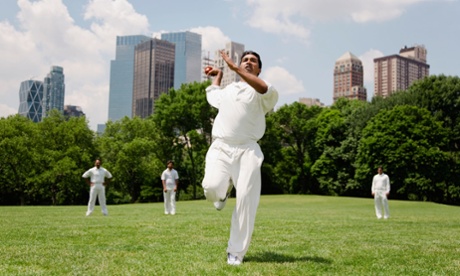
Cricket has a long history in the US. In fact, cricket on US soil predates the formation of the US itself by more than a century. An international between the US and Canada, watched by maybe as many as 20,000 punters, took place as long ago as 1844. (For a fascinating rundown of the history of the game in the States, take a look at Raf Noboa y Rivera’s excellent piece here.)
In 2001 the USA finished sixth in the ICC Trophy (ahead of Ireland) missing out on a place at the 2003 World Cup by a couple of wins. But the national side these days is in pretty poor shape, languishing in the World Cricket League Division Four alongside Denmark, Italy and Bermuda, and the governing body might not be the governing body by the end of the week.
The road to this point is a long and pretty shambolic one. Where did it all go wrong? Usaca has already been suspended twice by the ICC since the election of Gladstone Dainty as president in June 2003 – once in 2005 and once in 2007, with both suspensions coming as the result of issues about elections. The 2005 debacle prompted Malcolm Speed, then ICC chief executive, to write to Dainty that “we have seen numerous sporting organisations in various states of disarray throughout our period of involvement as sports administrators. We have never seen a sporting organisation that combines such great potential and such poor administration as Usaca.”
More recently there was the decision just prior to the presidential elections in April 2012 to bar 32 of their 47 member leagues from the voting. The 15 remaining leagues all voted for Dainty. In October of 2012 there was the Kenwyn Williams Facebook meltdown. In February 2014 Andy Pick resigned as high performance manager for Usaca, saying that his personal and professional reputation would be at risk if he stayed in the job. Two months later Darren Beazley quit as chief executive. He is yet to be replaced.
In June last year Usaca had a pretty major falling out with Richard Kaplan, the mayor of Lauderhill, Florida – venue for the national T20 championships. “I don’t know why the ICC would want Usaca to continue being the sanctioning authority because it just can’t do it,” said Kaplan after the venue was switched from Indianapolis to his city. The event didn’t go well. And in November 2014 the national side suffered that relegation to World Cricket League Division Four.
In January this year the ICC decided at its board meeting to write to Usaca, “requesting certain information be provided about its continued compliance with the ICC’s constitution and membership criteria”. The resultant letter is a 19-page demand for Usaca to sort itself out and to show that it has sorted itself out, or face suspension. It is a damning document.
The ICC wanted to know exactly what a $200,000 loan to Usaca has been spent on, with supporting bank statements, invoices and receipts. It wanted to know why there has been no chief executive since April 2014. It wanted a letter from the government of the National Olympic Committee affirming that Usaca has the “appropriate status, structure, recognition, membership and competence” to be recognised by the ICC as the governing body of cricket in the country.
Its concerns could be grouped into four categories: that Usaca is not able to fulfil its financial obligations to the ICC or any associated company (accounts from 2013 show a debt in excess of $4m), that Usaca may have failed, and continues to fail, to comply with its membership obligations to the ICC, that Usaca may not appear to be the sole governing body for cricket in the US (the growing American Cricket Federation is mentioned as an alternative), and that Usaca’s actions and governance of the game of cricket in the USA is contrary to the best interests of cricket. Any one of those could lead to suspension, though the ICC did give itself some wiggle room by concluding that “unless Usaca is able to remedy the concerns identified above … the board will consider seriously the prospect of suspending Usaca’s membership of the ICC with immediate effect”.
And just to bring you fully up to speed: two large Texas leagues became the latest to jump ship to the ACF in February; last month Dainty, in Blatter-esque fashion, was predictably enough re-elected for a fourth term; and this weekend the latest Twenty20 national championships ended in high farce.
Will anything change? Well, the ICC’s recent track record on decisions over associate nations isn’t exactly great and it is a decision that could have huge ramifications for the sport in the States, but we shall see.