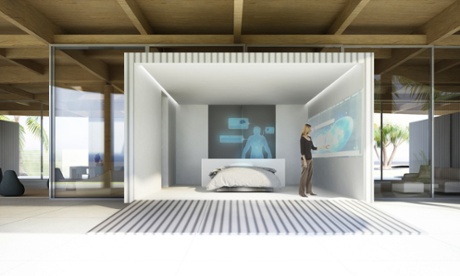
In a suburb of Rio, a new house is taking shape. It’s a building that can think for itself, react to outside conditions to adjust the lighting and temperature, all while generating more energy than it consumes.
The house is part of the NO.V.A. project (Nós Vivemos o Amanhã or We Are Living Tomorrow) and while energy efficient homes are nothing new – the first homes built to the Passivhaus standard went up in Germany in 1990 – NO.V.A. will be the first to act as a “living lab” with residents testing its technologies daily.
“We need to understand our customer’s relationship with energy in the future,” explains Marcelo Llévenes, head of Enel Brazil – the arm of energy multinational Enel that is building the house. “We will use feedback from the people living in the house to enable us to learn more about how the most innovative solutions available can be made to work for people, and we’ll even have the opportunity to test solutions that are still in the pre-market stage. This is a very exciting project.”
The project is a partnership with two leading Brazilian universities: Pontifical Catholic University (PUC-Rio) and Getúlio Vargas Foundation (FGV). The house has been designed by local architects Studio Arthur Casas, with the technology coordinated by Enel’s Brazilian subsidiary Ampla. It is due to be finished before next year’s Rio Olympics, with the residents chosen in a competition on the internet.
The project marks the first time that crowdsourcing has been used to help build and design a home of the future. People from around the world were invited to use the internet to discuss what the home of the future should look like. Over 4,000 new ideas were put forward – all of which were assessed by the project’s technical committee.
“We realised that people wanted the house of the future to be autonomous and take decisions by itself, not to damage the environment, and to be energy self-sufficient,” says Llévenes. “The most interesting ideas we received have been incorporated into the architectural design.”
Innovation starts with the construction, which will generate 85% less waste and 80% less carbon emissions than standard houses of the same size. This will be achieved by using prefabricated modules made of reforestation-certified wood which will help to cut construction time by around a quarter, as well as reducing the use of water, and materials like mortar.
The walls will be clad in specially treated wood that provides high insulation, while newly developed flame-retardant paint, which also has soundproofing qualities, will also be used.
Solar panels on the roof will make the house energy self-sufficient and allow it to operate as its own micro-power grid, with Prátil, another Enel Brazil company, ensuring that surplus green electricity can be stored in high-capacity batteries, or transferred to the local distribution grid.
Remarkably, even the flooring will be generate energy: a kinetic floor has been installed in one room, with every step taken by residents generating around 0.1 watts of energy.
“Some of the most interesting ideas people had were around the use of sensors and remote-controlled equipment,” continues Llévenes. “So, for instance, the house will be able to detect fire and alert the fire brigade, and close the windows when rain approaches.”
Residents will also be able to take advantage of intelligent, remote-controlled appliances, which can decide what time of the day it is best to operate, leading to a more efficient use of energy. Even the countertops will be interactive and equipped with internet access, giving the residents handy access to a set of tools that interact with the furniture.
The house will be self-sufficient in water, with all water and effluents, including sewage, treated on site and reused, with extra water supplied though rainwater harvesting, a process that also helps reduce the risk of flooding. Naturally, given Enel’s involvement, smart meters will be used to measure water, electricity and gas consumption in real time.
The house has also been designed so that it can rely totally on natural light during the day, without the need to flick a switch, and will include windows made of self-cleaning glass that gets lighter or darker depending on the amount of available sunlight.
An intelligent cooling system will cut out the need for energy-sapping air-conditioning by using liquid, naturally cooled in pipes 15m under the ground, which is then pumped back into the house to cool it.
Outside, residents will be able to use an extensive garden for growing crops, with any organic waste going into a bio-digester which will generate gas to use in the kitchen.
“But the innovation doesn’t stop there,” says Llévenes. “NO.V.A.’s house is an open innovation project and will serve as a laboratory to test different technologies from other partners. And that includes see-through TV, which could even be solar-powered.”
The home will also be the first in Brazil to be in the running for the Living Building Challenge (LBC) certificate, an extremely rigorous building performance standard. Launched in 2006, it is run by the environmental NGO the International Living Future Institute and, although over 250 projects are currently registered, just 25 have achieved full LBC certification.
“The Living Building Challenge was created to push the envelope on creating buildings that essentially become living systems,” says ILFI executive director Amanda Sturgeon. She says the key fact that makes LBC stand out is that: “it drives building owners to create good buildings rather than buildings that are ‘less bad’… LBC participants are first movers in every way.”
The certification is based on an assessment of the building’s performance. Indeed, a year, the building will be checked and re-assessed by an independent third party to ensure it is performing as promised.
“The LBC is not just about changing how we design and build, it also challenges us to think about what we value,” continues Sturgeon. “Homes are based on a supply and demand basis, if we can demonstrate that a homeowner can have a healthy and high performing home that’s not ladened with toxic chemicals, and with no energy bills, for example, we believe demand for them will grow.”
Llévenes agrees. “This is a remarkable project, with some incredible ideas, that has caught the imagination of so many different people. It really could lead the way to a greener future and energy efficient housing that is standard, rather than unique.”
Content on this page is paid for and produced to a brief agreed with Enel, sponsor of the energy access hub on the Guardian Global Development Professionals Network.