‘Let us start right here,” proposes Emily Woof’s second novel, “with a man and woman in bed by the sea. The woman is Ursula. She is thirty-one years old.” It is a confident, stylish opening, and Woof’s passionate narrator soon promises even more: to “strike you with the full weight of my arm, make your heart pound ... reveal love in all its forms”. All we have to do is surrender to this quixotic, forceful voice and allow ourselves to be taken back to Ursula’s babyhood in Newcastle in the early 70s, where her mother Joyce is preoccupied with the imminence of nuclear war and has absent-mindedly left her infant out to be pecked by crows.
We are ushered through the next 15 years with similar dynamism. Ursula survives the pecks and grows into a dreamy, sensitive child who enjoys acrobatics and outings with her grandmother. In “Ganny Mary’s” childhood home, we are pointed towards a lightning-struck tree; and in Newcastle shown scenes from the childhood of a precocious working-class boy, Jerry. Portents gather around both.
Soon we arrive at Ursula’s juicy teenage years, which she spends cheerily dying her hair orange and 69ing with boyfriends in bands until she meets Jerry and falls in love. Jerry gets into Oxford; Ursula takes a gap year in India. Jerry writes: “Your letter about the class divide has been worrying me all day. I think you misunderstood me”; Ursula backpacks. Jerry makes friends in student politics; Ursula gets gastroenteritis and has a religious experience expressible only as, “It was mind-blowing … I was the hills”; and then everything goes pear-shaped.
Sadly, not just in the relationship. The buoyant, bossy narrator also seems to lose her grip: instead of enticing encounters with significant people, we are introduced to a huge range of characters – Caroline, Zoe, Keith, Suki, Mellie, Judy, Pavel – who disappear again after a few pages; instead of choice, interwoven moments in time, we are buffeted through a series of brief, linear vignettes – all, exhaustingly, in the present tense. Errors proliferate, especially with time. It does not matter, perhaps, that Jerry takes the Oxford entrance exam in May, or goes for a weekend away that lasts a week, but it does matter that he runs through a couple of decades’ worth of a relationship – courtship, honeymoon, house renovation, affair, irrevocable decision to have an Aga instead of children, doubts, mourning for unborn children, estrangement – in less than five years, because it makes him seem pompous and silly.
Similarly, it is mostly comic that Ursula is nearly 25 when she gets her break as a film actor, and only 31 several films, a relationship, a pregnancy and eight years of childrearing later; but much more bothersome that, in the same scene, Ursula gazes at Ganny Mary and is surprised she is looking old. Mary was at least 20 when talkies hit the cinemas and now the Gateshead Millennium Bridge is well established in Newcastle. She had “burrowed fifty years” on her marriage bed when Ursula was five. She is probably 103, and Ursula ought to be shocked that she is still toddling about unattended, looking for the point of herself.
“What has this old bird to do with love? With anything?” asked the narrator of Mary in the first chapter, and at this late stage in the novel, we worry that the answer may be nothing. For although Mary has by now taken us up and down many bridges and hills, and through pages and pages of gothic reminiscence, she hit structural trouble early on when it emerged that it was not she but her mother Annie who had a revelation of the “I was the hills” sort. And it seems that in this novel, it is the visionary people – Ursula, Annie, Joan of Arc – who count. “Like, I am God, you know?”, as Ursula puts it, for poor articulation is beside the point. So is organised religion. Anyway, as poor Mary is unspiritual, her only function is to connect her mother’s lightning flash with her granddaughter’s: this is hard, as she wasn’t there for either of them, and Ursula didn’t even tell her about the India bit. Eventually, Annie leans down from the afterlife to explain it all to Ursula, and Mary is superseded entirely.
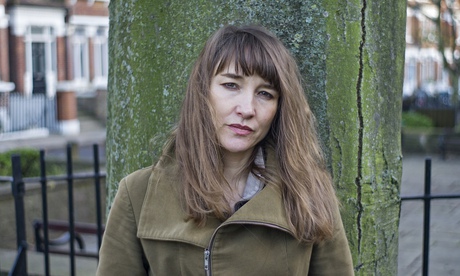
These sorts of basic problems in time-scheme and character should be resolved in the drafting process of a novel. The Lightning Tree seems to have been finished in a hurry: even the proof copy was substantially different from the published book. It’s a pity: with a little more care, Woof (left) might have had a novel equal to her high ambitions, her fine and feisty first chapters, and her own indubitable talent.
• Kate Clanchy’s Meeting the English is published by Picador. To order The Lightning Tree for £10.53 go to bookshop.theguardian.com or call 0330 333 6846.