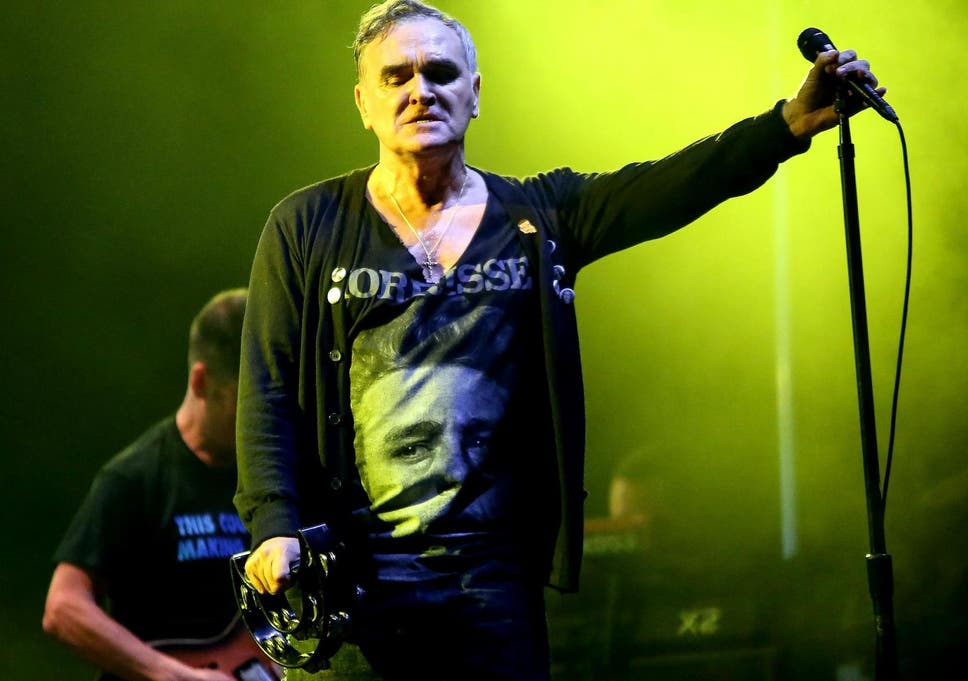
On a shelf at the back of my wardrobe sits an ancient, misshapen T-shirt that hasn’t been worn in years. It bears black-and-white images of Oscar Wilde, Shelagh Delaney and James Dean, with The Smiths emblazoned across the top. It’s not the most elegant of band T-shirts, but 30 years ago it was all I could find in rural Devon to advertise my allegiance to a band that meant everything to me. I have never been able to throw it out.
The songs of The Smiths still pump through my veins, a potent reminder of the agonies of my formative years and the ability of music to unlock strange new feelings and turn your world inside out. Yet listening to them now makes me feel sad with longing at what they were, and distress at what their singer has become. Morrissey’s pithy turns of phrase and his parochial preoccupations have formerly seen him compared to Alan Bennett, at whose front door he once appeared in London clutching books of poetry. But while the latter is a national treasure, the former has become a national embarrassment.
Certainly, it can be hard to square the author of such sweetly heartfelt lyrics as “Hand in Glove”’s “It’s not like any other love/ This one’s different because it’s us” with the bitter and wilfully myopic 60-year-old roaring about how he has been maligned, or the songwriter who once aspired to the eloquence of Oscar Wilde with the man who, last week, appeared at the Hollywood Bowl wearing a vest on which the words “F*** The Guardian” were written.
It has become a dispiriting ritual on social media that, every few months, Morrissey’s name begins to trend, prompting swathes of music fans to sigh wearily and wonder what the silly idiot has said or done now. Recent triggers have included his performance on The Tonight Show Starring Jimmy Fallon, where he sported a For Britain badge in support of a political group that leans so far to the right that even Nigel Farage has distanced himself from them. There was an interview with German newspaper Der Spiegel in which, discussing allegations of sexual abuse related to Kevin Spacey and Harvey Weinstein, Morrissey said there were times “when the person who is called the victim is merely disappointed”. There was last year’s comically mad interview on his own website where he mocked shadow home secretary, Diane Abbott, and mayor of London Sadiq Khan, and claimed Hitler was left-wing.
Accusations of racism have dogged Morrissey for years, of course, from his flirtations with fascist imagery in the Nineties (he famously sang “National Front Disco” at a Finsbury Park festival while draped in a Union Jack flag), to his grim pronouncements on music by black artists – including the assertion in a Melody Maker interview that “a black pop conspiracy” was preventing The Smiths from fulfilling their potential. As the years have passed, he has become ever more brazen in his anti-immigration stance, telling NME in 2007 that England had been “thrown away”, that “the gates were flooded” and complaining that in London’s Knightsbridge “you’ll hear every accent under the sun apart from the British accent”. (Morrissey later sued the magazine and won an apology after he claimed the article accused him of racism.) This, it should be noted, from a man who is the son of Irish immigrants and an expat who has variously taken up residence in Italy and the United States. Morrissey’s defence following each furore invariably revolves around his misrepresentation at the hands of a hostile press, yet another symptom of the persecution complex that has been a feature of his life and career.
Much of Morrissey’s reputation as an artist has rested on his outsider status, which chimed with teen fans who felt similarly dislocated and alone. It’s this, combined with the sublime beauty of The Smiths’ music (which can be attributed to Morrissey’s bandmate, the guitarist Johnny Marr), that led many – myself included – to give him the benefit of the doubt. Looking back, however, the evidence pointing to a pop star who was a dreadful human being with repugnant views on race and immigration is undeniable.
Yet still the faithful flock. Morrissey retains a large audience in America, a hardcore of fans who are either unaware or unfazed by his awful bigotry. The British press, meanwhile, remains fascinated with this once-revered figure, faithfully reporting his every utterance no matter how barmy. Yes, I am adding more column inches by agonising over my fallen idol, but perhaps it’s time we stopped giving him our time and attention. The Smiths were magnificent but the Morrissey we once festooned with love and flowers is no more. The light has gone out.