Galileo is a restless, endlessly evolving masterpiece. Brecht himself wrote three versions between 1937 and his death. David Hare has now amplified his 1994 adaptation for the Almeida. And along comes Howard Davies, in this Olivier production, and puts Hare's version into modern dress with surprising and often illuminating results.
At first, one jibs slightly at Davies's presumption. Does it make sense to transpose a play set in 17th century Italy and dealing with Galileo's confirmation of Earth's peripheral status in the universe? It seems odd to see a cigarette-smoking Galileo announce "What you are seeing has been seen by no other person than me", when looking at the familiar sight of the mountains on the moon.
Logic aside, I sometimes missed the aesthetic beauty of the Berliner Ensemble's historically precise production. But in the end Davies has been true to the spirit of Brecht by "alienating" the audience: he has forced us to re-examine what was in danger of becoming a museum classic.
Two ideas, contradictory yet strangely linked, run in tandem through this production. One is that we live in an age when, as a university chancellor says, "knowledge is a commodity - it must profit the person who buys it". Against that mercenary vision is Galileo's argument that "the only purpose of science is to relieve the hardship of life". Both are materialist; but one offers a neo-Thatcherite, the other a neo-Marxist view of science.
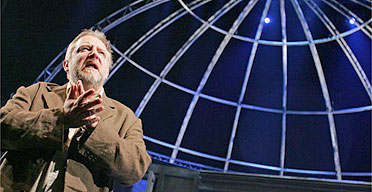
In short, put in modern dress, Brecht's play becomes a debate about the responsibility of the scientist, beautifully articulated in Simon Russell Beale's towering Galileo. In the play's early stages he shows a man so dedicated to truth he seems culpably indifferent to all else - a shabby figure who treats his daughter with contempt and is equally hard on himself: "Forty-six years old," he mutters, "and I've done nothing which satisfies me."
Russell Beale makes no attempt to elicit sympathy for Galileo: the result of dedication to reason, he suggests, is rejection and angry impotence. Even when forced by the Catholic church to recant his heresy, Russell Beale does not overtly seek our pity.
It is only in the final scene when, looking oddly like the blind Hamm in Beckett's Endgame, he acknowledges the social duty of the scientist that he gains our admiration: Brecht wrote this speech after Hiroshima, and the point seem ever more urgent and topical today.
Though Russell Beale dominates with his vehement, intellect-driven Galileo, there is good work around him. Julia Ford as his common-sensical housekeeper, Elizabeth Dermot Walsh as his despised daughter, Oliver Ford Davies as a slyly jocular inquisitor, and Andrew Woodall as a pope who grows more politically rigid as he is ritually robed, are all first rate. And Bunny Christie has designed a revolving set dominated by an elliptical globe.
But the great thing is to go to Brecht's hallowed classic and emerge after discovering a play for today.
· In rep until October 31. Box office: 020-7452 3000