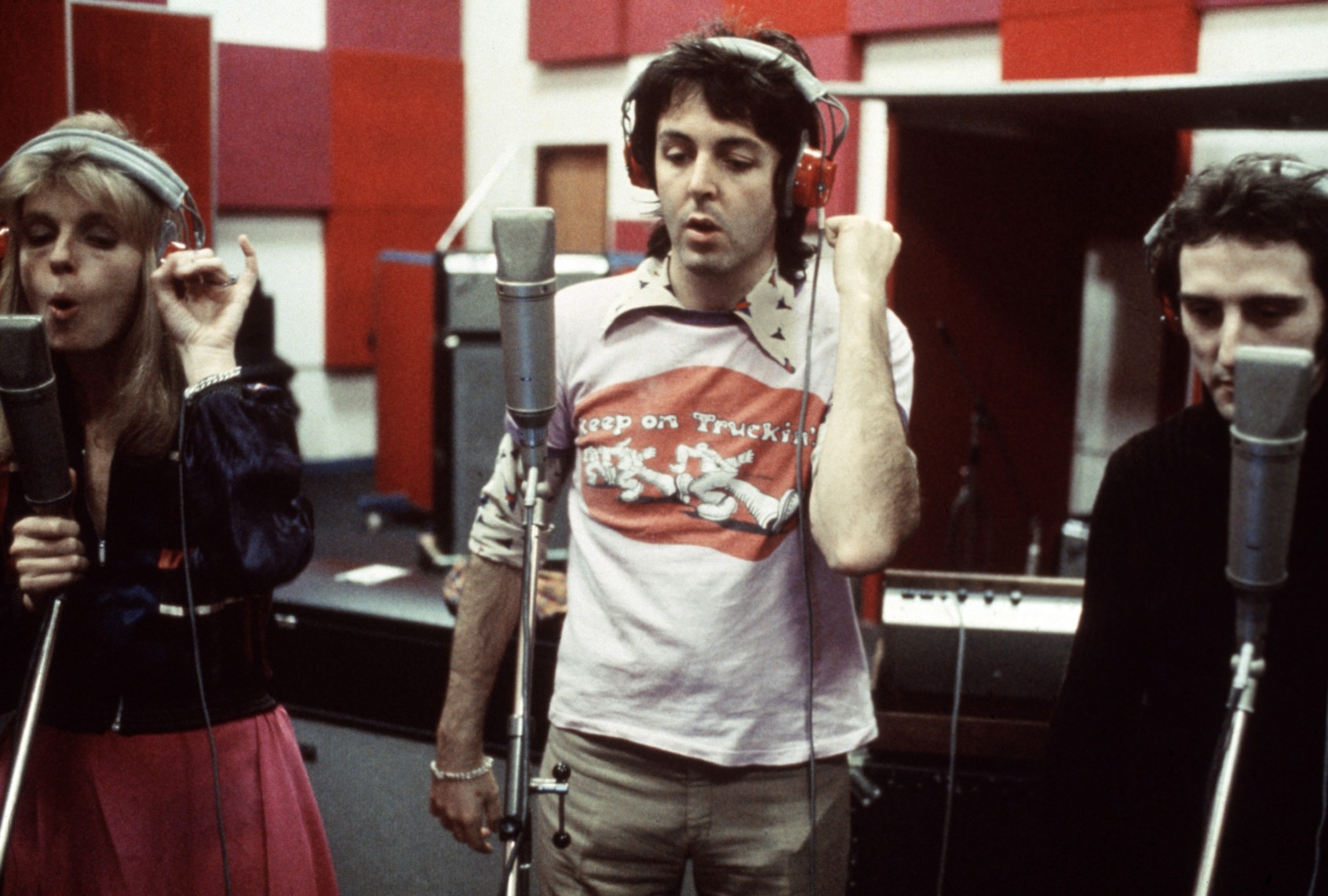
50 years ago, Paul McCartney went on tour in the United States with his band Wings. It was the first time he played live since The Beatles’ last tour in 1966. 2026 has become the year of Wings, with a wave of new historical and archival celebration around Sir Paul’s post-Beatles band. There’s a documentary (“Man On The Run”), a 550-page oral history (“Wings: The Story of a Band On The Run”), and the first major museum exhibit on Wings at the Rock & Roll Hall of Fame. The end result of all of the above is both practical and aspirational: the total effort rounds up all of the loose ends around this era while there are still enough people around to talk about it, and officially induct Wings into McCartney’s larger legacy.
It’s charming to observe within these different archival efforts just how very much Paul McCartney wanted his post-Beatles musical projects to be a band. He didn’t want to be “The Cute Ex-Beatle And Some Other Guys.” He wanted it to be a proper group, where each of the individual members had the opportunity to contribute and have a voice in the songs or the arrangements. This mindset explains his approach to the early days of the band, when they hopped into a van and drove around the UK, stopping at universities and offering to play for 50p at the door, dividing up the bag of coins at the end of the night.
This is absolutely a delightful conceit, except for the fact that the guy who wrote the songs and recruited the musicians was in The Beatles and, short of putting together a “supergroup,” there was never going to be any kind of equal balance of power. No matter how nice you are, no matter how much you want the other musicians to come to the studio with their ideas, no matter how many times you say, “we’re a band!!,” It doesn’t change the immutable fact that the person signing your paychecks is one of the most famous musicians on the planet.
To be fair to Paul, he was trying to figure out what his post-Beatles life was going to look like, and there weren’t a lot of examples out there he could follow. McCartney makes it clear in these new releases that he truly wasn’t sure that he’d ever write another note of music again. There wasn’t an accepted (or any) pathway for what you do when your huge pop group breaks up.
That’s what makes this whole post-Beatles/new band saga interesting to a more general audience who might not care about all the small details of Sir Paul’s post-Beatles music-making: this re-appreciation of Wings is also the story of the evolution of the music business and how it changed as the 1960s turned into the 1970s, everything from writing and recording music as well as touring, promotion and the media.
(Amber Patrick/Rock and Roll Hall of Fame) Paul McCartney and Wings exhibit
The McCartneys decided that they’d like to travel to exotic locales to record, asking their record company for a list of their studios in countries that weren’t the UK. That’s how Paul and Linda (and Denny Laine, the only band member who didn’t chicken out) ended up in Lagos, Nigeria to record “Band on the Run.” They arrived to find a studio without the most basic technical requirements (they taught them how to build vocal booths) and ignored the advice to not walk anywhere — and promptly got held up at gunpoint. (Besides the general trauma from getting mugged, all of their demo cassettes and lyrics were stolen, necessitating Paul having to recreate it all from his brain.) Later, the sessions for 1977’s “London Town” were recorded in a studio they built in one of three yachts anchored off the coast of the Virgin Islands.
The McCartneys took their three small children on tour in a time where “old ladies” were considered verboten on the road (much less in the band) and no one was thinking, “We don’t want to be away from our kids for months at a time so let’s just take them with us.” Now, of course, it’s something that anyone who can afford it is doing; it’s not an aberration. The small McCartneys are adorably running around all of the on-tour footage, and everyone acts like it is absolutely normal.
Want more from culture than just the latest trend? The Swell highlights art made to last.
Sign up here
Even the music press had to find a new way to approach the band that helped them sell papers, because they were still evaluating them as “The Beatles” and holding everyone’s solo material up against the previous output of the group. There were some terrible, terrible reviews written about almost all of the post-breakup Beatle solo albums. There was no thought that perhaps there needed to be a slightly different approach to evaluating the work of one person who used to be part of a group of four. “‘RAM’ represents the nadir in the decomposition of sixties rock so far,” wrote none other than Jon Landau at Rolling Stone, while the NME offered, “Certainly it would be true to say that it contains not one worthwhile or lasting piece of music.” It all reads like everyone is still mad at The Beatles for breaking up.
No one was taking into account that the same guy who wrote “Yesterday” was waking up every morning in his remote Scottish farmhouse — where he fled because he couldn’t do anything without having press and/or fans (or both) following him everywhere — feeling like he didn’t know how to write songs, so the fact that he plowed through what sure sounds like overwhelming depression to write, and then record (using a studio he built himself) an entire record was actually a tremendous personal accomplishment. But the industry was going through its own Beatles withdrawal, and every part of the ecosystem that profited off the existence of The Beatles was going to be screaming from the withdrawal of not having that anymore.
People like to talk about toxic fandom in the age of social media, but the thing is that toxic fandom always existed. If you’re watching “Man On The Run,” you see the hysterical fans crying outside the Marylebone Registry Office as Paul and Linda emerge after tying the knot. And it was some of these very same fans that used to stand outside Paul’s house in London and yell insults as Linda emerged to do the shopping.
All of this is why Paul and Linda ended up at High Park Farm, his 183-acre sheep farm in Scotland. Paul had purchased the property back in his Beatles days as an investment. It was located in a remote area and took hours to get there. Although the long-time residents of the area respected their privacy, that didn’t stop Life magazine reporters from showing up in the middle of the “Paul is dead” scandal in 1969 to prove that he was, in fact, not dead.
One of the absolute delights of the “Man On The Run” documentary is that you get to see movies and photographs of High Park Farm: the ancient buildings, the sheep, the utterly breathtaking Scottish landscape, and Paul running around with his sheepdog, Martha (of “Martha My Dear” fame). And then you get to watch Paul throwing a bucket of slop at the reporters filming the above. Paul has this footage because he bought it back from Life in exchange for an interview, so the magazine didn’t publish a picture of the Cute Beatle being mean.
(Amber Patrick/Rock and Roll Hall of Fame) Paul McCartney and Wings exhibit
High Park Farm also looms large in the Rock & Roll Hall of Fame Exhibit, with a whole section configured to look like the inside of their farmhouse: wood paneling, quaint lighting, faux windows. Given how large the farm figures in Wings’ history, it’s a brilliant idea. And of course there are photographs everywhere, and on the “kitchen table” is one of Linda McCartney’s cameras, which feels like a holy relic.
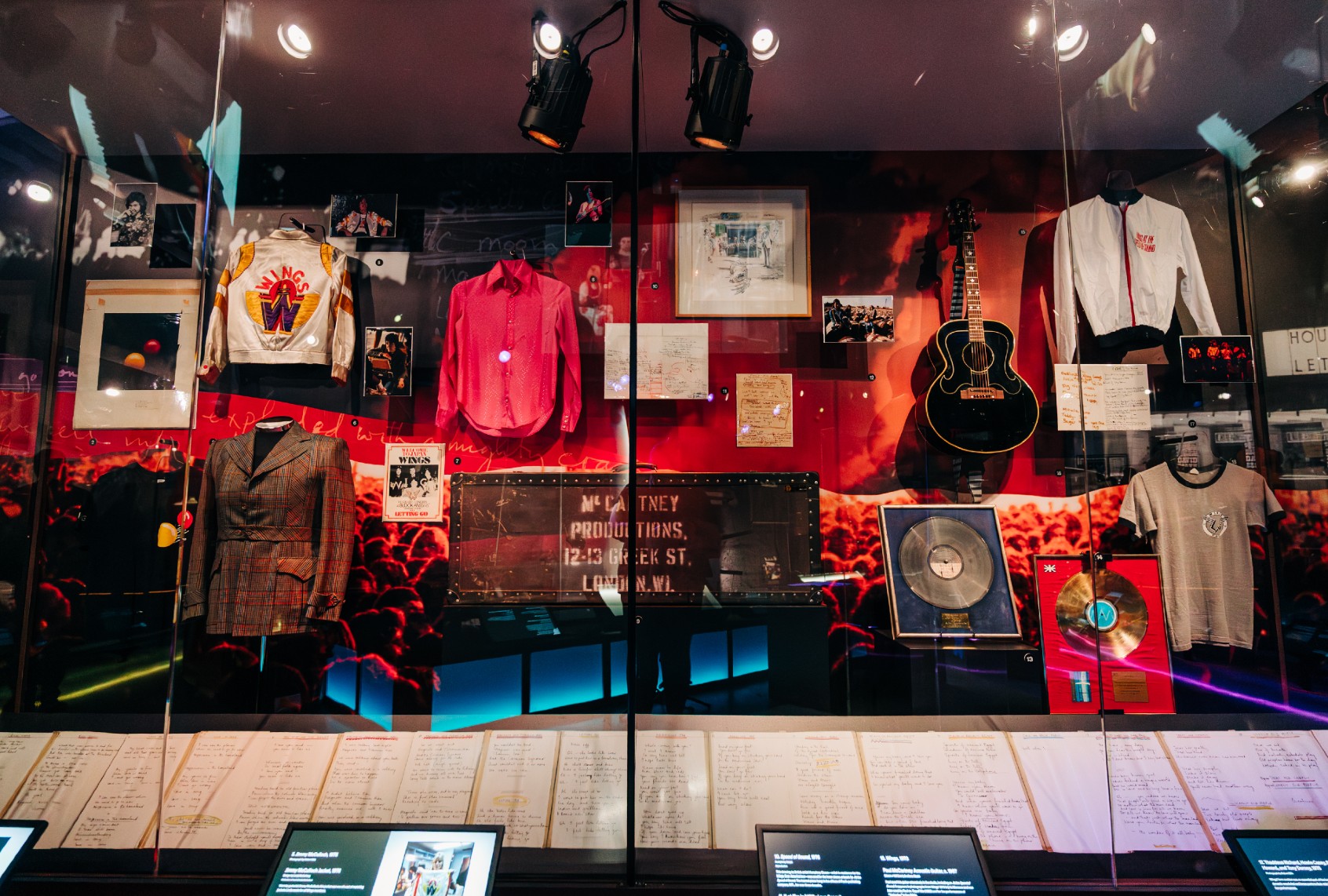
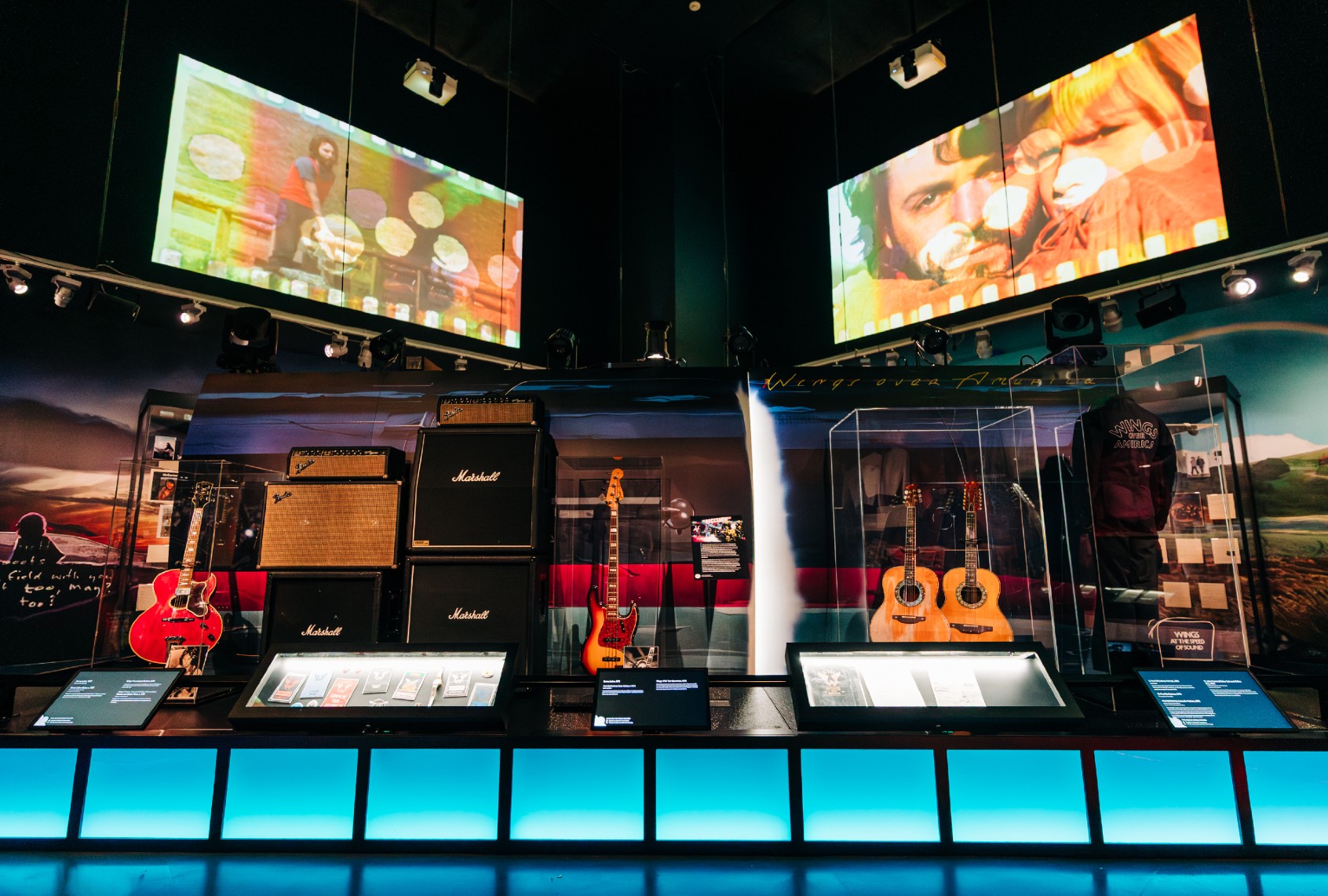
The Wings exhibit is small by Rock Hall standards but absolutely packed with details: Handwritten lyrics; the orchestral scores for “Live and Let Die;” a whole slew of guitars, keyboards and other instruments; stage outfits; Paul’s sweater vest; caftans from Morocco when they were preparing to record “Band on the Run.” The actual sign for High Park Farm’s “Rude Studio” (which, as the musicians explain in the documentary, was basically a barn with some recording equipment in it) is there, along with original artwork layouts for various McCartney solo and Wings albums. It was a band with changing lineups and a limited discography, but the entire trajectory of the project is well-represented.
The challenge with the Rock Hall exhibit goes back to Paul’s insistence that Wings was a band. It’s hard to see anyone but the most rabid Wings fan interested in, say, guitarist Laurence Juber’s amp or similar artifacts from the horn section, but on the other hand, this is a Wings retrospective. If you’re already planning a trip to Cleveland and the Rock Hall, the Wings exhibit is definitely worth a visit, but to use the Michelin designations, it’s worth a detour but probably not a special journey.
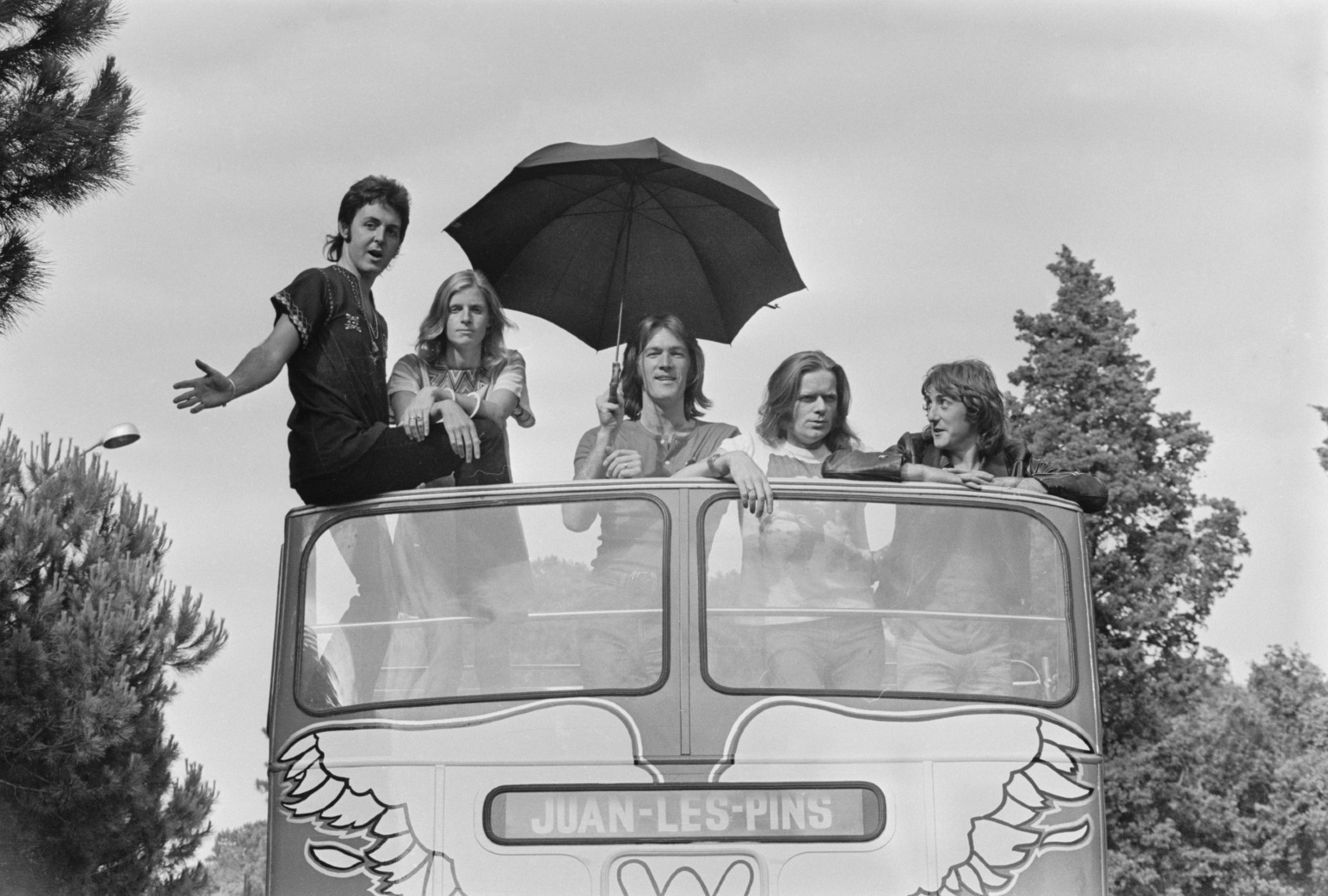
The exhibit also features some pieces of the Wings Over Europe tour bus, which you can see in the documentary and read about in the book. They took an old double-decker bus, removed the roof, and retrofitted the rest, instead of just renting a tour bus. The top half of the bus was kitted out with cushions and mattresses and you see footage of Paul, Linda and the kids lounging in the sun as the bus drove under motorway overpasses, while the rest of the band sat downstairs. (The bus also only went about 40mph so there are stories in the oral history about promoters sending cars to meet the bus so the band could get to shows on time. If Wings hadn’t included an ex-Beatle as a member, it’s likely this routine wouldn’t have lasted more than a handful of tour dates.)
The book is constructed from the hundreds of hours of interviews used in the film, so there’s some overlap between the two, although that ends up feeling like you’re in on the secret rather than being repetitive; still, it’s mostly going to be something appreciated by Wings completists. As noted, the book is presented as an oral history, and the only problem with that is that while some quotes are dated (and others are obviously older, because the person speaking is no longer with us), you don’t know whether you’re reading someone’s contemporaneous thoughts or if the statement is more modern and thus represents the time and space to reflect. And there’s a lot of commentary from Mary McCartney (who is responsible for her mom’s photography) and Sean Ono Lennon — which is fine, given their positions in the family business, but none of them were old enough to remember with any detail what things were like when Wings was on the road in the early ’70s.
(Reg Lancaster/Daily Express/Hulton Archive/Getty Images) Wings, 1972
Another thing you will learn from this project (if you didn’t already know this) is how much the McCartneys really liked pot, to the point where they were almost evangelists for it. If it had been legal, none of this would have been more than a mention, but given that it was not only illegal but viewed as evil and addictive (it was during the height of the “war on drugs” in the U.S.), cannabis ends up looming very large in the Wings history.
It’s kind of crazy to think that Sir Paul McCartney had trouble getting a visa to tour the United States because he got busted for pot in the UK at the same time all of the British rock stars were being deliberately targeted for their recreational drug use. But this was also at the same moment Nixon was trying to use these various cannabis-related transgressions as the grounds to throw John Lennon out of the U.S. This is especially meaningful once you realize that it was Paul’s bust for possession in Japan that was more or less responsible for the end of Wings as a project.
One thing the book spends a lot of time doing is defending the various Wings albums (as well as McCartney’s first solo efforts, “McCartney” and “RAM”) while also using that cliched phrase “soundtrack of a generation.” But at a minimum, there’s that stretch of three albums, beginning with 1973’s “Band on the Run,” 1975’s “Venus and Mars,” and 1976’s “Wings At The Speed of Sound,” capped with the triple live LP “Wings Over America,” released in the middle of a platinum-selling, coast-to-coast concert tour, which needs no defense.
Yes, the other Beatles were all releasing new music, but they didn’t dominate the airwaves the same way Wings did: “Jet,” “Band On The Run,” the Bond theme “Live and Let Die,” or the live version of “Maybe I’m Amazed.” And Paul was the one Beatle who was out in public, on the road, and ready to perform Beatles songs. For the generations who were just a few years too late to have experienced Beatlemania, this was their first chance to rep their team in real time.
There’s unfortunately no way this retrospective effort can avoid talking about the world’s reaction to Paul McCartney asking his wife to be in his new band. Not only did Linda McCartney meet with vitriol for marrying the last unmarried Beatle, but she received an unprecedented amount of fury for daring to make music and go onstage with her husband as though it was not her husband’s idea.
No one ever took Paul to task for putting his wife in the band. The rampant misogyny against Linda was virulently out of proportion because she didn’t actually do anything wrong, and because Paul wanted her there. It’s something that’s never made any actual sense. People who didn’t like Linda in the band were free to not buy records or attend concerts.
That said, the way this retrospective tries to make Linda into some kind of feminist icon as “one of the first women to be in a band” is unnecessary, given her actual accomplishments outside of Wings. Linda McCartney didn’t deserve any of the hate she received, but it’s a little disrespectful to try to compare her to working musicians who spent their lives working on their craft. Paul didn’t need to justify her presence by trying to make Linda into something she wasn’t; “man who has written timeless, million-selling songs wants her in the band and likes her voice” kind of overpowers everything else, or at least it should.
Our Summer sale is on!
Support Salon’s bold journalism. Annual members save 58%But given that the woman has been gone since 1998 (RIP) and this aspect still has such a firm presence within this historical project shows how exactly upsetting it must have been to both McCartneys. Linda’s work as a photographer and animal rights activist should be what dominates the discussion rather than letting a bunch of closed-minded fans continue to be worked up over who’s playing with a musician they purport to admire.
While “Man On The Run” features live footage of Wings in its heyday and clues you in to what it was probably like to see Paul in his post-Beatles glory, it’s too bad that the band’s 1980 documentary “Rockshow” couldn’t make an appearance. Some of what you see in “Man On The Run” comes from the same source, but it doesn’t have the same kind of raw power that sitting in the theater watching “Rockshow” did at the time. “Rockshow” had a lot of issues (with sound and also image quality) when it was released on Blu-ray in 2013 (when the triple live album “Wings Over America” got the box set treatment) and that’s probably why it’s AWOL in this particular victory lap.
And that’s too bad, because this is where you can truly appreciate not just how genuinely great Wings were as a live band, but you also get to enjoy and to some extent experience how much fun Paul McCartney was having onstage. None of us ever got to enjoy The Beatles maturing into a live touring band, and “none of us” means John, Paul, George and Ringo as well. They didn’t get to figure out that they wanted a horn section or brainstorm on what visuals, lighting and pyrotechnics would add to their show. They didn’t get to figure out staging, costuming and what made a good Beatle setlist. We all lost out on that. At least Paul got a second chance with Wings, which everyone can witness through all of these efforts.