Thank you, Navinder Singh Sarao. The man in the tracksuit who lives with his parents in Hounslow, west London, and who last week became the suspect in the “flash crash” of 2010, when 9% was wiped off the value of the Dow Jones index in a matter of minutes.
When it comes to handy stereotypes we can all understand, Sarao ticks any number of boxes. An introverted computer geek who lives at home with his parents? Tick! A thirtysomething bloke who works in IT? Tick! A mathematical whizz who can work out how to crack the world’s most sophisticated computer programmes but can’t be trusted to turn up in court wearing a pair of trousers? Tick! Tick, tick, tick!
All of which suggests that there’s probably something else going on here, not the least of which is that it took the US authorities five years to finger the “Hound of Hounslow” as a suspect. Five years in which, as Michael Lewis, the author of Flash Boys and an expert on high-frequency trading, pointed out last week, not a single major trading firm – the sort of firms that retain highly paid legal counsel – has been held responsible of any wrong doing.
There’s just something a little too convenient about this on all sorts of levels, but mostly that it makes something almost entirely incomprehensible comprehensible (it was a loner in his bedroom!). And something potentially rather scary (the brightest brains in Wall Street had no idea what was going on) into something more like an Ealing comedy or maybe a film starring Seth Rogen.
Whatever the role of various people, Sarao included, might have been, the “flash crash” of 2010 is what happens when algorithms go to war. When you hand over control to computers, in this case trading software designed to react to market movements faster than any humans. They react. Just not in ways that anyone can predict or control.
Which is something to think about, possibly, given that 70% of the trades of the stock market are made by machines. Or, to put it another way, your pension is in all probability in the hands of a piece of computer code that may one day be undermined by another piece of computer code… and well, who wants to think about that? The Hound of Hounslow is a much better story.
Or some sort of parable, perhaps, because algorithms haven’t just taken over the stock exchanges, they’ve taken over our world. They’re in everything, from Amazon recommendations to internet dating matches to drone strikes. You think you’re choosing what to watch on Netflix? Ha! More than 75 % of all content watched on Netflix comes via “suggestions”, a bit of computer code that literally has your number. Or, at least, what it’s decided is your number, because Netflix believes its algorithm knows you better than you know yourself. “A lot of people tell us they often watch foreign movies or documentaries,” a Netflix engineer told a journalist. “But in practice, that doesn’t happen very much.”
And while you think I have chucked in Kim Kardashian’s arse into this piece for no reason at all, you’d be wrong. I’m dropping it in, alongside a few variants – ass, butt, bottom, tush, derriere – and some other random newsoids of no consequence, Katie Hopkins Nazi hellbitch, to attract the attention of another algorithm (hi there, Mr Google!) to push this article up the search results. Half of what passes as news these days is a bunch of people talking to a bunch of algorithms.
The financial markets are just one area of our life that we don’t understand and can’t control that we’ve outsourced to computer code, a language most of us have less hope of understanding than Klingon. Every day, our needs and desires are driven more and more by forces we’re not even aware of, let alone comprehend. No wonder we need lone computer nerds. In teenage bedrooms. Thank you Navinder Singh Sarao! A cartoon villain, or possibly hero: a shorthand cypher for a world we no longer have a clue about.
Free coffee? Only with some crumpet
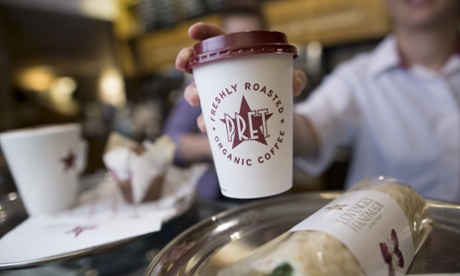
Pity the poor employees of Pret A Manger. Not because they’re paid only a fraction over the minimum wage, or that, according to a now deleted corporate website, they’re expected to exhibit “Pret behaviours”, one of which is that – heaven forbid – they shouldn’t be “just here for the money”. Or that, according to a book published last month, even the sandwich makers are expected to exhibit MasterChef levels of “passion” for their work. Or that if a mystery shopper discovers an employee isn’t sufficiently “enthusiastic”, the entire shop misses out on their bonus.
Not because of any of that or that the fabulous nature of these jobs is such that only one in five of its employees is British-born, the others being migrant workers (note to Katie Hopkins: these are the “good” sort of migrants). But because all week long they’ve had a steady stream of undercover reporters looking to find out the truth: namely, is it possible to flirt your way to a free cappuccino?
In lieu of a loyalty card scheme, it was reported last week, staff are enjoined to give away a certain number of free coffees to customers on the basis, the chief executive said, that they decide “‘I like the guy in that tie” or “I fancy that girl or that boy”.
The verdict? Yes, found an intrepid duo from the Evening Standard, who scored a filter coffee each. No, wrote Deborah Ross in the Times who encountered a female barista and discovered that her “older lesbian who might take someone on a cruise” gambit missed the mark. It took the might and cunning of the Daily Mail to uncover the truth: no, if you dress “plainly” and wear spectacles. Yes, if you wear a short red dress and get your knockers out. So there you have it. Free coffee operates according to ancient rules. As you were.
So just a bit of an own goal, there, Dave, my son
So, football. It’s a big round ball that certain overpaid men like to kick around between other more important pursuits, polishing their Ferraris, curating their body art collection etc. Apparently, the team one supports is quite a big deal. Note to David Cameron: I am available for consultancy should a briefing be required in the wake of the greatest gaffe of the campaign so far: #Villagate, as it became known on Twitter. (Complete with some lovely postings of Roger Nouveau, the Fast Show’s fake “fan”. )
“This is a shining example of a country where multiple identities work,” he said . “A country where you can be Welsh and Hindu and British….Where you can support Man United, the Windies and Team GB all at the same time. Of course I’d rather you supported West Ham.”
Whoops. If you’re going to be a man-of-the-people fake football fan, it’s important to remember which man-of-the-people fake football fan you are. You support Aston Villa, Dave. It’s the one in Birmingham. West Ham is the team with Karren Brady. You remember: you gave her a peerage for her services to voting Conservative. Anyway, football. It’s a big, round ball…