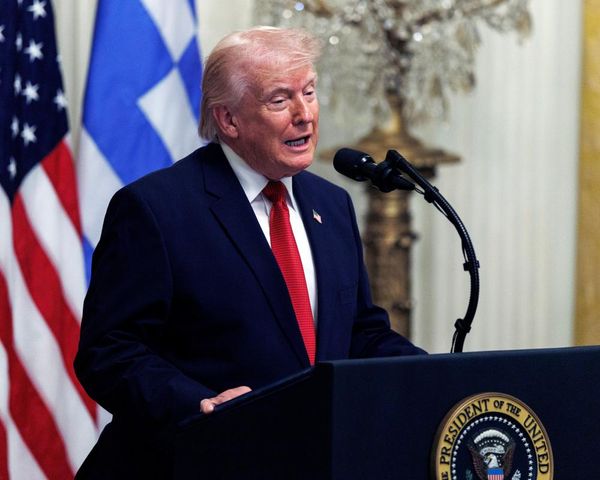
Iranian officials responded to President Trump directly via Twitter Sunday after he tweeted that the U.S. had "targeted 52 Iranian sites," including some "important" to Iranian culture, that it would hit if Tehran attacked "Americans, or American assets."
The latest: Foreign Minister Mohammad Javad Zarif tweeted on Sunday, "Having committed grave breaches of int'l law in Friday's cowardly assassinations, @realdonaldtrump threatens to commit again new breaches ... Targeting cultural sites is a WAR CRIME."
- Hossein Dehghan, the military adviser to Supreme Leader Ayatollah Ali Khamenei, told CNN that Iran will target U.S. military sites in response to the killing of top Iranian commander Qasem Soleimani. He also claimed that Trump's threat to target 52 cultural sites would be a war crime.
- Information and Communications Technology Minister Mohammad Javad Azari Jahromi tweeted: "Like ISIS, like Hitler, Like Genghis! They all hate cultures. Trump is a 'terrorist in a suit.' He will learn history very soon that NOBODY can defeat 'the Great Iranian Nation & Culture."
Why it matters: Friday's drone strike that killed Soleimani is the most direct confrontation from the U.S. since the Trump administration pulled out of the 2015 Iran nuclear deal. Iran has vowed to take revenge, according to the official Iranian news site IRNA.
- Experts including Ryan Goodman, a former special counsel at the Defense Department, have said attacking cultural sites is a war crime.
- Trump has faced criticism over the strike that killed Soleimani from some world leaders and members of Congress, including House Speaker Nancy Pelosi.
The big picture: Mourners flooded the streets of Ahvaz after the bodies of Soleimani and Abu Mahdi al-Muhandis, a senior Iraqi-Iranian militia commander who also died in the U.S. strike in Iraq, arrived in Iran Sunday.
- Iraq's parliament is holding an emergency session Sunday, Reuters reports.
- NATO has suspended training missions in Iraq after Soleimani's death, citing security concerns, the Washington Post reports.
The decision to strike: U.S. officials say they acted following the death of an American contractor the Friday before Christmas in Iraq by Iranian-sponsored militia groups. Secretary of State Mike Pompeo claimed Soleimani was "actively" planning an attack on Americans, the Post reports.
- Trump said he's not looking to change the Iranian regime, per the New York Times.
The attack fallout: Iraqi officials and Iranian-backed militias reported another deadly airstrike in Iraq 24 hours after the U.S. killed Soleimani, AP reports. It left five dead, as thousands gathered in Baghdad Saturday to mourn Soleimani and al-Muhandis.
- On Saturday, several rockets fell inside Baghdad's fortified Green Zone, the Jadriya neighborhood and the Balad air base housing U.S. troops, but there were no reported deaths, the Iraqi military said, per Al Jazeera.
Global reaction:
- Iraqi Prime Minister Adel Abdul-Mahdi, who formally resigned a month ago, said the attack will lead to a "dangerous escalation," NPR reports.
- Russia condemned the attack and blasted the Trump administration for refusing to use official channels, such as turning to the UN Security Council following protests at American embassies in Iraq, per NPR.
- U.K. Defense Secretary Ben Wallace said the Royal Navy was escorting British-flagged vessels in the Persian Gulf and that under international law, "the United States is entitled to defend itself against those posing an imminent threat to its citizens."
- Israeli Prime Minister Benjamin Netanyahu supported the U.S. and said, "Qassim Soleimani is responsible for the deaths of many American citizens and many other innocent people," the BBC reports.
- China appealed for restraint on all sides, but added, "The dangerous [U.S.] military operation violates the basic norms of international relations and will aggravate regional tensions and turbulence," per Al Jazeera.
What to watch: Iran is "likely" to launch a cyberattack against the U.S. following the death of Soleimani, AP reports.
- The disruptions could target American manufacturing facilities, oil and gas plants, and transit systems. U.S. cybersecurity officials warn businesses and government agencies to be cautious, per AP.
What's next: The White House is preparing to present allies with intelligence on the "imminent threat" it says prompted this attack, said Kirsten Fontenrose, who served on the National Security Council earlier in the Trump administration, during an Atlantic Council conference call.
- The administration is sending more U.S. troops to the region, with roughly 3,500 troops in Fort Bragg, North Carolina, preparing to go to Kuwait.
Go deeper:
Editor's note: This article has been updated with new details throughout.