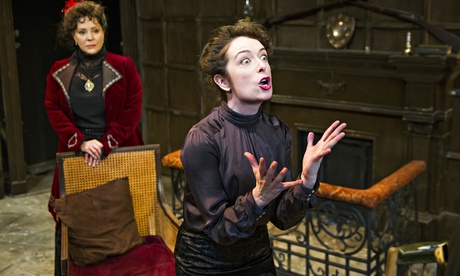
Aside from periodic revivals at the Orange Tree, the plays of St John Hankin are pretty much ignored today. Yet, in his Edwardian heyday, Hankin was championed by Shaw and Granville Barker, and this piece, first seen in 1908 shortly before his death, showed he could smuggle progressive ideas into a traditional family drama.
The situation is pretty straightforward. Janet De Mullin, a working mother running her own London hat shop, returns to the Dorset family home that she fled to have an illegitimate child. Now accompanied by her nine-year-old son, she fiercely resists all attempts to sacrifice her newfound freedom in order to perpetuate the family line. But while Hankin pins down the social hypocrisy that forces Janet to pose as a widow, and subtly indicates that she only achieved independence with the aid of a small legacy, there is a problem with the play: Hankin is so clearly on Janet’s side in countering patriarchal tyranny and the whaleboned snobbery of her female relatives that he never allows her to meet any credible opposition.
But even if the piece lacks genuine debate, it rattles along thanks to the sensible decision of the director Joshua Stamp-Simon to play it straight through, over 90 interval-free minutes. Charlotte Powell excellently gives it internal tension by suggesting that Janet’s bold assertiveness is accompanied by a lack of emotional sensitivity, especially in her disdainful treatment of her stay-at-home sister. Maya Wasowicz lends this character, secretly pining for a local curate, the forlorn beauty of the overlooked, and there is sound support from Stuart Organ as Janet’s blustering father and Roberta Taylor as her dithering mother.
It’s not as good a play as Hankin’s earlier The Return of the Prodigal, but it makes its point and shows us what Edwardian women had to endure in order to gain a measure of independence.
• Until 28 February. Box office: 020-7287 2875. Venue: Jermyn Street theatre.