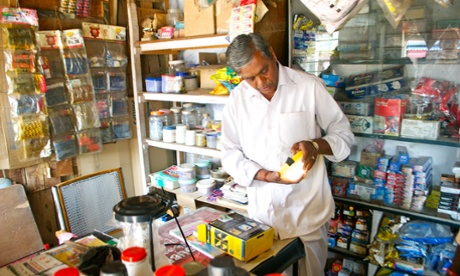
“India has one of the strongest local retail shop networks in the world. This network, estimated at 15m local shops, accounts for about 10% of GDP,” says Jackie Stenson, co-founder of the last mile distribution company Essmart.
In terms of an actual customer base and market size, India’s unorganised retail market - the kirana shop network - serves about 90% of Indian households who depend solely on these small, family-owned retail shops for all of their consumer needs.
Even Stenson’s co-founder, Diana Jue, who studied urban planning and international development at MIT, visits her local kirana shop a few times per week. “Maybe every day,” Jue says.
Shop owners in Essmart’s network, who are connected to six distribution centres run by 42 staff members in seven locations in India including Bangalore, can receive shipments of more than 50 life-improving products in two ways. They can either pick and choose which items to stock on their shelves, or allow customers themselves to browse an on-site product catalogue and request goods (typically delivered within a couple of days).
As for what’s offered - non-electric water filters, clean cooking stoves, mobile phone controlled water pumps, reflective wear, natural mosquito repellent, electric bicycles, solar mobile phone chargers, amongst many other life-improving goods.
“So far the best selling product is solar lanterns,” says Jue. “It’s a product that, where we work, is very much needed because there are so many power cuts, even in cities. We’ve seen people use lanterns to keep their off-grid food stall open at night, or keep their off-grid barbershop open after hours.”
While Essmart consumers benefit from additional income, or fewer mosquitoes, Stenson and Jue see their work as a boon to kirana shopkeepers - the partnership is a “no-brainer” in terms of business development.
Essmart staff host product demonstrations in small kiosks outside kirana shops, free of charge, commanding the attention of potential local consumers.
“After we do enough demonstrations, shopkeepers see that people actually want the products we’re selling,” Jue says. “They’re good products and customers in the area start to ask for them, so shopkeepers start to provide products and do marketing on their own.”
As an added bonus, Essmart eases the burden on kirana shopkeepers by taking care of customer service issues. Essmart sales executives exchange broken goods under warranty and even order replacement parts, including solar panels or broken wires, a benefit most distributors don’t offer.
“Neither of us really wanted to be entrepreneurs,” says Stenson, who studied mechanical engineering at Harvard and completed her masters in engineering for sustainable development at the University of Cambridge. But neither her nor Jue were able to find anyone addressing the supply chain gap in a sustainable and scalable fashion - so they came up with their own fix.
“We’ve changed Essmart’s model. We have tweaked, altered and refined it as we’ve gone along. But the fundamental elements of focusing exclusively on marketing, sales and distribution, and doing so by leveraging the local retail shop networks have actually been a part of our model since day one,” says Stenson.
“We can basically go anywhere in the world, to any of the emerging economies that have a strong local retail shop network, as of right now, that’s pretty much everywhere.”
Stenson, Jue and the rest of the Essmart team have big plans for the future - expansion to other parts of south Asia, as well as to sub-Saharan Africa and Latin America.
“We really want Essmart to be a one-stop shop where customers and shopkeepers can come to access a portfolio of products that can improve their lives, and where designers and innovators can come to get their products out to their intended users,” Stenson says.
“Many people say: ‘You’re just in the middle of a supply chain.’ And we say: ‘That’s exactly where we want to be.’ We can help everybody, both upstream and downstream from us, improve the tech-for-development ecosystem.”
The Unilever Sustainable Living Young Entrepreneurs Awards is an international awards programme delivered in partnership with the Cambridge Institute for Sustainability Leadership and in collaboration with Ashoka, that rewards inspirational entrepreneurs aged 30 and under who have developed a product, service or application that helps make sustainable living commonplace.
This is an edited extract from an article that originally appeared on virgin.com.
Visit Unilever Project Sunlight for more inspirational stories from people making a difference in the area of sustainability.
More from the Unilever partner zone:
- The cloud-based tool improving healthcare across the developing world
- The power of mobile communication to achieve social goals
- The blackout that shed light on a national problem in India
Content on this page is paid for and provided by Unilever, sponsor of the sustainable living hub