Spoiler alert: this blog is for those who have watched the first episode of The Last Kingdom showing on BBC2, Thursday nights in the UK; please refrain from posting any spoilers if you’ve seen more of the series.
Hello and welcome everyone. First off, a minor piece of housekeeping: like many people, I’ve read (and hugely enjoyed) the Bernard Cornwell novels on which this adaptation is based, but I’d like to do what we do with the Game of Thrones blog and try to keep the book spoilers to a minimum. Thanks.
Despite some casting issues (which we’ll come to later), this was a pretty strong opening episode, thrusting us straight into the action. The year is AD866 and England is divided into many kingdoms of which the four major ones are Northumbria, Mercia, East Anglia and Wessex. Northumbria, the biggest, is currently split between three rulers (or ealdormen), of whom only one, Uhtred (Matthew Macfadyen) has any idea how to fight, which is unfortunate as the Vikings are coming. Our hero is Uhtred (Alexander Dreymon), son of Uhtred, but when we first meet him he’s just a boy named Osbert who can’t keep his mouth shut …
Congratulations to series adapter, Stephen Butchard who, in addition to imparting a great deal of information economically, did a good job of capturing the feel of the times, while also making The Last Kingdom feel distinct from both Game of Thrones and Vikings, with which it shares some DNA.
One of the reasons this show felt so different is the streak of melancholy running through its heart. This is a drama as much about what it feels like not to belong as it is one about loss, betrayal, war and retribution (although it’s about all those things as well, which is great). It might seem as though our hero Uhtred is in the early stages of a simple coming-of-age story, albeit one forged in fire and gruesome death, but the story Cornwell and Butchard are telling is actually far more complicated. Uhtred is a man constantly being reborn: he begins life as Osbert, is rechristened as Uhtred after his older brother’s death, goes from being a Saxon to a Dane and from slave to son, before ending the episode seemingly beholden to no one and in control of his destiny. Driven by revenge but also by the need for survival in treacherous times, his journey does not look set to be an easy one.
All of which brings me to my main quibble with this adaptation: I’m not yet convinced by the casting of Dreymon in the lead. The child Osbert/Uhtred (Tom Taylor, last seen in Doctor Foster) has a spark about him, a sense that this is a boy who might grow into someone who can find the humour in this life despite its brutality. Dreymon, by contrast, is a little bit Jon Snow, a little bit Legolas. Which is another way of saying that he has lovely flowing locks and a chiselled jaw but lacks vitality. That’s potentially a problem because for The Last Kingdom to subvert traditional coming-of-age stories it needs its hero to do more than look pretty and frown well.
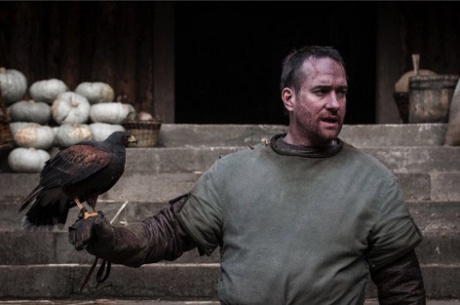
‘A village can be rebuilt. A warrior can only die once’
Thankfully, The Last Kingdom has put a hell of a supporting cast in place. As Uhtred senior, a brilliant commander fatally let down by the general spinelessness of the other Northumbrian ealdormen, Macfadyen stole the opening 20 minutes, making me rather sad when his death inevitably and terribly came. Ian Hart was similarly good as the priest Beocca – the scene when he prayed for the out-fought and out-thought Saxon army: “Do not forsake us, do not forsake England” sending shivers down my spine – while Joseph Millson was suitably shifty as Aelfric, Uhtred’s brother whose plans for succession were in place before a sword had even been parried.
‘All this way and no reception party’
Over on the Viking side we met the fierce but secretly warm-hearted Ragnar (Danish actor Peter Gantzler) and his family, including his blind seer of a father, Ravn (Rutger Hauer turning the mystical wanderings up to 11 as only he can); the psychotic Ubba (Norwegian Rune Temte), of whom Ravn memorably says: “Never cross Ubba and never, never fight him. He listens to no one but the gods, and men who take their orders from the gods are a bit unpredictable”; shipmaster Kjartan and his son, lecherous would-be rapist Sven, who waited a long time before brutally enacting his revenge on Ragnar’s family and walking the dead earl’s daughter Thyra off to living hell.
Those last devastating moments when Sven and Kjartan burned the settlement to the ground while Thyra, catching sight of Uhtred, hoped desperately for salvation, marked out why this will be a show to stick with. In a lesser drama, Uhtred would have ignored his desire for revenge and tried to save Thyra but The Last Kingdom stayed true to the reality of a young man who has spent his life dreaming of revenge, and thus Uhtred instead took his moment of vengeance, as a consequence condemning Thyra to her brutal fate.
Additional notes
- The opening credits are a thing of great beauty and I could watch them again and again.
- In an episode that was pretty testosterone-heavy, Emily Cox’s Brida stood out, and not least because she is interestingly pragmatic. Her advice regarding telling the story was sound. I also thought it interesting that, as a village girl, she saw things in terms of service whereas the nobly born Uhtred was desperate never to be any man’s servant again.
- While Cox was good, I did have my doubts about her fetching sheepskin coat. It made her look as though she were on her way back from a late night at Glastonbury.
- The death scene between Ragnar and his wife was beautifully done. See you in Valhalla indeed (well after I’ve set myself on fire and taken a few of these treacherous backstabbers with me, that is).
- In addition to Beocca’s speech, I also got a case of the shivers when Ragnar referred to Wessex as The Last Kingdom; I knew those two years studying early medieval history would come in useful one day.
- Talking of history, Ragnar’s Viking stronghold being in Leeds explains an awful lot about Yorkshiremen and hardiness …
- Finally, a lot of very violent things happened in this episode. Interestingly, while The Last Kingdom didn’t shy away from the violence, it didn’t dwell on it, either. In contrast to Game of Thrones, there was no desire to keep the cameras rolling once the true nightmares began.
Violence count
A very violent episode began with the beheading of Uhtred the elder son before moving on to several bloody Saxon deaths both on the battlefield, where Lord Uhtred had a sword thrust through his throat, and Uhtred the younger found himself knocked to the ground unconscious. And back at the Viking hall surviving prisoners were crucified, pushed over balconies, beheaded and later nailed to posts as a warning. There was one fight with an evil boy would-be rapist which culminated in justice Viking-style and the loss of eye; one settlement burned to the ground and the murder of all within. One wife granted a merciful death and passage to Valhalla with her husband and said husband’s subsequent fiery revenge and magnificent end slaying several while literally burning to death. One beheaded henchman delivered to Aelfric’s gate as warning.
Quote of the week
“If he arrives at Heaven’s Gate as Uhtred, they might wonder what happened to Osbert” - Oh Beocca, it’s the way you tell ’em.
So what did you think? Did The Last Kingdom do enough to convince you to tune in next week? Are you interested in our hero’s travails or does young Uhtred struggle to convince? And finally, if you were aiming to enter Valhalla which incredibly gruesome yet awesome death would be yours? As ever, all speculation and no spoilers welcome below …