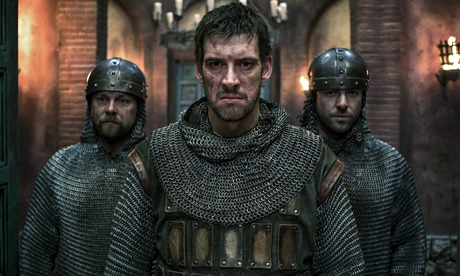
Northumbria, AD866, when Viking warriors captured Eoforwic and British place names were decided by a cat sitting on some sort of ancient litho-keyboard. At the time, the country was such a mess of randomly scattered vowels that things were shaky, domestic security-wise, and the regions that made up Britain were vulnerable to regeneration from visiting Danes.
The heathen Vikings on new historical drama The Last Kingdom (Thursday, 9pm, BBC2) aren’t as marauding as you might expect. They’re also infinitely more sympathetic than the God-fearing Saxon kings they’re up against. The BBC (let’s ignore the fact The Last Kingdom was produced by the same lot as Downton Abbey for a moment) has pulled a clever trick in pandering to the romantic idea a lot of rye-happy knitwear fans harbour: that Britain is, deep down, a Scandinavian outcrop. Sure, they might be uncouth in places: their habit of hanging Saxon women from the ceiling while they stand below cheering is a bit much. Neither am I a big fan of the Sepultura beards. But the Danes are shown to be community-minded, fair and highly organised. They’re on a definite proto-Scandi cool tip. In line with current historic thinking, the Vikings aren’t so much about the raping and pillaging as the settling down somewhere nice and verdant. “I see a place to grow fat and old,” says conquering Lord Ragnar, the big sop, as he and his men longboat it somewhere scenic north of Newcastle upon Tyne.
Let’s not forget, though, that Vikings are still Vikings, and during troublesome times they’re prone to a bit of swiping. Exactly this fate befalls our young Saxon protagonist Uhtred when he is nicked from his home by the rampant Ragnar. As any Guardianista knows, the Danes have very progressive childcare arrangements, so Uhtred is bought up by the Ragnars as their own. This sets us up nicely for future prodigal-son identity crises, all played out with bloodthirst, adolescent feelings of abandonment and axes.
Chez Jodelks, a drama only needs to throw down some muddy landscapes and a handful of historical tough nuts to be over-heartily accepted. But what with the animal pelts, the swords and the adaptation from popular fiction (in this case Bernard Cornwell’s Saxon Stories, fixture of railway terminus WH Smiths across the country, and scorn sponge of literary snobs), concerns about a misguided stab at Game Of Thrones – Game Of Krones maybe – are natural. I’m going to make this bold statement, though, and claim that it’s just as good. The cast is excellent, much of it made up of Scandi actors. Levente Törköly, who plays the priest Scallion, is a favourite. He plays the part with a clever and economic use of buffoonery. He’s pious and feeble and, while I’m not saying these are recognisable parts of the British identity, I do feel that if they had acoustic guitars in the ninth century, Scallion would be all over that, kumbaya-ing across any Umbria that’d have him. Scallion is also one of the few friends Uhtred will have, and possesses just about enough gumption to know that Uhtred’s evil uncle Ælfric is up to no good.
On the subject of mighty clans rising in the north, the McQueens are among the Hollyoaks (Monday to Friday, 6.30pm, Channel 4) residents celebrating its 20th anniversary week. All soaps do big anniversary events – we’ve just seen Corrie’s for ITV’s 60th – but Hollyoaks is the only soap that not only finds room for a big ’un every year, but manages to pack in roughly 20 scandalous hooks per episode. Top notch ones, too. The big draw for its anniversary week will be a tragedy at Hollyoaks Pride, organised by money-grubbing Tony who, like his spiritual guide Ian Beale, has been knocking about since the soap’s very beginning. With Lipsy-armoured warrior queens, matricide, hospital serial killers and visitations from famous pop stars in dream sequences, Hollyoaks is proof that chaos should reign in drama. On The Last Kingdom, some guy called Arthur eventually comes and sorts out all the trouble, or so I’m told. I’m not sure I want him to.