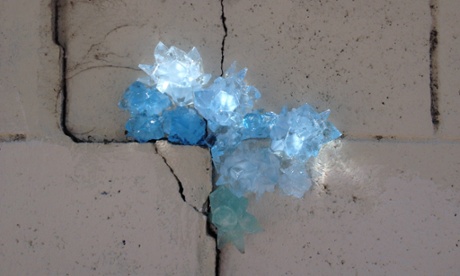
Down a narrow alley between two brick buildings in a Los Angeles warehouse district – now an expensive loft neighbourhood – in the small corner of a ground floor window filled in with concrete, a small plastic growth spreads out from the sill.
Like sculpted globs of clear ice, the crystalline shapes spill out from the window’s crevice, mixing with translucent blue mineral forms, forming a blossom of geometry.
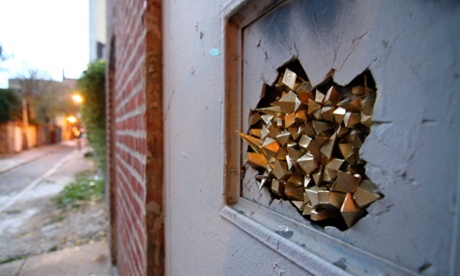
Less noticeable but bigger, another cluster of golden crystals juts out a few feet overhead from another crook in the window. The crystals – fully and perceptibly artificial – burst from the window frame. But despite their sci-fi glam, they’re so subtly inserted into this unremarkable slit of the built world that they’re much more likely to be overlooked than noticed.
These crystalline growths are the sculptural street art of Los Angeles-based artist Paige Smith. They’re what she calls “urban geodes”, the cityscape version of the mineral growths that can form inside sedimentary and volcanic rocks. She places these clusters in the crevices of the city – in the void of a wall’s missing brick, in the spout of a tiny pipe, or in the crack in a façade.
“I think there’s kind of a beauty in paying attention to those things that most people overlook,” Smith says.
Small, unobtrusive and sometimes hard to spot, these small-scale works are both a celebration of the ignorable parts of the city and an invitation to seek them out. Smith hand-folds the shapes out of paper, glues them together, and fills them into pre-measured forms that she can later quickly implant in the cracks and crannies of the city. Recently she’s also been measuring her sites and creating perfectly tailored moulds into which she pours resin, casting plastic-like crystal clusters to install.
Smith is a graphic designer and when she moved to Los Angeles from San Francisco about five years ago, she ended up in LA’s burgeoning arts district. With massive murals on warehouse walls and an abundance of sanctioned and unsanctioned street art, the neighbourhood can seem like a big outdoor gallery. “I was looking at a wall with these big murals, and there was a missing brick on the wall next to it,” she says. “Then I started to see them everywhere.”
To counter the large-scale artwork, she began hand-folding tiny paper shapes – pyramids and polyhedrons and rhombic prisms – and planting them in those crevices about two and a half years ago. Inconspicuous cracks in a wall would soon be filled with the glint of a gold-painted paper crystal growth, implanted surreptitiously by Smith for passersby to see – or not. Some are covered in glitter, others are painted in blues or purples or blacks, but most are gold.
The paper sculptures, when exposed to the elements, eventually break down. The newer crystals, made of hardened resin, are more durable. But Smith says the public nature of the works means they’re also exposed to the human element. Many have been taken or smashed. One was even set on fire. She’s curious about these interactions; how people notice, respond to and even vandalise them. She’s considered monitoring them but, she says, “the mystery is interesting”.
Smith has mapped the locations of her geodes, which are scattered around Los Angeles and other cities, but only provides their general locations. “What I prefer is that people stumble upon them. You still have to go out and find them; you have to look around,” she says, hoping these small installations can get more people to notice and think about the smaller spaces and interstices of the built environment.
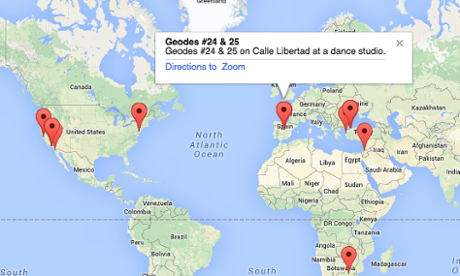
In addition to the geodes she’s placed around LA, Smith has also installed some on her travels around the world, including in Madrid and Bali. And, through a network of fans worldwide, she’s shipped geodes to be installed in the crevices of cities such as Istanbul, Amman and Melbourne.
Smith says the project is like a street-art version of the concept of magical realism, and she hopes these little pockets of unexpected crystals will inspire a sense of wonder in the people who happen to come across them: “I like to believe in those bits of magic that can exist in our world.”
Find out more about the Urban Geodes project here, or email streetart@acommonname.com if you are interested in participating