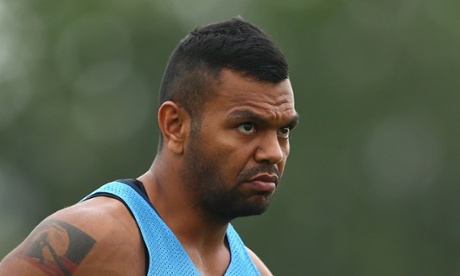
Opinions will be divided for some time on the Kurtley Beale saga, which mercifully came to an end late on Friday when an independent code of conduct tribunal fined him $45,000 for sending an inappropriate text and image to former Wallabies team business manager Di Patston in June. The tribunal cleared Beale of subsequently sending far more serious and lewd texts after IT forensics on his phone proved otherwise. On balance, it was a fair decision; there was insufficient evidence in the case brought by Beale’s employer, the Australian Rugby Union. Like the OJ Simpson case, the glove simply didn’t fit.
And there were mitigating circumstances: a team divided by what some saw as Patston’s overbearing and intimidating management style, and her close relationship with the other casualty in this sorry saga, former Wallabies coach Ewen McKenzie, who sided with Patston and lost his players – and job – as a result. Beale’s act was one of gross stupidity, but his fire had been lit and stoked well before his text of 9 June by what we all now know was a totally dysfunctional Wallabies management team, operating sans checks and balances and without proper oversight from the ARU’s chief executive, Bill Pulver.
The losers, including Beale
The texting saga has damaged lives and reputations. None of Beale, Patston, McKenzie and Pulver will be able to move forward saying this sorry affair hasn’t scarred them in some significant way. The most sympathy has to go to Patston who by all reports worked long and hard for the team only for her efforts to end in tears, public humiliation and ill health due to stress. Beale, too, has been left chastened and shaken to the core. McKenzie gave him his first professional contract. To see his great friend, mentor and a loyal servant of Australian Rugby, a 1991 World Cup winner no less, reduced to the forlorn figure who shuffled off alone down the corridors of Suncorp Stadium after announcing his resignation last Sunday would ache Beale’s heart in a way no $45,000 fine could ever do – it’s only money after all. And, last but not least, Pulver who has to endure the private shame of knowing people are thinking that he’s an incompetent chief executive.
Player agent Isaac Moses on the rise
The only winners from what is beyond doubt the most damaging period in Australian Rugby history are player agent Isaac Moses; Michael Cheika, the new Wallabies coach; and the independent tribunal, chaired by district court judge Mark Williams SC. Pulver probably underestimated Moses and the extent to which he’d fight for his client, Beale. Moses left no stone unturned in putting together a formidable legal case for Beale. The Rugby Union Players Association also assisted, but Moses quarterbacked the legal and public relations war from day one. He asked Beale if he had sent Patston the second, far more offensive text. Beale said he hadn’t. Moses believed him and mounted a tenacious fight back despite the ARU telling him not to bother; his client was a dead man, the ARU said in private. Indeed, Moses, whose other big client is Israel Folau, has emerged from this train wreck as a Johnny Cochran-like figure, a street smart player agent who cuts good deals and, more importantly, knows how to mount an effective defence and get his clients the best outcome possible in code of conduct proceedings. His influence has increased significantly.
Of course, Moses has to thank the independent tribunal. The ARU and many board members wanted Beale gone. They were convinced it would happen. Judge Williams and panel members John Boultee and Dominic Villa, however, gave the ARU’s wishes short shrift. In a matter that had attracted substantial media coverage, the tribunal quite properly judged the merits of the case based on the evidence and strength of legal argument alone. Fears Beale would be put before a kangaroo court were completely unfounded. If anything, the tribunal’s decision has validated the integrity of the system and given confidence to players that if they prepare their cases well enough, there’s every chance of a favourable outcome. The players’ union must also be commended for its role in introducing the independent judge-chaired tribunal concept into ARU player governance.
Cheika’s win is self-evident; he’s now Wallabies coach, a position he deems an honour and a privilege. He didn’t expect to get the job like this (McKenzie is a good friend of his), but now that’s he’s there, there’s every chance he will carry on with his winning ways and get the best out of the playing group, many of whom he coached at the Waratahs to win this year’s Super Rugby title.
Has the ARU learned its lesson?
The biggest lesson for the ARU from this mess? It’s getting the team manager role right, and getting the right person for that job. Patston was on a hiding to nothing with her ambiguous job description. The players didn’t know what her role was, only that it was growing by the day and extending into areas they were uncomfortable with – for example, amateur psychology sessions on long-haul flights, and setting up suspect HR and disciplinary processes (re: last year’s Dublin drinking fiasco). In the end, Patston probably didn’t know where the role started and finished either. She only knew she answered to McKenzie alone and was loyal to him above everyone else. She tried to save the ARU money by wearing several hats at once after the ARU slashed costs and shed several team staff positions. But the end result for the ARU’s short-sightedness was millions of dollars in brand damage, termination payouts, and massive legal fees.
Sadly though, the ARU may not have learned its lesson. There is speculation it will create a new ‘technical director’ role to act as conduit between coach Cheika and Pulver. Cheika has made it clear to Pulver to keep away from team affairs including the appointment of assistants, and won’t have it any other way. However, Pulver, for good reason, needs a way to regularly gauge the temperature in the locker room to ensure recent events never happen again. To that end, it’s understood the ARU is considering a technical director role as an interim measure pending the appointment of a full-time manager. This person’s duties are expected to be “many and varied”, a phrase which ought to set off alarm bells straight away. It’s understood the new technical director would also monitor players during next year’s Super 15 competition while Cheika sees out his final-year commitment at the Waratahs. And former national coaches Eddie Jones, Rod Maqueen and Bob Dyer are being mentioned as candidates.
So, just so we’ve got this right – this new appointment will keep tabs on the team’s vibe, report to the executive, and also monitor players in competition and prepare weekly performance reports? That sounds like two important jobs merged into one. And it also sounds like another train wreck. By all means, the ARU should hire someone with a rugby-specific knowledge to assist Cheika in evaluating and assessing players in an orderly and systematic basis. But to expect this person to then wear the hat of team manager and act as an independent conduit between the team and executive is ridiculous and shows the ARU may have learnt very little from Patston’s ill-fated tenure.
Does the ARU need a Godfather style consigliere?
The conduit/team manager role is arguably the most important position in the Wallabies set-up behind the head coach. We are talking about someone who is a highly organised, skilled communicator with demonstrable expertise in conflict resolution. Ideally, this person has no ambition of becoming the next Wallabies coach (read Robbie Deans’ take in his biography on how David Nucifora undermined him as the ARU’s general manager of high performance), and is someone respected by both Cheika and Pulver for impartiality of thought and sound advice. The ARU can find any number of rugby gurus to assess players in a technical director role. But what it really needs is a consigliere-type figure, like the Tom Hagen character superbly played by Robert Duvall in the Godfather trilogy as go-between for the Corleone and Barzini crime families; someone who is a close and trusted confidant of both Cheika and Pulver, is devoid of ambition, has a deft, soft touch and is valued for giving disinterested advice. It will be a hard job to fill. However, the ARU ought not compromise with a mish-mash position lest it wants recent history to repeat itself.