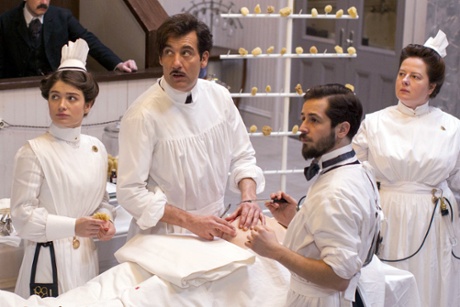
“There is simply too much television,” opined John Landgraf, CEO of cable network FX, last week, prompting applause and derision in approximately equal measure. For the purposes of this humble column, he’s right: several much-discussed recent series make their DVD debuts tomorrow, and while I’d like to weigh in on Wayward Pines or Humans, the 24-hour day has other ideas. I can, however, join the chorus of approval for The Knick (Warner, 15), which admittedly jumped ahead in my small-screen queue owing to some big-screen bias on my part: Steven Soderbergh retains must-see status in any medium for this dedicated follower.
Because of his supposed retirement from feature film-making, this 10-episode medical drama is the most Soderberghian viewing experience we’re going to get. Set in New York’s grubby Knickerbocker hospital at the dawn of the 20th century, this blood-and-guts soap has the simultaneous fascination with the clinically procedural and grotesquely human that characterises its creator’s best film work; as Soderbergh’s camera stalks corridors streaked with visceral residue, peering in close at brusquely opened bodies, it digests the life-and-death despair of passing patients as much as it does the larger anguish of Clive Owen’s brilliant (naturally), drug-addled surgeon. Given time to grow, it could become to ER what The Wire is to NYPD Blue.
This week’s film lineup, meanwhile, doesn’t make the most compelling argument for TV to cut back. Best of the bunch is The Duff (eOne, 12), a sprightly reworking of Pygmalion for high-school society — not a brand-new idea, but executed with enough perceptive, heartsore sass to separate it from a glut of similar-looking teen comedies. Much of its character comes courtesy of Mae Whitman, so winningly unschooled as a Vincent Price-fixated classroom misfit attempting to reposition herself on the intricate political ladder, while the titular acronym (short for “designated ugly fat friend”) hints at the film’s witty, complex overlapping of mean-girl perspective with outcast empathy. It’s modest, but could carve out a long-term fanbase within an overpopulated, under-challenged genre.
That’s more than can be said for The Town That Dreaded Sundown (Metrodome, 15), a stiff, tricksy attempt to remake the cult 1976 slasher with a metatextual bent that likens horror do-overs to copycat murders; it’s a superficially nifty idea that probably couldn’t sustain an undergraduate media studies essay, much less an entire film. Director Alfonso Gomez-Rejon has since won big at Sundance; perhaps he has more to offer. Liam Neeson, meanwhile, is serving up no more or less than usual in his latest gruff action workout: Irish-American mafia shootout Run All Night (Warner, 15) may not be as extravagantly daft as Unknown or Non-Stop, his two previous collaborations with director Jaume Collet-Serra, but it’s businesslike thriller filler.
More delicate options are in short supply: Kate Barker-Froyland’s insipid indie-folk romance Song One (Sony, 15) coasts on the bright-eyed chemistry between Anne Hathaway and sensitive strummer Johnny Flynn, but can’t quite sell a narrative that hinges on the life-affirming properties of musical wallpaper. At least it features less graphic goat-slaying than Still the Water (Soda, 15), Japanese sensualist Naomi Kawase’s esoteric, eco-conscious romance between fey teens on the isolated island of Amami-Oshima. Democratically braiding human and environmental circles of life, Kawase’s visions hover between the abrasive, the seductive and the frankly stagnant.
They might be surprised to hear it, but Naomi Kawase and Kevin Costner have rather a lot in common. The latter’s perennially underrated 2003 western Open Range, happily added to Netflix this month, is as idealistically dedicated to the conservation of its own natural landscape as any of its classic genre peers: there’s soul in the sagebrush. Its cattle-rancher protagonists, played with tender-terse authority by Costner and Robert Duvall, don’t battle the traditional odds for their own survival so much as that of the ground – physical and mythological – wilting beneath their feet. Twelve years on, the upside of Costner’s near-strenuous classicism is that it’s already ageing beautifully.
.jpg?w=600)