1) Strath hits two men, storms off (1876)
The 1873 Open was the first to be held at St Andrews, and the first to be played over two rounds on an 18-hole course. (The competition had previously been decided by three rounds of 12 at Prestwick.) A record entry of 26 players contested it. Tom Kidd, a local lad, triumphed with rounds of 91 and 88. The scoring was high, even by the standards of the day: Mungo Park would take 20 shots fewer the following year at Musselburgh. The cause? Driving rain had turned the Old Course into a quagmire, though the local press hesitated before finally admitting any imperfections. “The putting greens were in fine condition,” one paper insisted, before finally, reluctantly, conceding downpage that “pools of water on the greens added considerably to the hazards”.
Unlike the recent US Open at Chambers Bay, nobody harped on and on and on and on and on and on about the imperfect putting conditions. Instead, it would be another three years before the Open’s – and golf’s – first big toy-pram divestment scenario. The second Open to be held at St Andrews, the 16th overall, was a farce from the get-go, with the organisers forgetting to book the Old Course for the tournament. Oops! This meant pairings had to be squeezed in between meandering groups of ordinary folk out for their weekend hack. One such punter, an upholsterer called Mr Hutton, was hit upside the head by Open competitor Davie Strath, who hit a wild one from 14 towards a parallel hole while chasing down Bob Martin’s clubhouse lead.
Strath already had four top-five Open finishes to his name, and this looked like being his year. Up until 14, he’d been going well. But though Mr Hutton was able to traipse gingerly back to the clubhouse, the incident disturbed Strath’s equilibrium. He bogeyed the hole, then dropped another at 15. Still, with a couple of holes left, his destiny remained in his own hands. A pair of fives would do it. Strath’s third into 17 looked like scampering on to the eponymous Road running behind the Hole, but the ball hit a member of the group ahead, who had taken their sweet time to vacate the green. Two putts, and that was the first five marked down. But Strath got snagged up in the Valley of Sin at 18, and took six. Never mind, he was still in a play-off the next day.
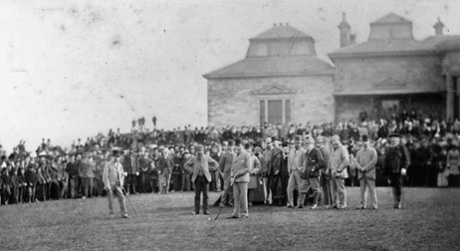
Ah but. The R&A hadn’t only – this is worth repeating – forgotten to book tee times for the Open. They’d also failed to appoint a referee to adjudicate any contentious decisions. And a protest had been lodged by cronies of Martin regarding Strath’s approach to 17, arguing that the player had benefited unfairly from hitting the slow mover, thus avoiding the road. It was nothing more than a breach of etiquette, and would doubtless have been waved away, but the R&A in its infinite wisdom refused to rule until after the play-off, which would be played “under protest”. Strath argued there was no point playing another 18 holes if he was just going to be disqualified at the end of them, and so stormed off in high dudgeon. Martin walked the 18 holes on his own the day after and was awarded the trophy.
Strath had another go the following year at Musselburgh, but the title remained elusive. He came fifth, six shots behind Jamie Anderson. It was his final Open. Two years later, suffering from tuberculosis, he took a boat to Australia, hoping the sun would provide a cure. But laryngitis set in, and he died soon after disembarking. Martin’s victory, meanwhile, was destined to appear with an asterisk attached, so it’s nice that his presence on the Open roll of honour was later validated by another, far less controversial, win at St Andrews in 1885.
2) Jones melts down in bunker (1921)
Jock Hutchison won the 1921 Open. It’s fair to say his victory turned the tide. It was the first time an American lifted the Claret Jug, at a point in time where Scotland already had 39 wins under her belt. Since then, only Sandy Lyle and Paul Lawrie have taken the Open back to the old country. But the folks from the US have kept on truckin’. Phil Mickelson’s win at Muirfield in 2013 nudged the States ahead in the all-time list for the first time, the Americans now 42 up. So for setting the ball rolling, hats off to Hutchison – who, rather deliciously, was only a naturalised American, having been born and brought up (where else?) in St Andrews.
Hutchison was a deserving winner in 1921, coming home early to study the course, and utilising deep-grooved pitching clubs to gain extra bite on greens that were running fast and hard. He aced the short 8th on his first round, and very nearly followed it up with a second hole-in-one in a row at the par-four 9th, driving the green, his ball scampering to within a couple of inches of the hole.
He handsomely won a play-off against the amateur Roger Wethered by nine strokes. Mind you, Wethered would have won outright had he not incurred a penalty during the third round for stepping on his ball. The crass error was unlikely to have ever kept him awake at nights, though, if his attitude to the play-off is anything to go by: he took quite some persuading to hang around for it, a game of cricket having been arranged back home.
An eventful enough Open, then, yet it’s probably best remembered for the Open debut of Bobby Jones. The 19-year-old American was the low amateur after two rounds, after which the Old Course showed its teeth. In the third round, Jones took 46 shots across the front nine, then another six on the 10th. And then on 11, having taken four shots in a bunker, he ripped his scorecard into tiny pieces, sent them scattering into the breeze, and stomped off wearing a look later described by onlookers as “puzzled dislike”.
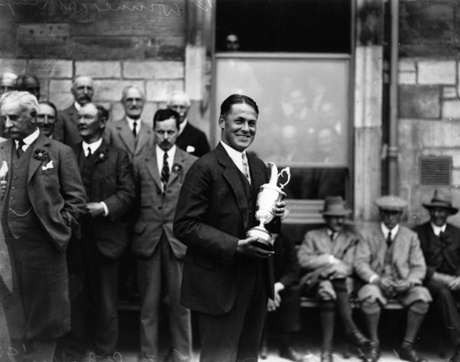
The greats have a way of turning things around, though, and the next time Jones came to HQ, for the 1927 Open, he shot an opening round of 68, eventually winning by six strokes, having led wire to wire. In his dotage, he explained how a drastic change of attitude led to a drastic change of fortune. “The Old Course is like a wise old lady,” began the wise old man, “whimsically tolerant of my impatience, but ready to reveal the secrets of her complex being, if I would only take the trouble to study and learn. The more I studied the Old Course, the more I loved it and the more I loved it, the more I studied it. There is always a way at St Andrews, although it is not always the obvious way.”
Incidentally, that bunker Jones lost his mind in paid no heed to star names. Twelve years after Bobby’s brain-melt, in 1933, Gene Sarazen found himself stuck in there too, and took three to get out. He lost that Open by one shot.
3) Slammin’ Sam slams St Andrews (1946)
Bobby Jones is not the only US superstar to have taken an instant dislike to the Old Course. Enter Sam Snead, harrumphing his way up the east coast of Fife in a right old stew. “What is this place?!” he spluttered on first sight of St Andrews. “That looks like an abandoned golf course over there.” In fairness, this was 1946, and the course was only in passable condition thanks to the efforts of German prisoners of war, so Sammy wasn’t being egregiously unfair in his Slammin’. Nevertheless, the course could have been so pristine as to make Augusta National look like a peat bog, and yet Snead wouldn’t have been any happier to be visiting. He didn’t hold the Open in high regard, and was rumoured to have only agreed to play at the behest of Wilson Sporting Goods, to whom he was contracted, and who were interested in giving British sales a boost.
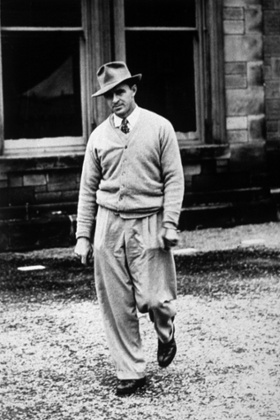
Snead was also unsure that his occasionally skittish putting stroke was reliable enough to pass muster on the Old Course’s huge double greens (a set-up which he also considered beyond ridiculous). But he was given a few tips by the old master Walter Hagen and, subsequently becalmed, agreed to play. It proved a fine decision: Snead, benefiting from his prodigious length, accurate driving, and ability to fire long irons into the wind, was by far the steadiest golfer over the three days and four rounds, winning the tournament by four strokes from Bobby Locke and his good friend Johnny Bulla.
Bulla may well have rued his troubles at the Road Hole during the tournament, where he took seven and six. He might also have regretted three-putting 16, 17 and 18 on his final round. But he must especially have questioned his persistence in persuading his pal Snead to come over and compete. (Bulla himself loved the Open.) A textbook case of self-sabotage.
Snead never really changed his opinion of St Andrews or the Open, his mood not helped when his caddy requested the winning ball for posterity, then immediately sold it. Did he enjoy his visit? “Whenever you leave the USA, you’re just camping out,” came the gruff reply. But it was a harsh analysis, given how good Scotland had been to him. After all, in time, that Open win became a crucial component of the Snead legacy, especially as the great man would never get his hands on a precious US Open.
4) Peter Alliss > Arnold Palmer (for one day) (1960)
The Centenary Open, at the home of golf. But the great British celebrations were overshadowed by a brash American. Arnold Palmer had just won the Masters and US Open, and fancied his chances of matching Ben Hogan’s three-major slam of 1953. Only this time, because there was no schedule clash between the Open and the PGA, he had a chance to go all out for all four. The grand slam. Or, as it was once known, the Impregnable Quadrilateral of Golf.
The Impregnable Quadrilateral of Golf! It never gets old, does it. Grand slams are two a penny in professional sport; golf’s marketing gurus are missing a trick by not reviving this one, you know.
But the Open organisers were more than happy that this brash American was here to overshadow their celebrations. Because the Open, 100, had dramatically slipped in status since the war, ignored by US players who would rather compete in the money-spinning PGA and didn’t fancy a long, expensive journey which promised little coin at the end of it. (Sam Snead famously complained that his travelling expenses in 1946 exceeded his prize money, though of course the notoriously parsimonious Snead never did factor in the extra endorsements that came his way.)
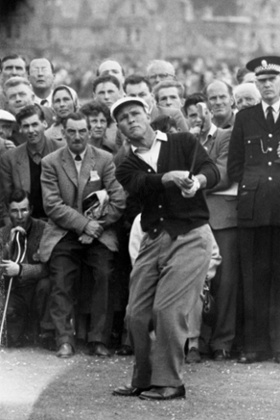
But Palmer sussed quickly what Snead never quite grasped: that the Open was, for all its idiosyncrasies, a must-win for any player with posterity in mind. Over he came, in a blaze of publicity, and shot 67 in one of the pre-tournament qualifying rounds. But it never quite worked out for Palmer in the tournament proper. He was there or thereabouts for the entire week, but always just off the pace, first lagging behind early leader Roberto De Vicenzo, then trailing eventual winner Kel Nagle. Palmer ended up in second place, a shot off the lead. Three three-putts on the Road Hole had proved his undoing.
So no Impregnable Quadrilateral for Arnie. Which was a shame, as his mere presence had given the Open a huge shot in the arm. The other Americans started taking notice again, their biggest stars trooping over from here on in. Palmer won the Open in 1961 and 1962. Tony Lema triumphed in 1964 and would surely have won more but for his untimely death in a plane crash. After which focus shifted to the emerging Jack Nicklaus, with Lee Trevino and Tom Watson not too far after him.
But there’s a lesson in Palmer’s near miss of 1960 for the grand-slam-seeking Jordan Spieth: they don’t call that Quadrilateral impregnable for nothing. And St Andrews, especially the 17th, won’t give you anything for free. Heed also the fate of poor Peter Alliss. The legendary BBC commentator was some player in his prime, and on the day Palmer shot that 67 in qualifying, Alliss broke the Old Course record with a 66. Then, when the tournament began, he carded a 79 and went on to miss the cut.
5) Bunkers and lofts (1978)
Who was the star of the 1978 Open? Well, by rights it should be Jack Nicklaus. He’d just failed to win the previous year’s duel in the sun at Turnberry, despite shooting 65 and 66 on the last two days. Tom Watson, with a pair of 65s, improbably bettered him. It’s the sort of defeat that would have finished a lesser man, but Nicklaus bounced straight back a year later at St Andrews, holding firm over the closing holes while the ostentatiously moustached Simon Owen crumbled, a pair of 69s over the final two rounds giving him a fairly comfortable victory. It was a 15th major for a player they said was past winning.
Maybe someone will write the same sentence one day about Tiger. Here’s hoping. But we digress.
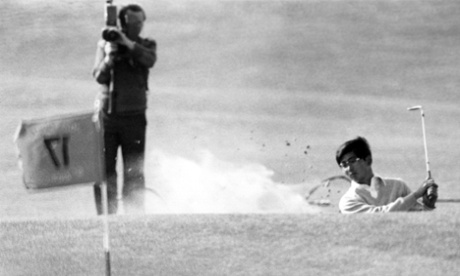
Perhaps the real star of 1978 was Tsuneyuki ‘Tommy’ Nakajima, who in the third round, one stroke off the lead, took four to escape the Road Hole bunker and left with a quadruple-bogey nine. His chances lay in tatters, his head gone, thanks to a trap quickly and wittily restyled as The Sands of Nakajima. Two things are often forgotten about Tommy’s troubles. First, that he’d actually been on the green in two, but had misjudged the borrow and putted into the sand. Second, that he wasn’t the only player to come a cropper on the infamous hole that day: there had been two triple-bogey sevens, 11 double-bogeys, 48 bogeys, only 18 pars, and no birdies. A true hell hole.
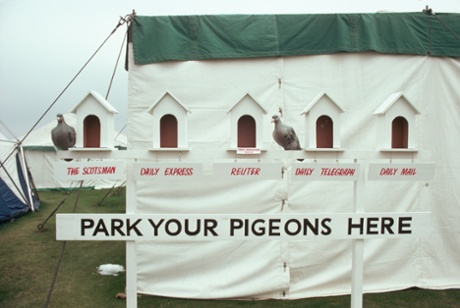
But our vote for Man of ’78 goes to the R&A secretary Keith Mackenzie, who came into his own after a telecommunications strike during the run-up to the Open. No additional phone lines could be set up for the big event, a state of affairs which caused great consternation in the press centre. Mackenzie snapped into action – but only to get a local carpenter to construct a pigeon loft outside the media tent. “Park your pigeons here,” read a tinder-dry sign. The fourth estate were thus forced to skitter hysterically into St Andrews each day to phone in their copy from local pubs, restaurants, hotels and shops. They weren’t smiling while they were doing it, either.
It is fair to say Mackenzie enjoyed baiting journalists. But then, who doesn’t? Even journalists enjoy baiting journalists.
6) Seve and Tom (1984)
At St Andrews in 1984, Tom Watson aimed to become the first golfer since Peter Thomson in the 1950s, and only the fourth player of all time, to win three consecutive Open Championships. He was also aiming for six Open titles overall, a record that would take him to the top of the roll of honour alongside Harry Vardon.
He gave it a bloody good go, too. He shot 66 in the third round, and went into Sunday as joint leader alongside a young Ian Baker-Finch, and two shots clear of Seve Ballesteros and Bernhard Langer. It was a stellar cast, though in the final round Baker-Finch crumbled to a 79, while Langer started with a birdie but never really got going after that. It would turn into a duel between Ballesteros in the penultimate pairing, and Watson in the last group.
Both men reached the Road Hole at 11 under par. Ballesteros was up first, and naturally he winged his drive into rough. But he lashed a six-iron to the front of the green, lagged his putt to the side of the hole, and escaped with a par. He pearled his drive down 18, then glanced back down the 17th, where Watson had split the fairway. “Well,” he thought to himself. “Watson is on the fairway, and Watson is Watson. He is going to make a par and he can make a birdie at any time.”
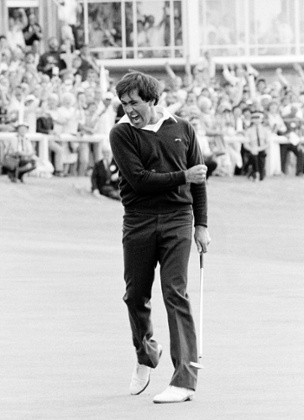
But Watson did not make birdie. And he did not make par. He pushed a two-iron through the back of the green and on to the road, the ball cannoning off the wall and stopping a couple of feet in front of it. Watson jabbed a chip up on to the green, but as he sized up his par putt, a roar went up on 18. Ballesteros had chipped to 15 feet, then sunk the putt. Seve pummelled the air with his fist – ¡Yé-yé-yé-yé-yé! – and Watson knew the jig was up. His par putt slid by. The bogey five was a damn fine result from down by the stone wall, but not good enough in this context. A par up the last, when only an unlikely eagle two would do, and Seve had landed his second Open.
Watson never won another major, though he’d come a yip away from equalling Vardon’s Open record as a 59-year-old at Turnberry in 2009. But it’s too early to talk about that painful day. It’s still far too raw. Ask us again in 2109 perhaps.