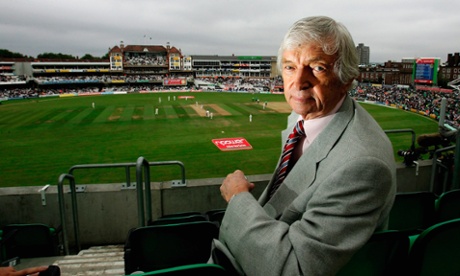
1) Richie Benaud, 1960 – present
Given that the purpose of the Joy of Six is not to rank things or necessarily pick the best, it’s pretty tempting to ignore the obvious, to cock a snook at the first thing that comes to mind. It’s a little like making a compilation C90 cassette (ask your older brother how he tried to get girls to like him at school) and not putting the Beatles or Nirvana on there; or at least if you do, picking the Kinfauns home demo of ‘Polythene Pam’ over ‘Let It Be’, or the live version of ‘Aneurysm’ instead of ‘Smells Like Teen Spirit’.
Of course though, as blindingly obvious as it might be for an appreciation of sporting commentary, you can’t ignore Richie Benaud. The theory behind having former sportsmen in the media is that they should have a greater appreciation of the game, having played it to a serious level, than any old mug that just watches Tests dressed as a nun while getting blotted on watery lager. They should be able to spot things that we don’t see, to explain why someone might have chosen a particular shot, or a fielding position. Of course, the theory sometimes doesn’t work for assorted reasons, from inarticulacy, to apathy, to playing the game with instinct so they never really had to think about it, to an odd lack of ‘feel’ for the game.
Not Richie. He understands cricket both in the way that a fan and a player would, crucial for anyone trying to both inform and relate to your average watcher. He is wise, informative, funny and perhaps as important as all of that, understands that less can very much be more in these situations. “My mantra is: put your brain into gear and if you can add to what’s on the screen then do it, otherwise shut up,” he has often said. “What I want most from being a television commentator is to be able to feel that when I say something, I am talking to friends.” Richie’s wisdom stretches beyond mere correspondent and disembodied voice, and into the realm of spirit animal. Or Yoda.
Narrowing his commentating gems down to one is a tricky business, because there have been so many. From the Colemanballsian (“The slow-motion replay doesn’t show how fast the ball was really travelling”), to the rather risqué (“I can think of one or two ‘ucks’, Michael, but ‘snuh’ isn’t amongst them,” after Michael Slater asked if there was such a word as ‘snuck’), to the classic “Gatting has … absolutely no idea what has happened to it. Still doesn’t know” after Shane Warne’s ‘ball of the century’, or “Don’t bother looking for that, let alone chasing it. That’s gone straight into the confectionary stall and out again,” during the 1981 Test at Headingley.
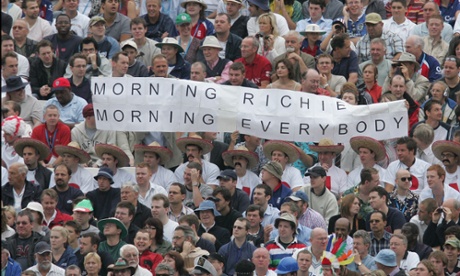
There are too many individual moments to pick just one (and for further Richie reading, see Russell Jackson’s dedicated Benaud Joy of Six, so it’s probably best to stick with his traditional greeting, the two words that let you know cricket is here, and everything is going to be OK: “Morning everyone.”
Get well soon, Richie.
2) Vin Scully, LA Dodgers v Oakland Athletics, 1988 World Series, Game One
If Benaud is the voice of cricket, an avuncular and comforting presence that anyone with any passing interest in the game can’t remember a time without, then his baseball equivalent is Vin Scully. Scully has been attached to the Los Angeles Dodgers since 1950, and is such an institution that in 1976 he was voted as the ‘most memorable personality’ in Dodgers history, which is remarkable enough for a ‘mere’ broadcaster, but for someone associated with a club that had seen greats of the game such as Jackie Robinson, Sandy Koufax and Don Drysdale, it’s astonishing.
Part of his appeal is that Scully hits that rare sweet spot between being relaxed and relatively uncontroversial but by no means boring, but it’s also his voice. Even now, aged 87, the sounds are soothing, laid-back, perfect for an afternoon or evening at a sporting event that will take around three hours to unfold in front of you. Writing on Salon.com back in 1999, Gary Kaufman said of the voice: “Vin Scully has the most musical voice in baseball … Although his timbre is thin, everything is smooth and rounded. The words slide into each other. He has flow. The melody rises and falls on the tide of the game. You can almost hum along to Vin Scully.”
Scully’s masterpiece is often said to be his call of Koufax’s perfect game in 1965, in which he spoke with such a perfect mixture of functional description and elegiac imagery that, reading it written down, you’d assume that it was an essay that took hours, days to write (particularly when he said the home fans were “starting to see pitches with their hearts” as umpiring calls went against Koufax), but it was all off the top of his head. It’s an astonishing piece of writing, never mind talking.
Yet it was his description of another great moment in Dodgers history that makes this list. Kirk Gibson had been the Dodgers’ star player through the 1988 season, but when the World Series against the Oakland Athletics came around he was in a bad way, left hamstring and right knee injuries and a stomach virus meaning he didn’t start game one, and furthermore looked unlikely to take any part in it. However, halfway through the game Gibson told the manager Tommy Lasorda that he “had one good swing in him” and was available as a pinch-hitter, so when the game reached the ninth inning with Oakland 4-3 in the lead, he hobbled to the plate, barely able to walk.
“Look who’s comin’ up!” exclaimed Scully, noting that throughout his long at-bat Gibson shook his leg, “making it quiver, like a horse trying to get rid of a troublesome fly.” Then, when Gibson finally summoned what strength was left in his ailing body and threw his bat at the ball, muscling the ball into the air …
“High fly ball into right field,” yelled Scully, the sound of a man trying to maintain his cool, almost losing it but then bringing it back under control. “SHE I-I-IS … GONE!” as the ball disappeared over the fence for the game-winning home run.
And here’s the art of great commentary, of someone who knows the game: Scully said absolutely nothing for the next 68 seconds. He understood, as Benaud did and does, that there was little he could add to this utterly extraordinary moment. He let the viewers watch 56,000 people in Dodger Stadium lose themselves, the portly Lasorda relinquish control of his limbs and just about run, astonished and flailing, to celebrate at home plate, and Gibson himself hobble around the bases, pumping his fist, eventually into the throng of his celebrating team-mates, desperately trying to stop them manhandle his disintegrating body too much.
“In a year that has been so improbable,” Scully eventually said, “The impossible has happened.” And as the replay showed the reaction of Dennis Eckersley, the star closing pitcher for the Athletics who delivered the fateful pitch: “And look at Eckersley – shocked to his toes!”
It’s often more about the notes you don’t play as the ones you do.
3) Peter Alliss, the 1977 Open
The written media have it easy, really. Even when writing a match report that has to be completed and turned in on the final whistle, there is at least a bit of time to ponder, to consider the words you’re using to tell the audience about the action. You can prune, add, improve, re-work and re-word, and present a relatively polished finished product.
Commentators don’t have that luxury, as they have to paint a picture instantly. Their first reaction is what will go out into the world, and there’s no such thing as a draft or work in progress, which is why there are so few genuinely great commentators, those who are not only able to tell us what’s going on but do so with some form of wit and art. Even in golf, a sport whose pace lends itself to lyrical, thoughtful commentary, sometimes an instant reaction is required, and when a brilliant shot is played then the heat is on to come up with something apposite.
In the closing stages of the 1977 Open, Jack Nicklaus was locked in a tussle with Tom Watson, one that the Golden Bear himself would call “the most thrilling one-on-one battle of my career”, which coming from a man who won everything and beat everyone, is quite a statement. On the 18th, Watson found the green and left himself only feet from the hole, meaning the tournament was basically won, but there was still one more piece of skill remaining from Nicklaus. In heavy rough, Nicklaus looked in a hopeless position, and here’s where Peter Alliss takes over.
“There’s Nicklaus’s ball. What a moment to be a stroke behind, with your opponent less than two feet from the hole, but Nicklaus has by no means given up the ghost. Can he get a backswing? It’ll be a miracle if he gets this out, let alone on the green … he smashes it with every sinew in his body. The crowd gallop across, Jack can’t see where it’s going to finish … going towards the front-right corner of the green … and in fact it’s on the putting surface. And that, I think is one of the most powerful … animalistic golf shots I’ve ever seen.”
The TV commentator’s job isn’t really to describe the action in a way you can see without actually watching with your own eyes, but that’s what Alliss did. When you can add something, do so, especially when using a word and an image like ‘animalistic’ that most of us would never have thought of, but is still evocative and perfect.
4) Mark Nicholas, England v Australia, third Test at Old Trafford, 2005 Ashes
It’s easy to forget that commentators are often just fans with microphones. Of course you expect a level of professionalism and impartiality, but sometimes, just sometimes, they can get caught up in everything, forget they’re being paid to be neutral and just lose themselves.
The 2005 Ashes is called the greatest series ever because … well … because it is. It’s difficult to imagine that such a confluence of events will ever happen again; an improving England side just reaching their apex as Australia, containing a smattering of the best players of all time, were just starting to decline, 18 years of complete dominance from one side and four such incredible, spine-tinglingly dramatic Test matches.
On the final day of the third Test at Old Trafford, Australia were battling for a draw when Ricky Ponting came to the crease. At one end, wickets tumbled as Australian batsmen scored 14, 36, 19, 4, 39 and 12, while at the other Ponting compiled the sort of century that makes those questions about his skill as a captain seem basically irrelevant. When you can score crucial runs at moments like this, with the players he captained, it hardly matters that he wasn’t exactly Mike Brearley. With five overs and two wickets, including Ponting’s own, remaining, it looked like he would lead his team home and a nation in a colossal relieved sigh.
Mark Nicholas can be regarded as a figure of fun, a character from a Jeeves and Wooster novel, a little too fond of his own voice and hair who buffs the brass buttons on his navy blazer. His commentary style was and is full of Nicholasisms, from the simple and splendidly posh ‘Oh yah,’ after a good shot, as if praising a good claret or fine cheese, to exclaiming “THAT, is [insert name of elegant batsman, once Michael Vaughan but since going native with Channel Nine in Australia, Michael Clarke]”, to the hyperbolic “ONE OF THE GREAT CATCHES/BALLS/SHOTS”. As a commentator he can be difficult to warm to, not least because his words tend to feel a little forced, a little rehearsed, like he’s reading lines from a script rather than reacting spontaneously.
Thus, when Ponting groped at a loose Steve Harmison ball somewhere around his hip, flicking through to Geraint Jones, and eternities passed and stars died in the time it took Billy Bowden to raise his bloody finger, Nicholas’s reaction was delightful in how unexpected it was.
“HE’S GIVEN IT OUT! OUT …! RICKY PONTING IS OUT! IT’S IMPOSSIBLE TO KNOW WHAT TO SAY.”
Nobody knew what to do with themselves. Ponting stood there distraught, unable to believe what he’d just done, the England players charged around like lunatics and a stadium of fans completely lost their thread. And so did Nicholas. For a moment he wasn’t a broadcaster but a fan, someone who just loved the game and became so caught up in it all that he couldn’t find any cogent words. For a man like Nicholas, it was all quite endearing.
5) Jack Karnehm, 1983 World Snooker Championship
Likewise, it’s not exactly surprising that some commentators can get emotionally involved with the sportspeople they watch. Not in the biblical sense, although there was always something of an unspoken frisson between Geoff Shreeves and Alex Ferguson. When this happens, it’s quite understandable that commentators simply wish competitors well on a human level – it’s not necessarily that they support the team they play for, or jingoistically bang the drum for the country they’re representing, just that they want someone they admire, or know, to do well.
One thinks of Harry Carpenter imploring Frank Bruno to “Get in there Frank!” when it looked like he might actually hurt Mike Tyson, and indeed his post-fight interview, which was even more touching, telling the boxer who had come to be a friend as well as subject: “You’ve taken it well Frank, and we all admire you. You know that, don’t you?” Then there’s Murray Walker, at the end of the 1996 World Championship, saying: “And Damon Hill exits the chicane and wins the Japanese Grand Prix … and I’ve got to stop, because I’ve got a lump in my throat.” Walker, who had followed Hill’s career from the start and knew him well, later described it as “the most emotional moment of my broadcasting life” and that the “lump which appeared in my throat was completely genuine”.
Perhaps the simplest of these came in 1983 at the World Snooker Championship, when Cliff Thorburn was on his way to completing the first ever televised 147 break. “There will never be another moment in Cliff’s life when he’s going to be so tense as this,” said commentator Jack Karnehm as Thorburn lined up the final pink. Then, after the pink disappeared, the applause from the knowledgable Crucible crowd (John Virgo™) died down, and Thorburn pulled back his cue for the last black, Karnehm whispered: “Oh, good luck mate.” That pot, the black off its spot, was one that in normal circumstances most snooker hall players could sink in their sleep, never mind a world champion, but in that moment the tension must have been unbearable. To miss would have not so much been a humiliation as a colossal gut-punch, a moment to floor even the most hardened competitor, and in simple, human terms Karnehm not only wanted to see Thorburn achieve this feat, but avoid the crushing awfulness of missing.
6) Bryon Butler, Barry Davies and Victor Hugo Morales, 1986 World Cup
Usually a great sporting moment will produce one great piece of commentary, but Diego Maradona always was more fond of excess, and his goal against England in the 1986 World Cup gave us three. And here they are, without any further ado or whiffle:
Maradona, turns like a little eel, he comes away from trouble, little squat man … comes inside Butcher, leaves him for dead, outside Fenwick, leaves him for dead, and puts the ball away … and that is why Maradona is the greatest player in the world” – Bryon Butler, for BBC Radio.
“Here’s Maradona again … he has Burrachaga to his left, and Valdano to his left … he doesn’t … he won’t need any of them … OH! … you have to say that’s magnificent. There is no debate about that goal. That was just pure football genius” – Barry Davies, for BBC television.
Maradona has the ball, two mark him, Maradona touches the ball, the genius of world soccer dashes to the right and leaves the third and is going to pass to Burruchaga. It’s still Maradona! Genius! Genius! Genius! Ta-ta-ta-ta-ta-ta-ta. Goooooaaaal! Gooooooaaaaal! I want to cry! Dear God! Long live soccer! Gooooooaaaaalllllll! Diegoal! Maradona! It’s enough to make you cry, forgive me. Maradona, in an unforgettable run, in the play of all time. Cosmic kite! What planet are you from, to leave in your wake so many Englishmen? So that the whole country is a clenched fist shouting for Argentina? Argentina 2 England 0. Diegoal! Diegoal! Diego Armando Maradona. Thank you God, for soccer, for Maradona, for these tears, for this Argentina 2 England 0” – Victor Hugo Morales, Radio Argentina.
- With thanks to Scott Murray, who also wrote a Joy of Six on football commentaries you should read.