1) The Tao of Sheahan
We’ll start with an unqualified statement, presented more as opinion than fact and let you decide for yourself: Fox Footy’s Open Mike is the best ever AFL TV show. Is that a shallow field? Most definitely, and to be absolutely truthful Open Mike is not without its occasional faults, but it’s deftly established itself as the best oral history of the modern game.
You also have to consider the AFL media landscape in which this show came to exist; one that is stuffed to the brim with big heads and raging egos but light on humour, humility and (intentional) pathos. This problem isn’t unique to AFL obviously, but bluff, bluster and strident opinion mostly drown out nuance and subtlety so a program as stripped-back and slow-paced as Open Mike is a revelation, filled from minute one to minute thirty with buzzword-free footy talk of a high order.
You learn something new nearly every time you watch an episode of Open Mike. How many footy shows can make that claim?
The ‘less is more’ formula is simple: take an interesting character and let them speak for themselves about football and life. Mostly it’s a reminder that football actually isn’t life after all. Host Mike Sheahan prods and pokes where appropriate but rarely inserts himself into the action and avoids the common pitfall of talking over guests or letting them dictate the conversation.
Jokesters are indulged and encouraged to a point, which can be great TV itself, but then Sheahan will shift a gear and knock them off balance like a fencer with an unexpected thrust and they’re out of the comfort zone. The results are often moving, sometimes shockingly so. For 10 minutes John Barnes is the definition of sportsman’s night jocularity; a binge-drinking lunatic breaking into team-mates’ houses as a practical joke. Seconds later he’s fragile; diagnosed with epilepsy, losing both his brother and his job within a 12-month period and then cleaning up his act as a garbo. Sheahan has a knack for sad clowns but rarely exploitatively so.
Elsewhere there are deep reservoirs of emotion and heartbreaking life lessons in unexpected places. John Kennedy Jr is in the back of an ambulance using two fingers to pump the heart of, and then losing, his 10-week old son. Allan Stoneham’s episode starts with a technicolour highlights package that wouldn’t be out of place in ‘The Sensational Seventies’, but soon he’s both emotionally and physically overwhelmed by the harrowing experience of his son’s murder conviction and the loss of a treasured life. The latter, like many episodes, treads a fine and uncomfortable line but in Stoneham’s rawness, honesty and compassion for the victims’ family (in my opinion, though not in others’, it must be said) above himself, it never loses perspective.
That’s perhaps the greatest triumph of the program; not only do we revel in the glamour and the glory of the game, but we’re also dragged fully into the emotional mire when things turn sour. Some guests find catharsis. Others resist honest examination and come off second best, giving a rare glimpse into the way sport intersects with real life, both good and devastatingly bad.
Yes it is a bloke-fest, as you’d probably expect (how awful that we never got a Jill Lindsay episode – what stories she could have told) but it’s never monotonous. Open Mike is a Greg Williams handball where most footy shows are a John Butcher set shot.
One other thing that’s probably worth noting by way of introduction; isn’t it wonderful that Sheahan, even if he’s sitting on AFL media’s Mount Rushmore either way, will be remembered for something other than his once-groundbreaking but now dated and thus mercilessly-mocked annual Top 50 players list? Open Mike is a monument to the stories and characters that have made Australian Rules football great and a journalist of remarkable staying power. The only sorrow is that nothing else even comes close.
2) Ricky McLean
One of the great joys of Open Mike is the insight it gives us into the lives of genuinely unique characters who sit at the periphery of footy history and they’re people whose stories would not otherwise reach such an audience. Naturally enough, football media tends to focus on the superstars and heavy hitters for the most part, but Sheahan’s penchant for offering up cult figures and master storytellers is probably unmatched on Australian sports television. The road less travelled throws up some of the show’s best moments.
Of this genre, Ricky McLean was never less than intriguing. Cast as a talentless thug in his time as a player, McLean pleads a case for looking beyond stereotypes in one of the series’ unexpected gems. An exploration of his friendships with “colourful characters” like Des ‘Tuppence’ Moran and Mick Gatto certainly doesn’t dispel the theory that the former Tiger was a ne’er do well. There’s no suggestion that McLean was of the Tony Soprano school himself, but Sheahan plays the role of Dr Melfi in this one and expertly so, drawing all of the emotion out of McLean in a fascinating look at friendship and loss.
“The person [Moran] that I knew, you’d love to have as your best friend and I miss him,” says McLean as he holds back tears. Not much of it passes the sniff test, but as ever Sheahan gives his guest enough slack for the rest of us to make that decision for ourselves.
3) David Schwarz
There is a certain skill to making something compelling from well-worn material and Sheahan possesses it. David Schwarz’s time in the spotlight starts with police knocking on his door before the 1994 elimination final seeking a $7,000 cheque for outstanding warrants and the pace never lets up, not even through three knee reconstructions.
“Why did it happen to my Dad?” ponders Schwarz, thinking back to when he was an eight-year-old kid in country Beechworth who watched on as his father is slain in cold blood. “I always thought that Dad would walk back through the door one day…. Sometimes things just aren’t fair. I was 31 before I grieved.”
By the age of 14 he’s hooked on punting. Horses, dogs, trots, casinos and pokies eventually strip away every cent he’s ever earned in football and then some; up to $5m before he finally confronts his addiction. “If I didn’t give up the punt I’m dead or in jail, it’s as simple as that,” he says at one point.
The figures are mind-blowing. Schwarz wins $700,000 in a day at Flemington and just under $1m in the space of three weeks then almost inevitably loses the lot within a matter of months. You shake your head in amazement as he’s checking race results on the MCG scoreboard in the middle of games. The lows are staggering and Schwarz’s shame at punting away his son’s christening money palpable.
Mostly it’s honest self-examination though Schwarz also takes aim at the league along the way. “I believe that the AFL is drunk on the revenue they receive from gambling agencies,” he says, “and until that goes we’re in trouble.”
4) Doug Hawkins
Another admirable achievement of Open Mike is that in many cases it forces you to reappraise the legacy of individuals whose number you thought you had. I didn’t think I’d ever need to hear another word from the mouth of Footy Show clown prince Doug Hawkins, but freed from his barely-literate oaf shtick, Hawkins reveals himself as a far more complex and thoughtful character than it seemed.
There’s a spiral of alcoholism after Hawkins does his knee. At just 26 ‘The Hawk’ loses his job and his fiancé and hits the bottle hard. The regular narrative of ‘Dashing Dougie’ is turned on its head. Having always been made to feel as though Hawkins’ blood was blue, white and red, it’s fascinating to note the hesitation and regret that he didn’t take up an offer to shift to Essendon in 1982, thus missing the taste of Premiership success. Quite necessarily, current players just can’t offer that same healthy measure of honesty.
Where Hawkins’ story touches a nerve most though is in the period immediately following his playing days, when the dye was being set on his larrikin media persona. “I think I have a pretty good footy brain,” he says, lamenting that the public came to know him merely as “the goose on the Footy Show.” He might not have been an AFL coaches clipboard, but Hawkins never got the chance to find out either way and it’s clear that it stings deeply. That insecurity and inability to avoid his fate make for an endearing character.
Hawkins finishes the interview wiping away tears and it’d be a hard-hearted footy fan who didn’t ride a few of the bumps with him.
5) The Bad Ones
In fairness there are genuinely ‘bad’ episodes of Open Mike, but they’re not cringeworthy due to the format or line of questioning from Sheahan but because of the unlikeability of the guests themselves. Even that has its own rewards and moments of illumination, but unfortunately it can tend to confirm pre-existing prejudices about certain characters.
Mal Brown is every bit the boorish thug and unapologetically offensive man we assume him to be; not so much brushing aside accusations of racism and senseless violence as doing his unrepentant best to prove that the rest of us are just oversensitive squares who don’t understand the rough-edged philosophies that have paved his bruising path through life. You almost feel sorry for his son and protégé, Hawks premiership player Campbell. Almost.
Others send you through a loop. Des Tuddenham starts well enough in his own unapologetically arrogant way, making you understand the bloody-mindedness that made him a star, but everything unravels when he shuts up shop to less flattering lines of questioning. It’s not the only train wreck.
6) Nicky Winmar and Gilbert McAdam
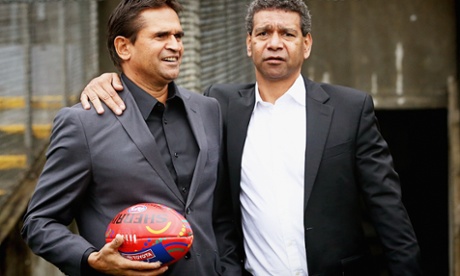
No episode of Open Mike has been more powerful nor encapsulated the impact a game can have on society than Nicky Winmar and Gilbert McAdam’s appearance. Rarely heard from in the media during or after his career, Winmar offers some rare and telling insights but it’s McAdam who emerges as a stirring voice of Indigenous football.
Given the time and space to talk seriously, McAdam’s passion for the game and his people – and his precision with hitting targets – leaves the viewer wondering how he hasn’t risen further in public life. “I can’t speak for Nick but being an Aboriginal person, I felt that it was my obligation to fly the flag for our people,” he tells Sheahan. “Every time I stepped foot on a football field I didn’t play for Gilbert McAdam or St Kilda football club or the Brisbane Bears footy club, I played for my people.”
There are some awkward moments as Sheahan pushes McAdam further, seeking his opinion on white Australia. “My [emotions] are coming from a pretty powerful background because my father was a stolen generation. My father actually got taken away from his mother in a gum tree and got taken to a place called Moolaboola, a Western Australia government concentration camp… I know what my people have gone through, especially my father… It brings up deep wounds and makes you angry.”
We learn of the death threats the pair received in the wake of Winmar’s famous gesture towards the Victoria Park crowd in 1993. “Brother, burn it and throw it in the bin,” McAdam tells Winmar, who fears for his life. The pair are incendiary at times. “It’s like we’ve gotta prove ourselves all the time,” says McAdam. It’s both a statement and suggestion.
Winmar is certainly not comfortable in the spotlight, hence his general reticence to appear in the media, but thanks to McAdam he comes out of his shell when he’s able to riff off his old team-mate. Their banter is a real joy and makes you wonder why no-one else had put the pair in front of a camera sooner.
Overwhelmingly you get a sense of how tough these guys had it and how the racial abuse they received on the field affected them as people. Still, both retain an optimistic outlook on humanity and remarkably good humour. When Winmar talks of being vilified by Dermott Brereton and then being suspended for 10 weeks himself for lashing out at the Hawk (kicking and eye gouging him) he does so with a smile. “He owed me 10 weeks’ wages,” laughs the champion Saint. It’s magnanimous but you wince as well.
More than being thankful for how far the game as come, when Winmar is talking of the way those suburban grounds turned boys into men, there’s also a lingering sense of shame that it was ever so. As is so often the case on Open Mike, the beauty and brutality of the game is effortlessly laid bare and the only thing you’re left wanting is more.