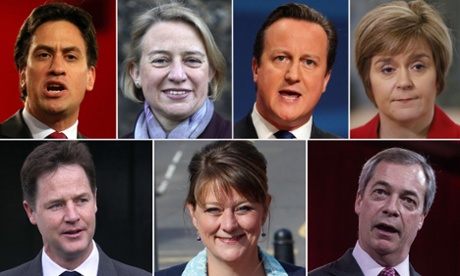
This TV debate row long ago descended into something less entertaining than farce. More like the closing stages of Strictly Come Dancing, but without the sparkly bits. So, in a gravity-defying lift, David Cameron has spun the political world over his head and across his back and declared he will after all take part in a single TV debate involving seven of the other parties (obviously, not all the other parties. Mebyon Kernow: I think you have been traduced)
The debate, if it can possibly be anything of the kind with seven people all trying to make a point and not respond to anyone else’s, is scheduled for 2 April, just in time for the Easter holidays and just before the Tories’ self-imposed deadline, which was the start of the real, four-week campaign.
The layers of tactics and strategy, party political and just political, will one day be unpicked by a pimply student looking for a third-year dissertation. Personally, when it got to the point where Ed Miliband was promising to legislate to make participation in leaders’ TV debates a statutory obligation, I seriously considered going to bed and staying there until 8 May. Boys: this is not what politics is for.
There may possibly be something in favour of fixed-term parliaments (although in Israel Netanyahu has just proved there is definitely something to be said for the snap election) but this prolonged pre-campaign charade is not it. The inordinate, petty, pathetic prancing, preening and posturing is a cruel parody of the deadly seriousness of what they should be arguing about.
For months, it seems, this wretched surrogate for the proper argument has simply magnified the inability of the participants to find a way of engaging voters in the real and important question of who governs and what for.
By their very nature, elections have to begin with a fight for attention. Equally obviously this is much harder than it used to be now there are so many other more interesting things to do, compared say with the days when an innovative political party could park a mobile cinema on the village screen and guarantee 100% turnout for a party political broadcast where politicians spoke in subtitles.
It’s also a product of – well, everyone has their own list – but for me it’s the refusal of clever, well-educated people to do us voters the courtesy of speaking in properly constructed sentences that engage with the subject at hand in a considered way that reflects the possibility of alternative points of view. See, for example, the SNP leader Nicola Sturgeon’s speech about budget making earlier this week at the LSE.
I realise that you can’t do that all the time, and there are occasions when politicians need to let rip with all the rhetorical prejudice they have been storing in their bile duct. That’s fun too. In fact, anything is better than the artificial over-emphatic simplistic bilge that they all churn out. Or the alternative, which is the sofa simpering (David Cameron yesterday with Susanna Reid for the latest version) the party leaders deploy to try to sound like likeable blokes with three kitchens. Oh, whoops, not kitchens again.
This deal is not a good solution. Of course, Cameron should go head to head with Ed Miliband. Once again, the voters are shortchanged. But this long, dreary argument has really been all about and only about tactics, about who gains and who loses from what configuration of which parties. Miliband might have the moral high ground this time. But Labour’s ducked debates too for just the same reasons.
It’s all about jockeying for position. Hold that thought. There’s always a chance that it will turn out to be less like the final throw of Strictly, and more like the start of the Grand National.