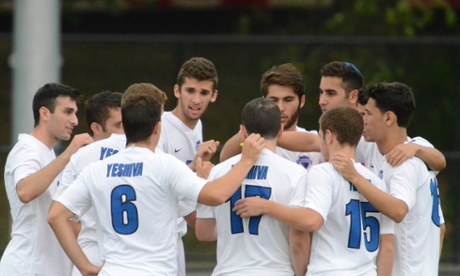
Before we go any further, we should clear up any possible stereotypes you might have of the Yeshiva University men’s soccer team – particularly those influenced by Woody Allen or Mel Brooks films.
The Maccabees do not wear payis and heavy beards, and they do not break into prayer during matches.
But they are passionate about their religion and their studies, as well as the beautiful game. And they have turned into the surprise team of the Skyline Conference, sitting atop behind a 2-0-1 start; they are 3-3-1 overall.
At one time, you might have said that the Maccabees did not have had a prayer of being successful. They entered this season with an abysmal 5-64-2 conference record over the past eight years. Though they cracked the .500 barrier for the first time in 2014 (10-7-1), they finished out of the conference playoffs at 2-5-1.
But now the team is talking postseason for the first time.
“I would be surprised if we weren’t there,” said team captain and defender Joey Krombach, a Los Angeles native.
Yeshiva is not your everyday NCAA Division III soccer team. The New York school is known for training rabbis, but it also has opportunities for other academic pursuits.
The soccer team faces more than its share of challenges. The players must take a double academic load. The team has to bus to practices and games from Manhattan across the George Washington Bridge to Votee Park Sportsplex several days a week. They cannot play on Friday or Saturday, and usually have a break right smack in the middle of their schedule because of the Jewish high holy days.
In other words, it’s not for everyone.
“It’s hard. It’s tough,” Krombach said. “With a dual curriculum, we’re choosing to be here because we care about the Jewish values in our everyday education. We make time for it.”
“It’s incredible,” coach Josh Pransky said. “I stress to them all the time, from the earliest recruiting conversations on, [that] is not a party school atmosphere. The only people who are successful here are driven, mature, committed individuals who are able to manage their time. You basically you have to DVR every show you want to watch until after the season. You have to tell your girlfriend, ‘I’ll call you in November.’ And you’ve got to buckle down. You’ve got to study on Saturday nights, you’ve got to get your sleep in.”
That’s because every player faces long days. Jewish studies run from 9am to 1pm. After lunch, the traditional college courses go through 8pm.
“It’s good preparation,” said native New Yorker and junior midfielder Sasha Bakal-Schlomann. “During soccer season, you pretty much have time for school and soccer and that’s just about it. but it helps you with time management. It’s a learning curve. but I think it’s very good for the real world.”
Freshman defender Chino Grobman added: “You get used to it. If I didn’t have soccer, I would feel like I had too much free time and I would get bored. I’ve been playing soccer since I’ve been a little kid. It’s part of your schedule.”
All that work doesn’t necessarily leave that much time to play, or in this case, practice. Yeshiva training sessions usually are held at night from 8.30-10pm at Votee.
Early practice sessions are out of the question because some players are in morning prayer sessions.
“I can’t guarantee they won’t get stuck in hours of traffic getting back into the city,” Pransky said. “I can’t do that to them. The only thing I can do is run a 6am practice in the gym or the weight room or the pool, the only facilities on campus. I can’t even run a small sided practice session on campus itself.”
Many home games are at noon Friday – to get back to Manhattan before sunset – and 8.30pm on Sundays.
When the Maccabees go on a rare long road trip, the university will pack kosher lunches. If they’re traveling to an area with a large Jewish population, a kosher deli is another option.
When there’s time, the team has even prayed together. When the team arrived early for a game in Farmingdale, New York last year for an evening game, the players had an opportunity to say their afternoon prayers prior to the kickoff.
“One of the guys turned to me and said, ‘Hey, coach, we’ve got time to daven [pray]. Can we get it in right now? Warm-ups don’t start for another 25 minutes,’ “ Pransky said. “Right then and there, guys in their uniform, some of them in sweats went off to the side and stood up up and prayed together in a communal prayer. I say credit to the guys.”
Pransky, a former Yeshiva player, started to change the team culture when he took over in 2013.
“What I walked into was a lot of players who had acted like I did when I was playing,” he said. “So many people have been telling us, pat on the back. ‘We can’[t believe you get out there and go for 90 minutes and practice at night. We’re so proud of you for putting in the effort.’”
But he heard from his players.
“Coach, we want to do good,” he said. “Coach, we should be good. Coach, we should be winning. We need to be focusing on that. I said, ‘Look, this is the kind of program that should be doing better, and it just needs for that belief. The university was pushing for that kind of thought process. It was an easy decision on a two-way street.”
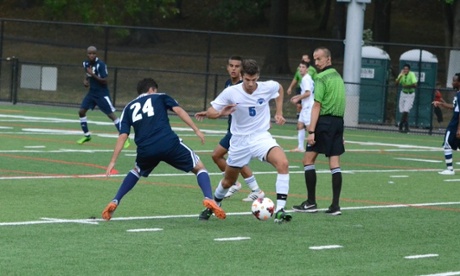
The Maccabees’ fast start was surprising to some of its conference foes as opposing coaches ranked them eighth out of 11 teams in a pre-season poll. The top six teams qualify for the playoffs, which begin October 31 and run through November 7.
To prepare, Pransky scheduled some difficult non-league opponents. The Maccabees started off the season losing to then 21st-ranked Stevens Tech, 5-0. They dropped a 6-0 home decision to Kean College, allowing two soft goals in the waning minutes.
“Three and four years ago Yeshiva absolutely had no business being on the same field as a team as established and as competitive as well put-together as Kean or Stevens Tech,” he said. “The fact we’re sort of breaking our teeth in going up against these guys is really as a coaching staff the only chance of competing was out of our conference. My guys got an earful after the game about heart, desire and pride and commitment, and things like that. I can’t sit there watching young men sell themselves short after all their hard work.”
Their most recent match, a wild 4-4 road draw at Mount Saint Vincent Sunday night, had enough twists and turns and drama to entertain fans for a week. The hosts grabbed an early two-goal advantage before Yeshiva rallied with a pair of goals apiece by senior midfielder Daniel Amar (team-best six goals, four assists) and junior striker Itamar Ben David. An own goal allowed the hosts to equalize in the 82nd minute.
“They will feel disheartened and let down if we don’t make the playoffs,” Pransky said. “Where in past years, making the first round of the playoffs would have been the farthest reach of our imagination of what was possible. It all goes back to the players. They’re the ones putting in the hard work, they’re the the pioneers, coming to this program when it really wasn’t a program. They’ve got this belief and it’s fantastic.”
Pransky certainly believes in Ben David. The Tel Aviv native has been the mainstay of the attack, leading the Maccabees in scoring the past two seasons (16 goals, 10 assists in 2013 and 18 goals, 10 assists in 2014). After some injury issues earlier this season, the 6ft 1in, 185lb striker has five goals and two assists in six matches. A first-team All-Skyline selection last year, Ben David also was named the Jewish Sports Heritage, Inc. Jay Fielder outstanding Jewish college soccer player of the year.
“Itamar has a very close place next to my heart, because he was my first every recruit,” Pransky said. “To be able to grab him first, before anybody else, really set the bar. He is a calm, cool, collected character. He really is not seized by a whole lot, an extremely down-to-earth and likeable guy. He just just loves the game. He sees the game beautifully.”
After hosting Lehman College Friday, they will take a 13-day break before playing Farmingdale State College on Thursday October 8. After dropping its two opening matches, Yeshiva is 3-1-1 in its last five games, so the break could interfere with the team’s momentum.
“I tell my recruits that we’re the only college team that has the Italian mid-winter break in the middle of September,” Pransky said with a laugh. “So it’s definitely not ideal. If i could get a week’s practice to get the rust out …
“We play against a very fit and a very competitive Farmingdale State the day after we come back. That’s brutal to come back against real high level competition.”
“I don’t think its going to be easy,” Grobman said. “I’m just going to try to stay fit, keep doing exercise, try to play soccer as much as I can during the break; stay focused.”
Pransky’s recruiting options are limited because not only he is restricted to Jewish players, but mostly ones that want to further their religious studies. He has created a network of alumni, his contacts and an international net as well.
“We hear about a Jewish player out in Northwestern or in Maryland in certain big-time programs,” he said.”There’s that myth that Jews are not athletic or not good in sports or something like that. I think stereotyping any culture or ethnicity is short-sighted, dangerous and extremely erroneous.”
Yeshiva is proving that.
“We’ve got a good amount of good players from areas and school that normally wouldn’t feed into Yeshiva University,” Krombach said. “But our coach has gone out, and he’s said the right things to the right people, and we’ve got in some great players over the course of the past few years.”
Sometimes a player attends the college and decides to play later. After his freshman year, Krombach, an accounting major, sent Pransky what he called “an audition video.” He was invited to training camp, joined the practice squad before working his way up to captain.
Sometimes it just happens. Bakal-Schlomann admitted Yeshiva wasn’t on his radar. He visited Israel on a summer program operated by the school. He liked what he saw.
“I learned about the school, and saw that they had a mix of religious kids as well as kids who didn’t come from a religious background but were interested in Judaism,” he said. “I fit into that mold.”
And sometimes word of mouth works. Grobman, a Peruvian who moved to Miami, had a friend who recommended Yeshiva.
“He [Pranksy] told me he was trying to grow the program every year,” he said. “So I kind of believed in the program.”
That belief has spread to the rest of the team.
Whether Yeshiva has turned the corner remains to be seen. The Maccabees will certainly learn a lot about themselves when they return from break next month.