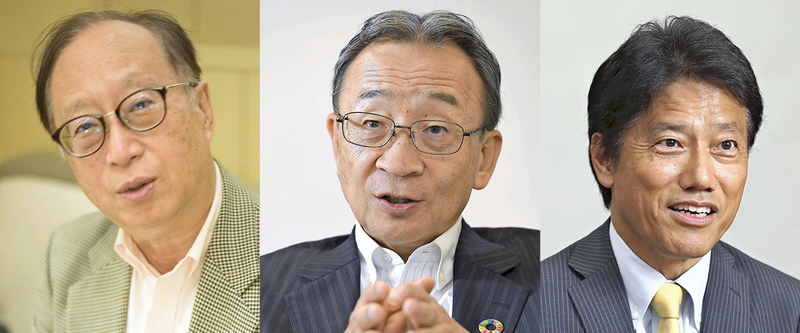
The Japanese government has signed an economic partnership agreement with the European Union. Alongside the Trans-Pacific Partnership (TPP) free trade pact -- for which 11 countries, including Japan and Australia, are working through their domestic procedures for its implementation -- the Japan-EU EPA will lead to the birth of a vast free-trade zone. At the same time, the United States, which touts "America First" as its slogan, is beginning implementation of protectionist policies that place high tariffs on foreign goods, intensifying trade friction with other countries. To learn more about the future of global trade, we asked experts in the field. The following are excerpts from the interviews.
(From The Yomiuri Shimbun, July 18, 2018)
Free trade bloc serves as 'weapon' for Japan
Following the new TPP, with 11 countries including Japan and Australia participating, prospects for the early enforcement of the Japan-EU EPA came into sight.
Japan and the EU account for about 30 percent of global gross domestic product, and the countries participating in the new TPP make up more than 10 percent of it. With the new TPP taking effect, a huge free trade bloc that will stimulate trade and investment will be born by reducing or abolishing tariffs on the imports of each country, and by establishing economic rules that facilitate the activities of foreign-affiliated companies.
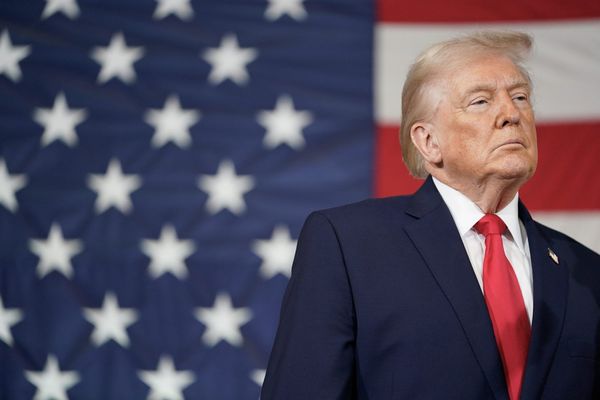
These two agreements are potent "weapons" for Japan in countering U.S. President Donald Trump and his protectionist trade policies. The reason is that trade between these countries will expand and increase economic growth, while in contrast, the United States, which will not participate in this free trade bloc, cannot receive its benefits. Moving forward, Japan must continue to promote free trade.
Trump must not forget that the United States has led the current multilateral free trade system since the postwar era. The massive U.S. trade deficit stems from the fact that the United States is the world's largest market and it buys goods and services from around the world. It is the driving force of the global economy.
There have been U.S. presidents who put forth policies similar to those of Trump in the past, including Richard Nixon and Ronald Reagan.
For example, amid ballooning national defense spending caused by the Cold War with the former Soviet Union, the rise of Japan and Germany to the forefront of the global economy and growing "twin deficits," referring to a nation's current account and fiscal deficit, Reagan sought to restore U.S. prestige.
To reduce the trade deficit, he demanded restrictions on auto exports to the United States, particularly from Japan. In response, then Prime Minister Yasuhiro Nakasone built a relationship of trust in which they called each other by their first names -- Ron and Yasu. They took the initiative to start new multilateral trade negotiations, the Uruguay Round of the General Agreement on Tariffs and Trade (GATT). That is to say, he brought the United States to the free trade table. No one had been expecting Reagan to begin multilateral trade negotiations when he took office.
There is a lesson in this. In current Japan-U.S. relations as well, the relationship between Trump and Prime Minister Shinzo Abe is not bad.
Trump levied high tariffs on steel and aluminum products imported from a wide range of countries, including Japan and China. He is also considering raising the tariff on auto imports.
However, unlike past times when trade friction arose, this time there is also little support for Trump's protectionist policies even among automakers and other U.S. manufacturers.
It will be important for the prime minister to stress the record of job creation in the United States, urge on the U.S. public and press Trump for a shift in his policies.
--This interview was conducted by Yomiuri Shimbun Staff Writer Tomoko Tsuda.
--Yorizumi Watanabe / Professor at Keio University
Watanabe, 64, served as economic affairs officer at the GATT Secretariat and as special investigator at the Mission of Japan to the European Union, among other roles, before assuming his current post in 2005. He is an expert on international political economy and international trade law.
Fair trade rules create model for world to follow
The heightened trade friction resulting from the rollout by the United States of trade restrictions on steel and other products could deal a heavy blow to the global economy going forward. The retaliatory sanctions and tariffs between the United States and China are especially grave, and Japan will not be able to avoid the repercussions.
Japan supplies China and the United States with parts and materials, which are assembled or processed locally into manufactured goods for export. If the United States and China each raise tariffs on the other's manufactured goods, exports of such goods will stagnate, also negatively impacting Japanese-made parts and other items. It will also hobble the exports of Japanese companies who have established local operations.
Furthermore, high tariffs levied on imports by the United States will raise the cost of raw materials for U.S. companies, which will eventually need to raise the selling price of their products. This will result in manufactured goods becoming more expensive for U.S. consumers, which carries the risk of dampening consumption.
For corporate executives, the future uncertainty is cause for psychological concern. With no resolution to the trade friction in sight, there are some Japanese companies that are hesitating to make new capital investments and undertaking other activities due to the uncertainty over the scale of future export growth. While there are calls for investment by Japan coming from all around the globe, it is difficult to take action under the present situation.
The United States and China are economic powerhouses, ranking first and second in gross domestic product in the world, and have been leading the global economy. I want them to consider the situation from the wider perspective of the prosperity of the world as a whole, rather than from the viewpoint of the interests of their own countries, and quell this trouble quickly. After all, economic prosperity in the United States and China depends on the robust growth of the global economy. To achieve this, the expansion of free trade and the creation of common rules that encourage investment are essential.
In this sense, I welcome the signing of the economic partnership agreement between Japan and the European Union. It is significant in that rules for free and fair trade and investment will be realized and it will also serve as a model for the world of "how trade should be."
Moreover, the expansion of exports is a main pillar of the Abenomics economic policy package promoted by the administration of Prime Minister Shinzo Abe that will spur economic growth. For Japanese consumers, the abolition or reduction of tariffs on a wide array of European products has the benefit of enabling them to buy items like cheese and wine cheaply. While some say that it will harm domestic agriculture and dairy farmers, it should be viewed as an opportunity to refine Japan's agricultural products and increase exports.
The countries participating in the new TPP are moving forward with the necessary procedures as well, and its enactment is within sight. It seems likely that Thailand will join, and countries such as South Korea, Indonesia and Britain are also considering participating. An increase in the number of participating countries will further stimulate trade and investment, and strengthen economic ties, thereby heightening the appeal of the TPP. While it may take time, it might be possible to create a basis for bringing the United States back into the TPP.
--This interview was conducted by Yomiuri Shimbun Staff Writer Taisuke Takeda.
--Kuniharu Nakamura / Chairman of the Japan Foreign Trade Council
Nakamura, 67, joined Sumitomo Corp. in 1974. After long involvement in imports, exports, and overseas sales of automobiles, he became president in 2012 and chairman in 2018. He took up his current post as chairman of the Japan Foreign Trade Council in May.
Prolonged U.S.-China 'trade war' seems likely
The United States has not only commenced import restrictions on steel and aluminum from a slew of countries, it has also launched additional tariffs targeting goods from China on the grounds of infringement of intellectual property rights.
The hard-line stance of the United States anticipates a future struggle for hegemony and is intended to weaken China before it is too late. The United States considers China's unfair trade practices, such as forcing U.S. firms to transfer technology, a threat to security. The U.S.-China relationship is unlikely to stop at a "trade war" and instead will likely escalate to an "economic war," which will involve broader conflict, including investment restrictions among other measures.
China's "Made in China 2025" plan to upgrade its manufacturing industry, which the United States considers problematic, is not simply a policy to promote high-tech industries. It will inject enormous subsidies into domestic industry with the aim of dominating global markets by mass-producing cheap goods. It also does not balk at obtaining foreign technology through unfair means.
Wariness toward China is at an all-time high, extending beyond hard-liners against China in the administration such as U.S. President Donald Trump and U.S. Trade Representative Robert Lighthizer to include the U.S. Congress and Washington policy think tanks as well. The U.S. Congress is deliberating a bill to impose restrictions on Chinese investment in U.S. companies, and it is also moving toward enacting tougher export controls on advanced technology.
The United States will hold midterm elections in November. Mindful of his support base, there is the possibility that Trump will make a deal with Chinese President Xi Jinping to achieve certain results, such as an increase in imports of U.S. goods by China. However, given the deeply rooted distrust of China in such places as Congress, there will be no real solution so long as China does not change the core of its national strategy. We should consider conflicts between the United States and China will be prolonged.
Japan, too, is forced to face a tough situation in new trade talks with the United States. In the U.S.-Japan Semiconductor Agreement signed in the 1980s, Japan was forced to accept numerical targets with regard to curbing exports of Japanese goods to the United States and the expansion of shares of foreign products in the Japanese market.
The United States is now considering an increase in tariffs on imports of automobiles, including those made in Japan. However, if the tariffs were to be raised, there is the possibility that exports of Japanese cars will stagnate, so a compromise of restricting the volume of exports must be avoided at all costs. If managed trade were to be permitted, there is the risk that the United States would apply further pressure to curb exports to the United States to reduce its trade deficit.
We must act in accord with the European Union and other nations that oppose the U.S. moves and bring the case to the World Trade Organization. The trade order is based on international rules and its decay on account of unilateral U.S. measures is a serious problem that must be prevented.
--This interview was conducted by Yomiuri Shimbun Staff Writer Taisuke Takeda.
--Masahiko Hosokawa / Designated professor at Chubu University
Hosokawa, 63, joined the International Trade and Industry Ministry (now Economy, Trade and Industry Ministry) in 1977. He served as director of the Americas Division, director general of the Trade Control Department, and director of the New York office of the Japan External Trade Organization (JETRO), among other roles. Hosokawa is involved in Japan-U.S. trade negotiations concerning steel and automobiles. He
assumed his current post in 2009.
Read more from The Japan News at https://japannews.yomiuri.co.jp/