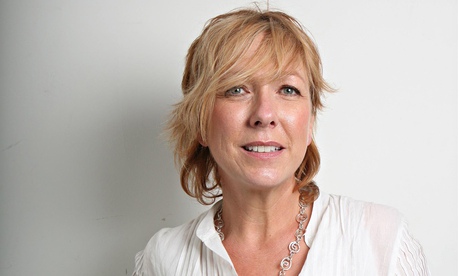
No one could accuse Helen Walmsley-Johnson of not living up to her motto, which is “to carpe the fuck out of the diem”. Married at 20, and a single mother of three by the age of 35, she successfully sued the NHS for unfair dismissal in her mid-40s, and by the age of 51 had relocated from her native Midlands to London where she landed the job of PA to the editor of the Guardian. Not only does this last gig sound like a lot of fun (whoever knew that so much Chablis still runs through metaphorical Fleet Street?) but it gave her the chance to write a blog dealing with fashion for “older” women, The Vintage Years. Now in her late 50s, she has expanded her meditations on making the best of middle age into a book.
As its title suggests, though, The Invisible Woman is not the textual equivalent of those adverts that show a chic, steely-haired couple flipping through their investment portfolio or looking simply thrilled at the prospect of getting a third off their train fare to some unspecified cathedral city. Instead, it is Walmsley-Johnson’s contention that hitting middle age – the proper sort that starts at 50, not 40 – is the moment when a woman fades from view. It’s not simply that she has to start dyeing bits of herself in order to be the colour she once was, it’s that the rest of the world still insists on seeing straight through her, freshly inked eyebrows and all.
By way of illustration, Walmsley-Johnson uses her own life, which turns out not to have been quite as larky as a summary of it suggests. A badly handled divorce all those years ago left her without a toehold on the property ladder, with the result that she is seeing out her middle years in a series of rented digs. Modestly paid secretarial jobs have given her no chance of building up savings, and having cancer in her 40s has left her prematurely aware of her body’s frailty. What’s more, since taking voluntary redundancy three years ago, she has been unable to find another job. After 500 applications, one conclusion could be that she is considered too old to add value to anyone’s business. And now, following an annus horribilis during which her father and several friends died from cancer, she has retreated to the countryside because it is cheaper. When she does come to London to attend the occasional function, she is often to be found grabbing extra canapes to eke out the food parcels that her grown-up daughters send her.
It does not sound nice and it is all credit to Walmsley-Johnson that she doesn’t pretend that she chose this way of life, which includes going to the pawn shop to raise money on a rather swish camera and paying on instalments to have her cat put down. She would have preferred options, just as she would prefer to be able to go into a shop and find plenty of size 14s on the rack, or to turn on the TV and see people who look a bit like her. And it’s this sense that the world simply doesn’t cater for women over the age of 50 that has sent her into to the library to forage for information.
Thus what could have been a bit of a mopey memoir (“misery” would have been putting it too strongly) is given stiffer sinews by Walmsley-Johnson’s determination to find out just why she’s in the state she’s in. She is not, for instance, the only woman to be facing poverty in middle age: according to a recent EU study there is a 43% pensions gap for British women relative to men. Nor is she alone in dealing with the shock of losing her innards: 20% of women are, like her, surgically relieved of their wombs by the age of 60. She even finds an answer to that burning question of why, if the epidermis gets renewed every two or three weeks, we still feel the need to spend £2.2bn a year on creams that promise to tackle the seven signs of ageing.
Her debut, then, is a blend of personal testimony and campaigning journalism. Walmsley-Johnson is occasionally guilty of that thing she accuses other people of, which is to assume that everyone’s experience of being 50 is the same as hers. Nonetheless, The Invisible Woman remains a warm, companionable book with a tart aftertaste. Above all – and this is perhaps not quite its intention – it is a reminder to all of us, man, woman, young or getting on a bit, that, no matter how solid our lives seem, we are all of us one bad decision or single piece of rotten luck away from losing everything. And for that we should be both grateful and prepared.
• To order The Invisible Woman for £7.99 (£10.99) go to bookshop.theguardian.com or call 0330 333 6846. Free UK p&p over £10, online orders only. Phone orders min p&p of £1.99.