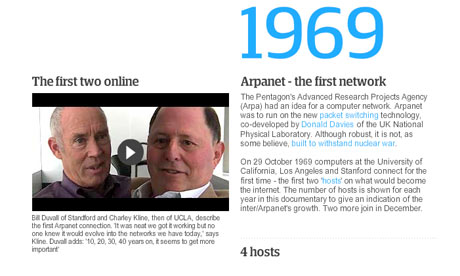
Today is the internet's 40th birthday. Well, not exactly the internet but Arpanet – the Pentagon-funded research project that is the predecessor to the internet. Forty years ago, a simple message "Lo" (it was supposed to be "Login", but the system crashed) was sent between two computers at two Californian research labs and a net was born. What happened next – the development of the now global internet, the web that you are reading this on – has had an impact on all of us. Last week, the Guardian published an interactive people's history of the internet telling the story of how that happened and interviewing some of the people who made it so.
Charley Kline and Bill Duvall – who made that first connection between the University of California, Los Angeles and the Stanford Research Institute – are in there, as are pioneers of politics, social interaction and gaming online.
Kline admits the importance was not recognised at the time. "It was neat that it was working ... but nobody recognised that it was the beginning of something," he says – but what would develop from that first connection has had a huge influence on how we live today.
It is also worth remembering the perhaps unexpected nature of those who made this military-funded network. Oliver Burkeman spoke to Leonard Kleinrock, the UCLA professor who led the project, for a complementary piece on how the internet changed the world for ever, noting that the Arpanet's development into what we have today was never inevitable.
It was a crucial idiosyncrasy of the Arpanet that its funding came from the American defence establishment – but that the millions ended up on university campuses, with researchers who embraced an anti-establishment ethic, and who in many cases were committedly leftwing; one computer scientist took great pleasure in wearing an anti-Vietnam badge to a briefing at the Pentagon. Instead of smothering their research in the utmost secrecy – as you might expect of a cold war project aimed at winning a technological battle against Moscow – they made public every step of their thinking, in documents known as Requests For Comments.
That thinking followed through and the internet – open both for people and machines thanks to the run-anywhere systems at its heart – would eventually win out over attempts in the 1980s to create more tightly controlled networks. It is also a spirit that informed Tim Berners-Lee's later World Wide Web (not the same as the internet) when the Cern European particle physics laboratory released it royalty-free for anyone to use.
Lots more contributed to the internet we have today – bulletin boards, Usenet, dial-up modems, innovators and hobbyists outside the research labs – but Arpanet was the foundation stone and is worth remembering.


.jpg?w=600)