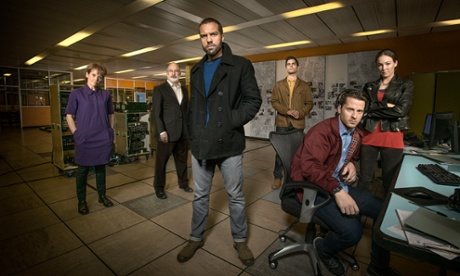
He! is Ash, the son of a drug addict who once shot a man, now all grown up and a customs officer fiercely committed to the war on drugs! But frequently frustrated by HMRC’s preference for going after dealer minnows while the big fish swim on unmolested, leaving crime, misery and despair in their wakes!
She! is Val, Ash’s former mentor when she worked in Customs but who has since become the head of a shadowy surveillance unit called the Unit (short for something like Undercover Nefarious Information Trackers, so that we can all keep our heads straight), which is on the trail of some of Britain’s most ruthless criminals! They look only for big fish to fry!
It! is The Interceptor (BBC1) – you cannot help but suspect it was called The Unit right up until someone’s flash of last-minute inspiration – and is evidently the Beeb’s latest attempt to find a replacement for Spooks, which came to the end of its 281,000-series run in 2011.
Ash and Val’s paths cross again after a botched seizure operation in which Ash’s friend Tommy is left paralysed by a particularly ruthless criminal (played by Paul Kaye on leave from Jonathan Strange & Mr Norrell). Val asks Ash if he wants to join the Unit. After some cogitation in an armchair because he is married to a criminally underwritten wife who is permanently anxious about his safety, Ash decides that he does.
But! as they investigate the drug gang involved in Tommy’s injury, Ash’s desire for revenge, as so often happens with wafer-thin characters with no more relationship to real-life professionals than the plot has to real-life events, conflicts with the team’s commitment to the bigger picture, so he makes a variety of insufferably stupid decisions that make no sense but do bring about a visually stimulating climax at a dirt-bike rally. He gets his man and his team get to teeter between Anger and Grudging Admiration for a few minutes before ultimately agreeing that they could do with a man of Ash’s commitment and passion, especially as the producers managed to get Trevor Eve to play the king of kingpins, who has turned up in the closing minutes.
It is insanely dull, unless you really, really like this sort of thing and/or have a particular fetish for watching good actors flinging their all at a thing that is stubbornly refusing to take flight. It may achieve take-off next week. It may not. That is undercover information I have not yet been able to track down.
No information was left untracked in Wednesday night’s opening episode of Andrew Roberts’s three-part documentary on Napoleon (BBC2). It was exhaustive and exhausting. Who knew the little general had so much in him? If anyone who is not already a diehard fan of Roberts and Boney gets to the end of all three parts, could they let me know? You should probably be studied by science.
There is always going to be a lot of heavy lifting needed in a documentary that not only has to rebut the common view of the subject, but also establish that common view in the first place because it is common only in a very narrow stratum of people compared even with the self-selecting group of people watching. But Roberts is a doughty fellow; he has been a Napoleon fan since he was 10 and has just emerged from years of research for a biography of his hero so he is – definitely, definitively – the man to tell us.
Napoleon was a monster, say the people who think Napoleon was a monster. Nonsense, says Roberts – to the fury of people who think Napoleon was a monster, the cheers of people who think he wasn’t and the mild interest of people who had no particular feelings about Napoleon one way or the other – he was a man of astonishing military ability and achievement who rose from nothing-ish to be crowned emperor of the French.
Couldn’t he be both, the slightly interested viewer wondered slightly more interestedly. Yes, he could. You pretty much have to be the one to be the other. Then historians take it in turns to decide which of your ends justified which means. Roberts reckoned almost everything was justified according to the mores of the day, and dropped into the demotic to prove it – “Everyone needs to get over themselves.” He did reluctantly concede that bayoneting up to 4,000 prisoners on the beach at Jaffa was “not his finest hour”. Two more episodes of Roberts’s series to go.