We live in an era where the “line” between offline and online is close to indistinguishable. Yet both channels are distinct and they need to be integrated. More importantly, we have to create a better customer experience in both spaces.
Offline retail venues are no longer simply places where transactions occur. They are places of experience, and the experience ought to be rewarding in a way that enriches our lives.
Ron Johnson, the former CEO of JC Penny, was so right when he said that “for most stores, moving from a transaction mindset – ‘how do we sell more stuff?’ – to a value-creation mindset will require a complete overhaul”.
We have heard so much buzz about the importance of transferring brand experience to digital spaces – both on the web and mobile – but the execution has been virtually absent. We’re still searching for genuine interactive retail experiences.
Can anyone think of anything more lifeless and dull than the experience of shopping for a new washing machine or refrigerator? All the rows of stainless steel, with typically nothing plugged in. Admittedly, this has to do with local law in many instances, where strict country regulations force shops to keep the power unplugged. Still, can we have a collective yawn, please? And let’s not even start on the engineering degrees required to make sense of the product information and marketing claims.
It’s not all a barren wasteland. Some smart brands are putting a priority on presenting their products with unique customer experiences. Last year, European electronics retailer Media-Saturn unveiled a new store where products could be accessed via a giant video wall. The outlet also has a drive-in collection point for online orders, with the aim of making the connectivity between online and offline more seamless.
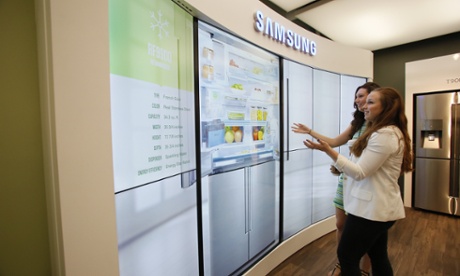
In Amsterdam, Marks & Spencer has used similar touchscreen technology to produce an endless virtual rail that can hold its full catalogue rather than a few selections. Samsung is another brand looking to reinvent the in-store experience through digital technology. It introduced CenterStage last summer in the US, and gradually expanded it to the UK, France and UAE. It will go further soon.
CenterStage uses large lifelike 4K displays, giving shop visitors new ways to view and experience devices and their functions, with clever interactive elements and slick animations replacing old-school brochures.
For retailers, suddenly, there is space for everything, and everything is life-sized. The overall professionalism of the display strengthens brand image for both Samsung and the retail outlets.
Early results show improved sales performance with CenterStage, compared to a control store. There was also a noticeable sales increase in refrigerator and washing machine categories.
But the success goes beyond just driving sales. CenterStage is dedicated to delivering a special experience that cannot be achieved in other retail environments.
From the project, we’ve learned that innovation should be focused squarely on consumers. It should satisfy their demands for something new and exciting by efficiently showcasing in-store products with better experiences. It also helps retailers solve their space dilemma. Sports brands such as adidas and Nike have used in-store screens to enable customers to customise and personalise products. New Balance even allows consumers to make their own shoes in its NY store.
By blending physical with digital in this way, retailers and brands can transform consumer experiences and make shopping easier and more fun at the same time. Today’s sophisticated technology helps to reflect consumers’ sophisticated needs and desires. But the starting point should be a deep insight into consumer mindset: their likes and dislikes. Only then will the technology be used in the right way to help both retailers and brands connect with consumers.
Sehee Kim is project lead at Cheil Worldwide
This advertisement feature is brought to you by the Marketing Agencies Association, sponsors of the Guardian Media Network’s Agencies hub