Get all your news in one place.
100’s of premium titles.
One app.
Start reading
The Guardian - UK
The Guardian - UK
Lifestyle
Tom Dixon

The inspirations behind Tom Dixon’s designs – in pictures

Dixonary: Tom Dixon at his shop in Portobello Dock
Designer Tom Dixon at his shop in Portobello Dock, Ladbroke Grove, London Photograph: Sophia Evans for the Observer
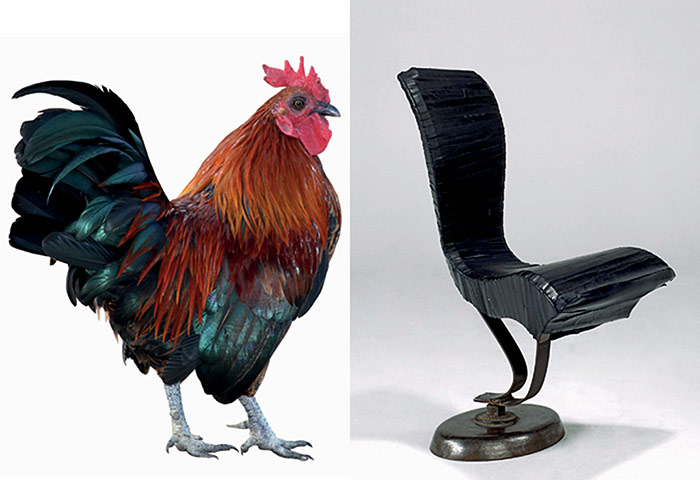
Dixonary: Pre S-chair 1986
Pre S-chair 1986 (and cockerel). 'I have often been asked what the inspiration was behind the S-Chair and, honestly, the only memory I have is of drawing a small doodle of a chicken on the back of a napkin and thinking I could make a chair from it. This one proves that if at first you don't succeed, try, try and try again because it was a bad idea and ended up as a spectacularly ugly object. If you look closely you can still see the chicken in it. This one was made for a hairdressing salon in Soho – for some reason, hairdressers were often early adopters of my work.' Photograph: Tom Dixon
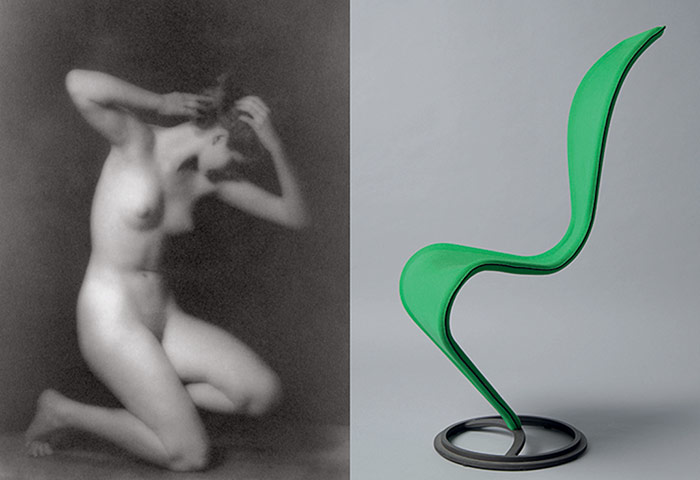
Dixonary: S-Chair (Green) 1991
S-Chair (Green) 1991 (and Female Nude Kneeling and Touching Head, photograph by J M Guerin): 'My slightly more successful designs seem to be ones that can be read in different ways, often quite opposite to their original intent. If the original departure point say, for the S-Chair for me was a chicken, it has often been described by others as a female form, by some as a flame or frequently as a 1960s-influenced Pop object. This is definitely a quality to which I now aspire – an expressive neutrality, on to which you can project many meanings, most completely unintended, allowing them to have a life of their own, beyond their original conception.'
Photograph: Corbis/Tom Dixon
Dixonary: Bolide Chaise 1988
Bolide Chaise 1988 (and cat skeleton illustration by Rush Shippen Huidekoper): 'Furniture is usually such a static expression of form, yet objects definitely have personality and character. So my train of thought on this piece was, why should they always be so immobile? That's why rocking chairs are such a fantastic typology. The Bolide was an attempt to rethink the motion – rather than back-and-forth, it's an up-and-down action with an occasional slight wobble sideways, just like sitting on the springy branch of a tree.' Photograph: Tom Dixon
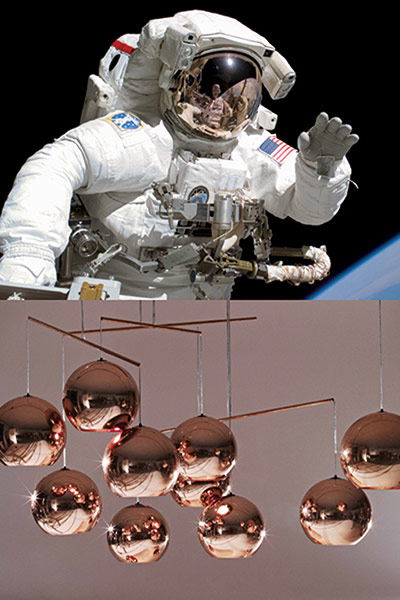
Dixonary: Copper Shade, 2005
Copper Shade, 2005 (and an astronaut): ‘Fascinated by hi-tech processes and desperate to obtain a perfect reflective surface on my lamps in a bid to make an over-scaled, basic yet extravagant spotlight that could use convenient bulbs and concentrate their output into a soft but narrow beam, I read up on a process called thin film vapour deposition, more commonly described as a vacuum metallization, which is commonly used in sunglasses. In this process, our polycarbonate ball is placed in a vacuum chamber, the air is sucked out and BANG – an immense electrical charge vaporizes a small strip of copper foil into a mist of particles that settle on the lamp in a coating between 0.01 and 0.02 micrometres thick. If the object is free of dust, this creates a perfect mirror and a beautiful optical effect.' Photograph: Tom Dixon
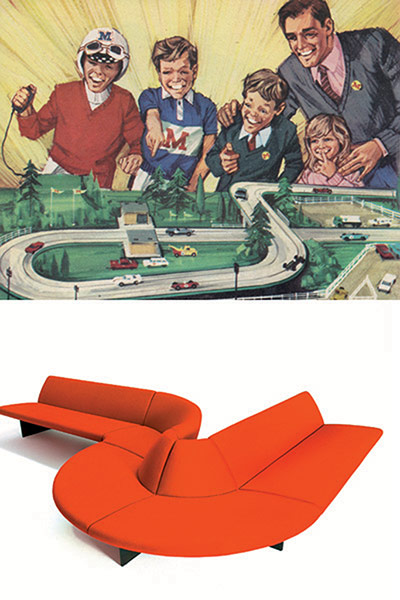
Dixonary: Serpentine Sofa 2003
Serpentine Sofa 2003 (and the Matchbox Motorway): ‘There is a lot of satisfaction in setting a few rules in an object, and then letting the customer or the space decide how to finish off your design. The idea here is to work with the bare minimum of sofa module (in this case, a straight, an inside curve and an outside curve). From that you can make almost any configuration to suit a variety of needs. Each sofa will then inhabit a room in its own unique way. Toulouse airport has these snaking through the departure hall of Terminal D. Four outside curves make a useful seating space around a column in a fashion shop on London's Bond Street. Arrayed in a U-shape facing inward, Serpentine Sofa makes a useful conversation pit for a futuristic interior.' Photograph: Tom Dixon
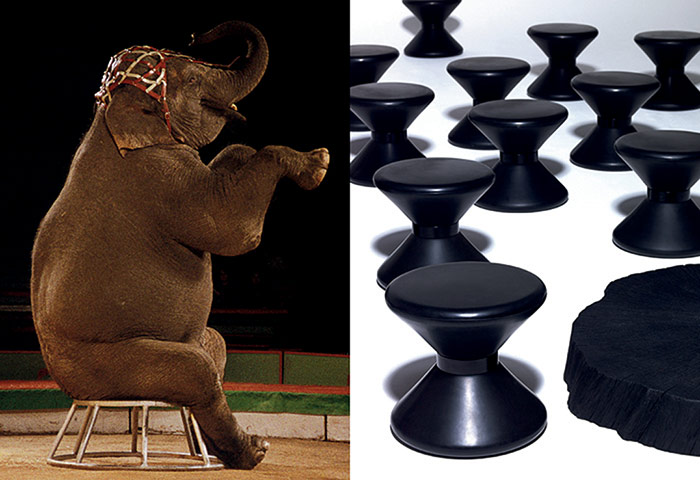
Dixonary: Drum Stool 2013
Drum Stool 2013 (and a circus elephant): ‘Two cones, end-to-end – one to provide stability and one for comfort. Produced in a material familiar from the car industry – self-skinning foam. This is a material that can be both strong and soft at the same time: perfect qualities for a gentleman and also for a footstool, which will inevitably be abused, stood on, stacked, kicked and knocked over. So often do designers misunderstand the rough and tough of the restaurant or the hotel room and underestimate the need for longevity and easy maintenance in use.'
Photograph: Alamy/Tom Dixon
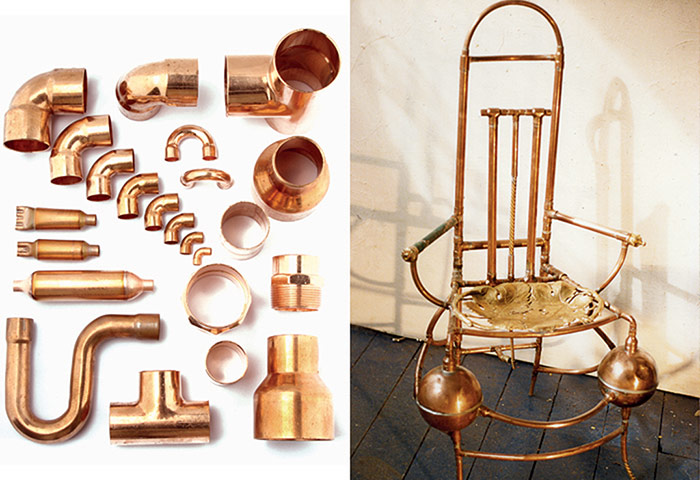
Dixonary: Plumbing Chair 1989
Plumbing Chair 1989 (and copper elbows): 'The bits and pieces and readymade junctions you can get in plumbing – the bits that fill the parts bins in builders' merchants – look like hidden treasure to me. So many configurations from a predetermined kit of copper components. The lead solder that holds the junctions together is great for waterproofing and allowing for flexibility as the pipes expand and contract in use, but unfortunately it really isn't good enough for chair making. If you rock back and forth, the solder joints break: something that I found out when I made a set of six dining chairs and sold them to Patrick Cox, the upmarket cobbler – they all broke and he was covered in flux. He wasn't happy.' Photograph: Tom Dixon
Dixonary: Plump Chair 2008
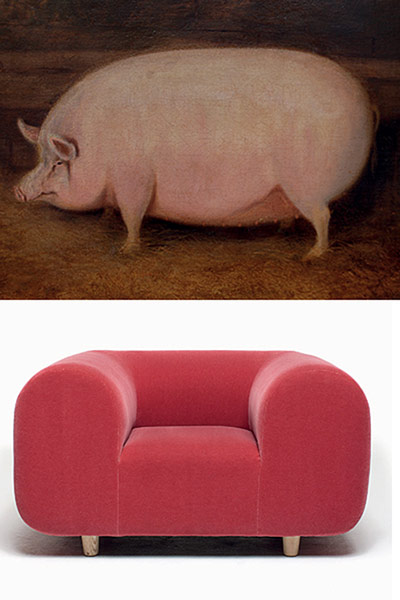
Plump Chair 2008 (and Prize Sow, by E Brown): ‘I don't know about you, but for me a proper sofa has to be fat and stuffed. Plump chair is an attempt at making as simple, inviting and generous a form as possible. The objective was also to allow for a secondary sitting position, to actively encourage the slobbing around and social aspect of comfy-chair-and-sofa life – perching of the back, legs over the arms – and give room for a mug of tea or a couple of small children to hide in the folds.'
Photograph: Blackbrook Gallery/Tom Dixon
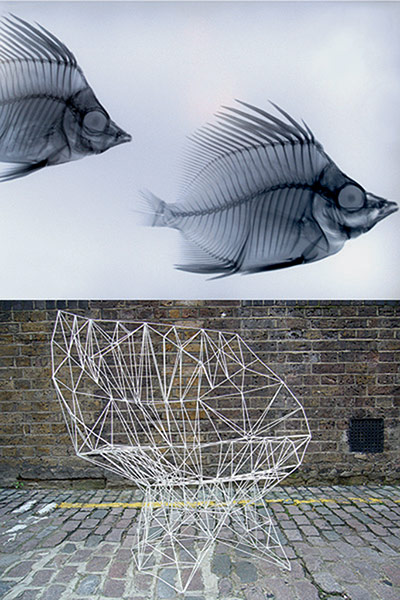
Dixonary: Pylon Chair
Pylon Chair 1992 (and x-ray of scythe butterflyfish): 'The making and remaking of the Pylon Chair countless times, to try and reinforce weak points and prevent collapse, taught me how to make things properly. It felt like a crash course in structural engineering, and better than going to art school. The results make me believe more in the underlying structures of an object, rather than in their surfaces, and leaves me in awe of the structural engineer.'
Photograph: Getty Images/Tom Dixon
Dixonary: Bird Chaise 1991
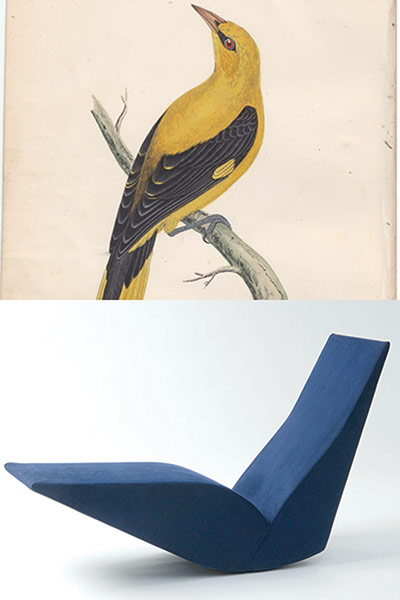
Bird Chaise 1991 (and an engraving of a golden oriole): ‘A collision of a rocking chair and chaise longue sounds improbable but just about works – and is an opportunity to create a brand-new typology of furniture: the rocking chaise. It has an unusually elegant line, which comes naturally from the gentle curve that touches the ground as a fulcrum in one spot only; a fat piece of upholstery where the most weight is distributed; and pointed ends. They all add up to give it a bird-like silhouette - like a decoy duck or, better still, an exotic songbird.’
Photograph: Frances Orpen Morris/Tom Dixon
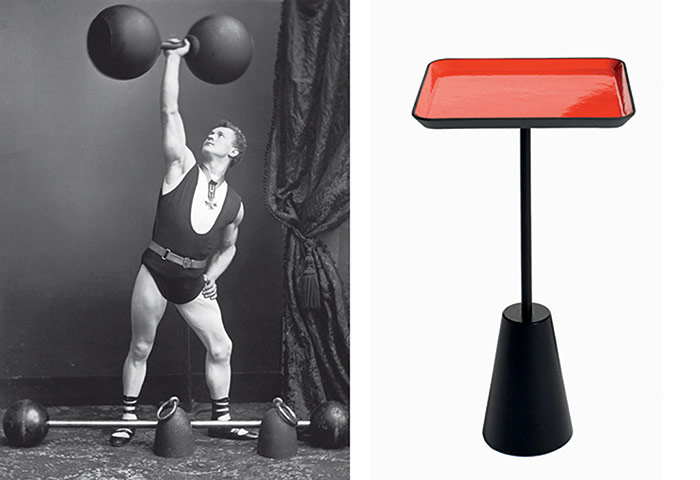
Dixonary: Spot Table 2008
Spot Table 2008 (and strong-man Eugene Sandow): 'Spot Table isn't so much a finished single object. It is the beginning of a whole series that I will one day complete. The cast-iron base, intended to be excessively heavy, holds a flat, vitreous enamel platter. But this particular side table is meant to be the first of a series that will use an identical base to hold up an outdoor ashtray, a mirror maybe, a lamp of some sort, a doorstop or whatever I next dream up to cap the heavy minimally designed mass.'
Photograph: Getty Images/Tom Dixon
Dixonary: Wingback Sofa 2008
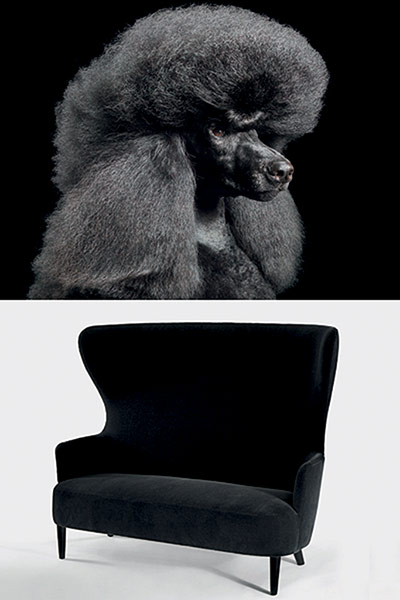
Wingback Sofa 2008 (and photograph of Alan, a black standard poodle, by Tim Flach): 'I'll tell you an occasional secret of a successful product: not always, but often, success depends not on functionality, not on price or provenance but just on an original recognizable silhouette. My theory is that you need maximum personality to survive in the aggressively competitive world of product design. Looking back, any of my faintly successful pieces tend to have a strong and distinctive silhouette and will do a double job, working as domestic sculpture at the same time as a practical piece of furniture.'
Photograph: Tim Flach/Tom Dixon
Dixonary: ‘The Etch Light 2012
‘The Etch Light 2012(and chinese lantern seed head): 'The Etch Light is a lamp designed for the digital age, conceived on a computer and manufactured through the digital-dependent manufacturing technique of precision acid photo-etching. As in the Stamp collection, the small size and thinness of the unassembled panels enable it to be packed into a standard Amazon pack and posted through as letterbox. The next step is to allow customers to adapt and define the pattern on the panels to their own designs, to size and resize the objects to fit their own requirements.'
Photograph: Alamy/Tom Dixon
Dixonary: Bash Vessel 2012
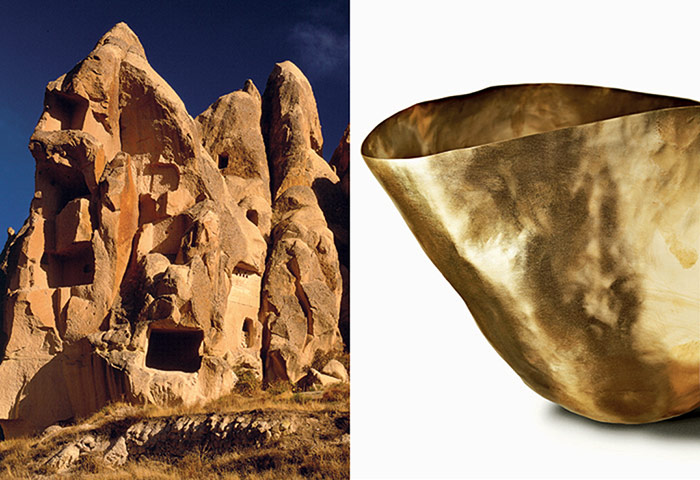
Bash Vessel 2012 (and Kapadokya Mountains, Turkey): 'I had spent years of going round factories and craft units asking, pleading and demanding absolute consistency and perfection in objects – all of them consistently well-finished, tastefully coloured, intelligently designed and just, well, polite – I yearn again for more aggressive, rougher and unpredictable design. I think that the eye starts to crave and demand imperfection and personality in an object. These Bash Vessels show the marks of their making: a few extra bulges and creases that give each piece an honest attitude all its own.'
Photograph: Henry Bourne/Tom Dixon
Sign up to read this article
Read news from 100’s of titles, curated specifically for you.
Already a member? Sign in here
Related Stories
Top stories on inkl right now
One subscription that gives you access to news from hundreds of sites
Already a member? Sign in here
Our Picks
Fourteen days free
Download the app
One app. One membership.
100+ trusted global sources.