
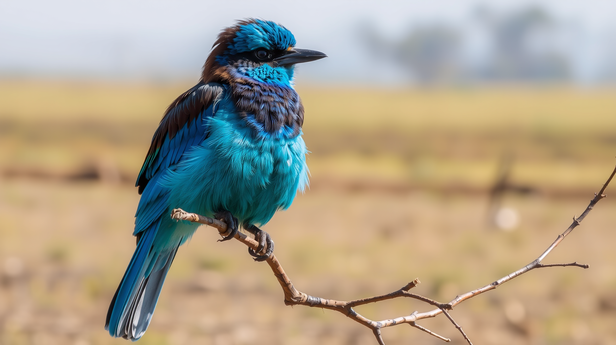
A Bird With No Blue Pigment
The Indian roller has no blue pigment anywhere in its body. Not in its skin, not in any fluid it produces, not in anything it eats. Every shade of turquoise, cobalt, and violet on those wings is produced entirely by the physical architecture of the feathers themselves, a fact that has kept ornithology researchers occupied for the better part of three decades.
The bird is common enough across India that most people have seen one without stopping to ask why it looks the way it does. It perches on telegraph wires and bare branches in open country, from Rajasthan to the coastal plains of Karnataka, where it is the state bird. It is also the state bird of Odisha and Telangana. Three states claimed it before scientists had fully explained what makes its colour work.
What Structural Colour Actually Is
Pigment colour works by absorption. A red flower contains molecules that absorb every wavelength of light except red, which bounces back to your eye. Structural colour works by interference and scattering. The feather contains no absorbing molecule at all. Instead, its microscopic architecture bends, reflects, and scatters light so that specific wavelengths reinforce each other and reach your eye as colour.
In the roller's feathers, the relevant structures are arrays of melanin granules packed into a spongy matrix inside the feather barbs. These arrays are amorphous, meaning they have no long-range order, no repeating crystal-like pattern, but they are consistent enough in their spacing to scatter short wavelengths of light preferentially. Short wavelengths are blue and violet. The result is a colour that seems to glow from inside the feather rather than sit on its surface.
Why Ornithology Pays Particular Attention to This Bird
The roller's plumage sits at an interesting intersection in structural colour research because it uses a different mechanism from the birds most people think of first. A peacock's tail feathers produce colour through thin-film interference: layers of keratin and melanin act like a soap bubble, and the colour shifts dramatically as the viewing angle changes. That is iridescence in its classic form.
The Indian roller is different. Its colour is largely angle-independent. You see the same blue whether you are looking at the bird straight-on or from the side. Stéphane Doucet and colleagues, publishing in the Journal of Experimental Biology, identified this as a hallmark of amorphous nanostructures rather than ordered thin-film arrays. The distinction matters because it tells researchers something about how the colour evolved and what function it serves. Iridescence that shifts with angle is good for display at close range. Colour that holds steady across angles is visible at distance, in flight, against a sky.
The Nesting Season and the Aerial Roll
The bird's common name comes from its courtship display. During nesting season, the male climbs steeply and then rolls and tumbles through the air in a series of fast lateral flips, flashing the underwing colours as it falls. The underwing in flight shows a brilliant electric blue that is almost invisible when the bird sits still with wings folded.
This is the point where the physics of feather structure and the biology of behaviour converge. The amorphous nanostructure produces colour that reads clearly at distance and in motion, exactly the conditions of the aerial roll display. The female evaluates the male mid-flight. A colour that required a specific viewing angle to appear would be unreliable at that speed and distance. The structural choice, if evolution can be said to make choices, was the right one for the display context.
Researchers studying nesting success in rollers have found that the brightness and extent of the blue-violet plumage correlates with male condition. Brighter birds tend to be better fed and less parasite-loaded. The colour is honest in the biological sense: it cannot be faked by a bird in poor condition because the nanostructure that produces it depends on the resources available during feather growth.
What This Tells Us About Colour in Birds More Broadly
The roller became a reference case in structural colour research partly because it is so common and so accessible. Unlike some of the birds studied for iridescence, species confined to remote rainforest canopies, the Indian roller sits on a wire by the highway. It can be observed in the wild, collected in controlled light conditions, and its feathers can be examined under electron microscopy without extraordinary logistics.
The broader finding that came out of roller research, confirmed across multiple bird families, is that amorphous nanostructures are far more widespread than previously assumed. For a long time, structural colour in birds was treated as a specialised trick of a few showy species. The roller helped shift that assumption. Its plumage showed that the mechanism was available to any bird whose feather development happened to produce the right granule spacing, no elaborate crystal lattice required.
The colour that makes a roller unmistakable from fifty metres away is the same colour that has made it one of the more productive study subjects in modern ornithology. The bird did not evolve to be useful to researchers. It evolved to be seen by other rollers. The fact that the same physics serves both purposes is the kind of coincidence the field runs on.