
Modern marketers need to move beyond being “on-message” to being “on-emotion”. Why? It’s because of the all-important role emotions play in influencing business change and decision-making.
Recent research undertaken by gyro, in partnership with Fortune Knowledge Group, found that 65% of board level executives acknowledged the importance of emotions in decision-making.
Research by gyro with YouGov also identified that the importance of emotions in decision-making increases when it comes to making change happen. In the past three months, 79% of the 345 senior decision makers gyro with YouGov surveyed in medium and large businesses experienced change in their workplace. These changes triggered a volatile cocktail of emotional responses seen by respondents. Worry, disappointment, fear and anger featured in the top 10, as did positive emotions such as satisfaction and hope.
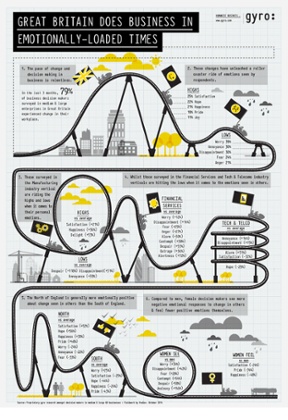
When digging deeper, notable differences were found. Male business decision makers responded differently to female business decision-makers. The North of England responded differently to the South. Industry verticals such as manufacturing responded differently to IT and technology, and financial services.
These differences create opportunity for marketers who embrace the idea of being on-emotion and view businesses as more than sterile decision-making machines. They will be the ones that think of businesses as networks of human relationships and focus on building strong emotional connections into those networks.
There are four practical steps to turning the concept of on-emotion into a competitive advantage:
- Identify the tangled web of emotional responses that surrounds the change you’re trying to sell in.
- Understand which of those emotional responses slow change down and speed change up.
- Decide if your brand should be the catalyst or the antidote for the emotional responses that make the biggest difference.
- Be clear about how to ignite or extinguish the emotional responses that matter.
Conventional wisdom has always been that business and emotions don’t mix. However, the evidence shows they do. So, whether the marketing industry feels totally comfortable with it or not, now is the time for modern marketers to move beyond being on-message to being on-emotion.
All figures, unless otherwise stated, are from YouGov Plc
Simon Calvert is chief strategy, tech and data officer at gyro
This advertisement feature is brought to you by the Marketing Agencies Association, sponsors of the Guardian Media Network’s Agencies hub.