Dominic Dromgoole's Classic Spring Season – his year-long celebration of the works of Oscar Wilde – comes to a climax now with Michael Fentiman's production of the author's masterpiece, a play which transmutes Wilde's turbulent real-life anxieties about double-lives and the threat of exposure into intoxicatingly madcap comedy. Simon Callow, in an excellent programme essay, writes that “His characters behave as if they had been given a kind of happy gas. Disinhibited, they are able to come right out with the well-concealed truth about social life”. The piece manages to be subversive and conformist at the same time. The discovery of Jack's parentage allows the established order to be reassembled but not before the whole idea of polite society has been exposed as a fiction, as dependent upon arbitrary rules as a piece of theatre or Miss Prism's abandoned three-decker novel.
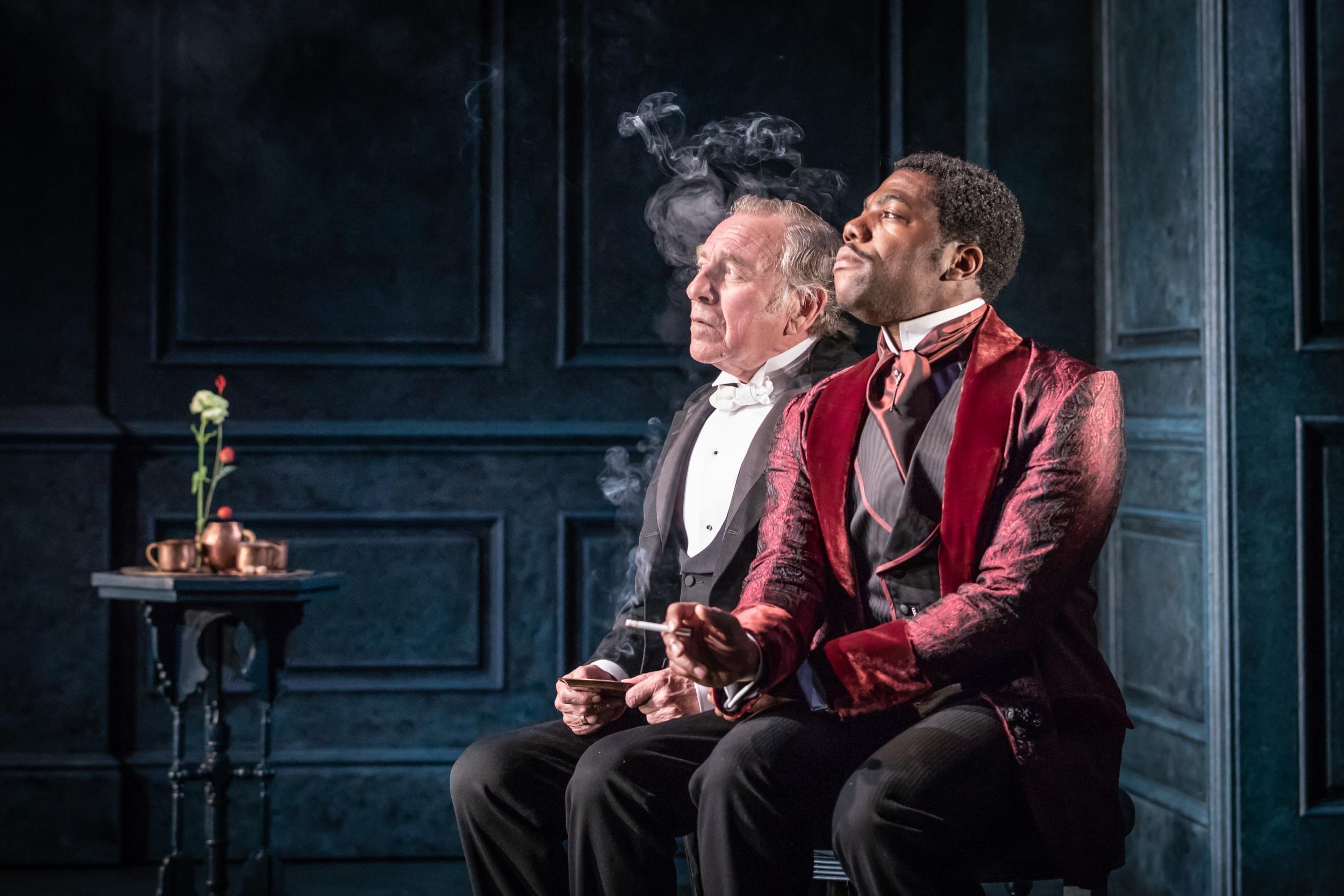
Fentiman's production takes the disinhibition a stage further in being explicit about the play's bisexual subtext from the outset. It's clearly the morning after the night before. Algernon (Fehinti Bahogun) is playing something splashy on his grand piano and a Bosie look-alike in a boater kisses him goodbye. The panelled morning room is decorated with a homoerotic oil painting (which somehow manages to escape Lady Bracknell's beady-eyed attention). As they bite epigrammatic chunks out of each other and shove food into each other's mouths, Algernon and Jacob Fortune-Lloyd's Jack seem to be stoking up a fierce flirtation. Oh, and the elderly manservant Lane (Geoffrey Freshwater) would appear to be offering satisfaction in more ways than one.
You could have knocked me down with a steam-roller. Seriously, does anybody need The Importance “decoding” in this heavy-handed, pseudo-radical way? The cast perform the play with a rampant energy that builds up its own giddy appeal. But there's barely a shred of subtlety in all the cartoonish excess. As Lady Bracknell, Sophie Thompson handles the tricky “handbag” moment by gesture of snobbish recoil that makes her look as if she's trying to ingest her own face. It's a very enjoyable performance but she seems to be offering a delirious descant on the part – a swooping, virtuosic scale-practice in the tones of dowager-hood. You don't hanker to pinpoint her socially.
The hints in the play that she's a dogmatic stickler for the niceties because herself a climbing upstart – and hence one of its catalogue of imposters – get overlaid. It's the nonsensical, Lewis Carroll-type aspect to her unwitting anarchy that Thompson conveys so vividly.
The younger women are consumed by slapstick-lust. Pippa Nixon's Gwendolen frots her backside against the piano. Fiona Button's Cecily clutches her womb and doesn't merely tear up Gwendolen's diary, but consumes some of it too. Orality is quite a running gag in this account. I liked Madeleine's Girling's designs which wittily reject Victorian clutter. The backdrop to the garden scene looks to be anticipating Monet's water lilies just as the gardener appears to be a sultry precursor of Lady Chatterley's Lover. Did I really see him instigate lesbian canoodling between two of the servants? I have to admit to laughing out loud several times at the sheer cheek of the way the production sticks to its gun. But it's devoid of any negligent finesse or lightness of touch. The dialogue is thwacked into the stalls with such brute force, you worry one of these balls might take your eye out.
This has been a wonderfully worthwhile season – particularly in showing you Wilde's sensitivity to the pressures women face – and Dromgoole deserves to be proud of it. A pity that it doesn't end on an undisputed high.
★★★
Until 20 October (nimaxtheatres.com)