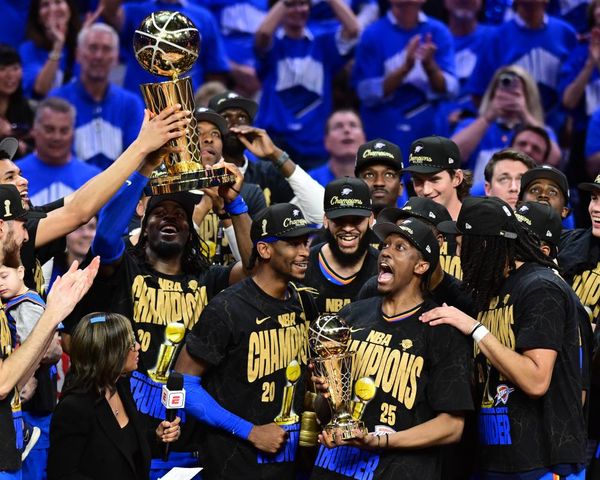
On 4 May, Steph Curry was named MVP of the 2014-15 NBA season. Curry’s season, however, wasn’t actually over until the Warriors defeated the Cleveland Cavaliers in the NBA finals. That would be either 16 or 17 June, depending on which time zone you happen to follow. Imagine holding a presidential election in September and then forcing candidates to keep on campaigning and debating until the first Tuesday in November.
There are reasons that the NBA does this, of course. Despite what you may have assumed from watching the Eastern Conference playoffs, not every team makes the postseason. In order to avoid penalizing players, coaches, executives etc for the things they can’t do in games they can’t play in, the NBA only examines the regular season when handing out its awards.
The result is an incredibly reasonable and fair process that also makes no damn sense. Trying to sort out the NBA’s best and worst while the most important two months of the season are still being played is a bit like trying to figure out the guilty suspect in a Law & Order or CSI episode while not being allowed to acknowledge anything happening in the third act. That’s why here at the Guardian, we wait until the season is officially over. Also we are terrible at guessing.
Most Valuable Player: Steph Curry (Golden State Warriors)
One of the biggest downsides of handing out the MVP award during the playoffs is that it can make an early playoff exit even more embarrassing. Maybe the most infamous example of this came when the league awarded the 2007 MVP to Dirk Nowitzki of Dallas almost immediately after the top-seeded Mavericks were knocked out of the first round of the playoffs.
This time around, Curry and the Golden State Warriors pretty much did the exact opposite of that. On their way to their first championship in 40 years, the Warriors defeated Anthony Davis’s New Orleans Pelicans, Marc Gasol’s Memphis Grizzlies, James Harden’s Houston Rockets and, in the NBA finals, LeBron James’s Cleveland Cavaliers. Basically, the only legitimate MVP candidate the Warriors didn’t beat in the playoffs was Russell Westbrook, and that was only because the Oklahoma City Thunder missed the postseason.
Playoffs MVP: LeBron James (Cleveland Cavaliers)
No, this isn’t an award that technically exists, but it should. If the NBA is going to argue that awards voting should only examine what players and teams did in the regular season, why shouldn’t they also have a companion award that only factors in what they accomplish in the postseason?
By dragging what was left of the Cavaliers all the way to Game 6 of the NBA finals, LeBron pulled off the most impressive accomplishment of his Hall of Fame career. He deserves something to commemorate this beyond the “what if Kyrie Irving and Kevin Love were healthy” wishful thinking that will inevitably be attached via asterisk to all of the accounts of the 2015 finals.
Least Valuable Player: Lance Stephenson (Charlotte Hornets)
How much do people in the league hate Stephenson? Well, after he fell out of favor in Indiana, the Charlotte Hornets snatched him for a three-year/$27m deal that was well below market expectations for a player of his talent, a clear sign that he didn’t have many suitors.
Then, less a month into his first season with the Hornets, there were already reports that Charlotte were desperately trying to trade him. Last week, they finally pulled off a trade with a Los Angeles Clippers team desperate to win back the title of “least likable team in the Western Conference” from the Houston Rockets.
Flop of the Year: PJ Hairston (Charlotte Hornets)
The good news, Hornets fans? They’ve made this list twice. The bad news? Their first appearance was for Stephenson and the second one was, well, this:
Coach of the Year: Mike Budenholzer (Atlanta Hawks)
It’s this simple: If you somehow get an Atlanta sports team out of the second round of the playoffs, you deserve both Coach of the Year honors and a promotion.
Rookie of the Year: Wait, who was the one that didn’t get hurt?
Okay, it wasn’t Julius Randle. He was injured in his first game with the Los Angeles Lakers. Or was that Jabari Parker? No, Parker actually played for about a month with the Milwaukee Bucks before his season-ending injury. I’m not entirely sure I’ve seen Joel Embiid in an actual Philadelphia 76ers uniform. He may be someone who only exists in the land of Photoshop.
Alright let’s just give this to the Minnesota Timberwolves’ Andrew Wiggins by default and move on. This topic is depressing.
Defensive Player of the Year: Draymond Green (Golden State Warriors)
One side effect of having voters maker their picks while teams are still playing meaningful games is that there’s a weird delay in the results. This year, the voters named San Antonio Spurs’ Kawhi Leonard as Defensive Player of the Year.
While the Spurs forward absolutely deserved the honor, his win this year was partly thanks to voters belatedly acknowledging Leonard’s transformation into a superstar the year before. Assuming Green stays healthy and avoids the dreaded sophomore slump after his breakout season, he should be considered the favorite to win the next season
Game of the Year: Los Angeles Clippers 111-109 San Antonio Spurs
As much as we’ve been mocking the concept of analyzing teams and players without factoring in the postseason, there’s a very good argument to be made that this year’s playoffs didn’t really tell us much that we didn’t know coming in.
We knew the Cavaliers would mostly breeze through the Eastern Conference playoffs and then would be huge underdogs against whoever emerged from the West. Barring injuries or a playoff collapse, which Clippers fans will remind you is always on the table, the Warriors were the best team in the league all season long and were probably going to be there at the end.
That’s what made the first round match-up between the Spurs and the Clippers so compelling. Both of these teams, the reigning champions and the most successful team in Clippers history, were good enough to make the NBA finals, yet only one of them would even make it as far as the second round.
So, this Game 7 should have been the most anticipated game of the month, or at the very least the week. Unfortunately for the NBA and its broadcasting partners it was also taking place on the same night as the Mayweather-Pacquiao fight. When Clippers point guard Chris Paul left the game after suffering a hamstring injury, it was looking like as much of an anticlimax as the big fight in Vegas.
Instead, not only did Paul return to the court, he came back playing what may end up as the defining game of his career. Despite having just one healthy leg, Paul’s return energized the Clippers, which, in turn, energized a Spurs team desperate not to lose a heartbreaker on their own court. The Spurs and Clippers hurriedly exchanged leads until there was one second left in regulation. That’s when Paul won the game:
There ended up being a few other classic moments during the postseason. No one will forget the grim spectacle of the Clippers blowing a 19-point lead against the Rockets to revive talk about the “Clippers curse.” Those first three games of the NBA finals, when it looked possible that LeBron could somehow take down the best team in basketball all by himself, were full of great drama even if they were light on good basketball.
This Game 7 though? This is what I’ll remember the most about the 2014-15 NBA season, when a game in the first round of an often interminably long postseason produced a hundred more highlights than the so-called fight of the century. No one came into Game 7 with any preconceived notions of who would win and who would deserve what award. The game controlled the narrative, and not the other way around.