In 1955, Arthur Miller wrote A View from the Bridge, his great play about the community of longshore men, or dockers, many of them recent immigrants from Italy, who worked the Brooklyn piers. Four years previously, while in Hollywood, he had written a screenplay for Elia Kazan set in the same community and inspired by the true story of Pietro “Pete” Panto, a young dockworker who stood up against the corrupt Mafia-connected union leadership. Panto turned up dead in a pit outside New York.
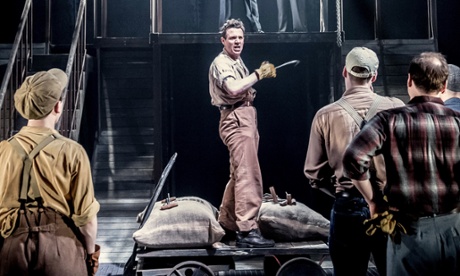
In Miller’s screenplay, given life on stage in a swaggering production by James Dacre, Panto becomes Marty Ferrara (Jamie Sives), a hothead who cannotstand by when he sees injustice. Whatever the cost to himself or his family. One of the great things about Dacre’s production is that, although this is a masculine world, the daily life of women is woven into the fabric. The worn, worried face and stooping shoulders of Marty’s wife, Therese (Susie Trayling), perpetually carrying a baby, and carefully choosing a pepper from the vegetable cart, speak eloquently of the difficulties of making ends meet in a world where the ends keep moving.
Falling foul of the political sensibilities and vested interests of early-1950s America and warnings from the FBI that The Hook might cause unrest in the dockyards, Miller’s screenplay never got made. It’s easy to see why. This is the story of a man trying to empower men who will not speak out for fear of losing their union card. It is a piece that calls for revolution.
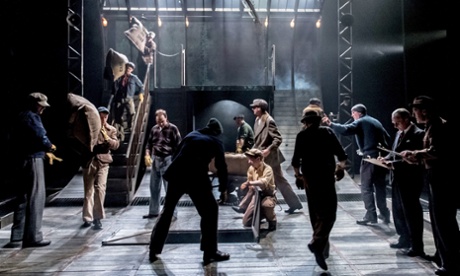
It would be nice to report that this version, painstakingly pieced together by Ron Hutchinson using only Miller’s own words, is a lost A View from the Bridge. It isn’t. The writing is often flat, and the characterisations sketchy. Few of the characters appear to have any inner life at all. The best scene comes towards the end, a rather pertinent reminder, following our own recent election, of why people vote the way they do.
But despite these failings, Dacre succeeds in masking many of the deficiencies with a production that swirls with neatly choreographed hustle and bustle, smoggy atmosphere, the sinister clang and thud of the dockyards, Charles Balfour’s broody lighting, and a terrific design by Patrick Connellan that conjures both the run-down drabness of 50s America and the austerity of a Greek tragedy.
Alas, unlike Miller’s best work, The Hook is more melodrama than Greek tragedy, but Dacre champions it in style and makes a case for it against odds.
• At the Royal & Derngate, Northampton, until 27 June.