Most recent figures show that about three million of Thailand's four million foreign workers are Myanmar nationals. The International Organization for Migration (IOM) estimated that about 4.1 million Myanmar nationals were living in Thailand in 2024, with 2.3 million officially registered by the Thai Ministry of Labour. Today, however, the number of documented workers has dwindled to approximately one million, according to the ministry's latest update.
This discrepancy suggests that much of the workforce is becoming undocumented, which in the long term will pose serious economic, social and security challenges for Thailand.
Indeed, the actual number of undocumented workers remains unknown because Thai agencies cannot track those who have gone underground or those entering in large numbers through illegal "natural crossings" along the western border. Managing this population has become one of the Anutin government's top priorities because of its geopolitical and economic implications.
The Thai government cannot afford to be complacent.
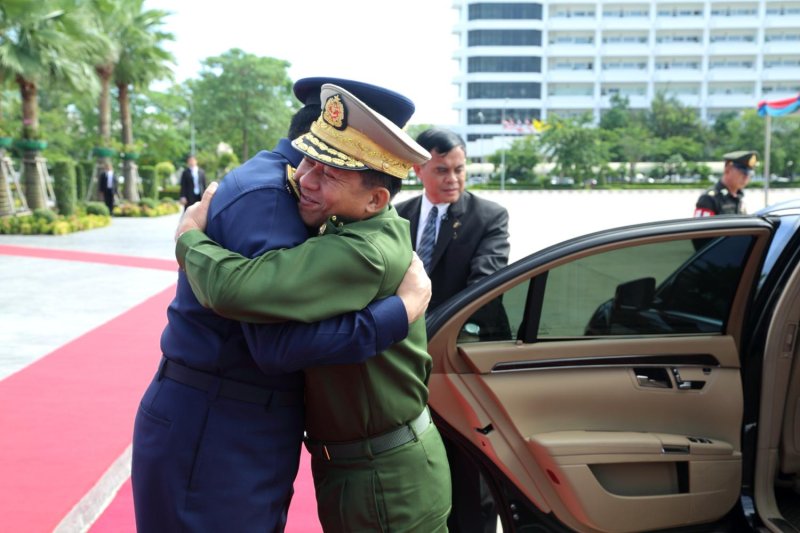
Against this backdrop, Thailand will later this week host Myanmar President Min Aung Hlaing, who has transformed himself from coup leader after the February 2021 takeover into the head of a military-backed administration since April 2026. He is scheduled to make a two-day official visit on Thursday and Friday as a guest of the Anutin government. His highly anticipated trip will be closely watched by stakeholders in Thailand, Asean and beyond.
Thailand and Myanmar, which share a mostly undemarcated 2,400-kilometre border, have one of the world's most complex bilateral relationships. It is shaped by memories of past conflicts, yet sustained by centuries of cultural interaction, migration, trade and geographic interdependence.
Since Myanmar's independence in 1948, however, bilateral ties have largely been shaped by the two countries' military leadership. At this juncture, the Anutin government and the Thai armed forces are working in tandem to manage border issues, particularly online scams, narcotics and environmental concerns.
When Min Aung Hlaing arrives in Bangkok, he will see a different Thailand and the Myanmar workforce that has helped drive the country's economic growth.
During better times, Min Aung Hlaing visited Thailand frequently. He also regarded the late Thai statesman Gen Prem Tinsulanonda as his godfather. Between 2011 and early 2021, Myanmar enjoyed a brief period of openness and democratisation. During those years, Daw Aung San Suu Kyi helped elevate the country's international standing as never before.
This week's engagements could herald a new chapter in Thailand's relationship with post-election Myanmar. Nay Pyi Taw considers itself the country's legitimate government despite sanctions and widespread rejection of that claim by much of the international community.
It maintains this position despite strong condemnation from Western governments, NGOs and human rights groups. For Thailand, engagement is a necessity.
The Anutin government has also earned the trust of Myanmar's top leadership. Quite simply, isolation is not an option, as the two countries face serious transnational challenges that neither can solve alone.
During this visit, Min Aung Hlaing will have the opportunity to address Bangkok's business community -- the first such appearance in an Asean member state aimed specifically at attracting foreign investment and strengthening private-sector economic cooperation. He is expected to build on last week's speech, in which he outlined an ambitious five-year development plan.
As widely reported, the roadmap comprises two phases. The first two years focus on building a stable federal state, followed by three years of accelerated national development. The plan is intended to reassure investors that Myanmar can maintain economic growth and policy continuity despite ongoing internal conflict.
Myanmar's president must also recognise that achieving these ambitious goals will require winning the hearts and minds of Myanmar's people, both at home and abroad, particularly its diaspora. Although Thailand hosts the world's largest Myanmar diaspora, it has no clear policy to encourage this vital workforce to remain.
Nay Pyi Taw's reconstruction plan could therefore become a win-win for millions of Myanmar nationals abroad -- if they believe and trust what they hear in Bangkok in the coming days.
Sad but true, Thailand's rigid bureaucracy and risk-averse regulators have trapped millions of Myanmar nationals -- including white- and blue-collar workers, investors and students -- in a gruelling obstacle course. The current system forces them into a stressful and ever-changing existence.
Thailand must find ways to reverse this unhealthy trend. Otherwise, the country will remain trapped in a vicious cycle. At the very least, those who choose to stay should be able to live with less uncertainty and plan for their future.
Myanmar workers are normally recruited under the Thailand-Myanmar labour MOU signed in 2003. They receive two-year work permits that can be extended to four years, after which they must return home and reapply.
However, the Thai government has extended these permits three times to ease labour shortages and respond to Myanmar's political situation. Following the coup, Nay Pyi Taw also tightened consular procedures and worker verification for Myanmar nationals abroad.
As a result, many workers have become increasingly reluctant to deal with Nay Pyi Taw, making work permit renewals even more time-consuming and costly. Faced with these obstacles, many legal workers have become undocumented.
It is time for Thailand to develop a new framework allowing Myanmar migrants to live, study, work and plan their futures legally and safely while they wait to return home.
When they see genuine opportunities across the border, many will choose to return.
The treatment of displaced professionals illustrates this bureaucratic bottleneck. Thousands of Myanmar doctors and nurses have crossed into Thailand to escape conflict. Many want to care for their fellow citizens but are unable to do so because of regulatory restrictions.
The Thai government should grant special, limited licences to these displaced medical professionals. Such a policy would immediately ease the burden on Thai doctors, who currently provide care for migrant patients in already overstretched public hospitals across the country.
Myanmar doctors also understand the language, culture and medical histories of their communities, ensuring better diagnosis and treatment. Regulators could limit their practice to migrant communities and cap fees so they do not compete with private Thai clinics.
This could be the next important reform. In private discussions, Thai doctors have expressed support and say they are ready. They are now waiting for government action and approval from the Medical Council of Thailand.
Another major hurdle is cross-border financial infrastructure. Today, Myanmar workers send billions of baht home through informal underground networks known as hundi. These systems remain popular because they are less cumbersome and offer better exchange rates.
Thailand and Myanmar should work together to channel these transactions through formal banking systems. A transparent remittance framework would allow workers to contribute to organised social protection schemes while helping secure their health care and future livelihoods.
The time for reform is now. Thailand needs a clear, forward-looking policy to break the vicious cycle surrounding this vital workforce.