When Marin Alsop steps up to the podium in London’s Royal Festival Hall on Remembrance Sunday to conduct Britten’s War Requiem, she will stand in a spot occupied by few women before her. She will be a human and visible rebuke to the traditional notion of the conductor as sketched by New York Times music critic Harold Schonberg in 1967: “He has been tempered in the crucible but he is still molten and he glows with a fierce inner light … Above all, he is a leader of men … a father … the Teacher who knows all.” Close your eyes and think of a maestro (an Italian word that has entered the English language in, by default, the masculine form) and the chances are that you think of a man.
We live in a visual world. Ms Alsop’s presence on that podium is a reminder of the importance of actually seeing women in prominent cultural roles. In the most pervasive medium, television – the one that we encounter from cradle to grave, brought directly into our homes – the imbalance between the numbers of men and women on screen remains severe, as the Lords committee on women in news broadcasting has been hearing this week.
Penny Marshall, who recently resigned as the BBC’s education editor and is returning to ITV, described herself, at 51, as “the last woman standing” in a generation of reporters who had mostly drifted out of the profession. “Newsrooms were created by men for men,” she said – a statement as true in papers as in the broadcast media, it must be noted.
Ms Marshall’s statement points to the fact that gender imbalance increases with age. Her comments are given further credence by former BBC reporter Olenka Frenkeil’s article in which she describes how she was sidelined at the corporation as she became older. A report commissioned by Harriet Harman found last year that fewer than 18% of TV presenters over 50 (not just in news) are women. The overall picture is less bleak: 38% of on-screen staff at Channel 4 News, for example, are women. To some, that might suggest that as time goes on, the imbalance will naturally correct itself. But this would be naive. It is not just a practical matter – that it can be difficult to re-enter the profession after a break to raise children, for example – but also more insidious and intangible. That older women, perhaps, don’t look like one’s idea of a reporter, just as Marin Alsop does not resemble one’s idea of a conductor.
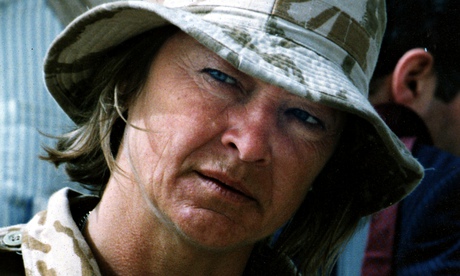
In this visual world of ours, it really matters who represents us on screen. Growing up, Cathy Newman, an anchor on Channel 4 News, was inspired to become a reporter because of seeing foreign correspondent Kate Adie, she told the Lords. Ms Adie will have inspired other girls to become doctors or lawyers or entrepreneurs simply through being an authoritative, powerful female whose image was beamed into living rooms.
The BBC has a special duty, through the universality of the licence fee, to lead the way. It has identified gender equality as a priority. Tony Hall has announced that by 2015, 50% of breakfast presenters on local radio should be women. That’s a good first step, but targets are needed in the newsroom too – at present, there are not even publicly available gender statistics on the BBC broadcast reporters. What we see matters to all of us; equality cannot be left to chance.