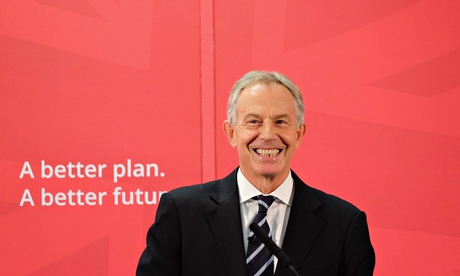
For some, the messenger will always now be more significant than any message he brings. Tony Blair has become a polarising figure in a land that once cheered his many victories. Everything he says is now subordinated to the catastrophe of Iraq, his unrepentant and naive championing of markets, and the personal wealth and lifestyle he has chosen since being forced out of Downing Street in 2007. So when he entered the election campaign on Tuesday with a speech on Britain and Europe, many preferred to talk about Mr Blair than about Europe. That is Mr Blair’s fault – no one else’s. It is also a pity, because Mr Blair brings a bigger perspective to the election debate.
The reality of the Blair factor should be honestly acknowledged. For Mr Blair to embrace a cause is at best a distraction and at worst a risk to that cause. The SNP, whom Mr Blair attacked at length in his speech, immediately denounced his “toxic legacy” and predictied that he will drive former Labour supporters into the nationalists’ arms. Other parties positioned to the left of Labour said similar things. And even among Labour supporters there is a widespread perception that Mr Blair has done his reputation no good by his spectacular reluctance to display any sort of humility since 2007, as the necessary precondition for winning the fresh hearing he clearly seeks.
That said, however, Mr Blair did the nation and the election a favour on Tuesday. Europe is one of the defining issues in the 2015 election. Depending on the outcome, Britain will be set on one of two very different courses in its relations with Europe next month. The choice of government will certainly have an impact on economic strategy, public spending and social policy options. None of these, though, would be irreversible. A decision to leave the European Union would be different. It would settle the issue for decades.
Yet until now the issue has been off the radar altogether. It was an extraordinary indictment of last week’s televised leaders’ debate that it did not devote any attention whatever to Britain’s place in the world. Nothing about EU membership. Nothing about the instability of relations with Russia. Nothing about the danger from failed states. Nothing about defence policy. This is not to pretend that the EU issue is the dominant one on the doorsteps. It isn’t. But it is a huge issue facing Britain. It needs to be discussed. It is one of the subjects that ought to define the choices that voters make.
So Mr Blair was right to raise the EU issue and right to argue for its importance. Above all, he was right to defend Europe and to draw attention to the potential for chaos and recession in the UK if Britain were to leave the EU. What Mr Blair called “a pall of unpredictability” would hang over the UK economy, the country’s international relations and, not least, the continuing existence of the UK itself. Our country would be undertaking a historic retreat from reality in pursuit of a fantasy with destabilising consequences at home and abroad. None of this is hyperbole. And all in less than two years’ time.
Mr Blair was also right to attack the case for a referendum now. David Cameron called for that vote because he was a weak leader under pressure from his Europhobes and a rightwing press so patriotic that many of its owners do not even live here, let alone pay taxes. It is hugely to Ed Miliband’s credit that he refused to make a similar trade. No one looking at the priorities facing this country can possibly argue that the number one issue facing a new Labour government in a month’s time will be to launch a referendum on the EU. Whatever else Mr Blair and Mr Miliband may think about one another, this key convergence between them is politically principled and in the national interest.
Not every aspect of Tuesday’s speech in Sedgefield showed an unerring touch. Mr Blair is too facile in the way he talks about Britain as a global power. When he talks about British business, he thinks boardroom not shopfloor. He has not learned wisdom from his mistakes. He forgets that things have changed since the crash of 2008. He does not understand Heraclitus’s insight that one never steps into the same river twice. Mr Blair still has much to learn from the country he left behind. But the country should listen to what he says about Europe, because he is right.