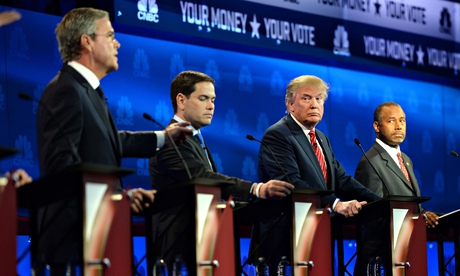
The Wi-Fi password for Tuesday night’s Republican debate in Milwaukee was: “StopHillary”. Therein lies both the party’s greatest strength and weakness. The Democrats have all but settled on Hillary Clinton as their presidential nominee. She has led every poll for the last year and all but two of those leads were in double figures. So Republicans know who they have to beat.
The trouble is, at first sight, they don’t appear to be any closer to reaching a consensus on who they should pick to beat her than when the debates started. On Tuesday night there were eight candidates on show. Over the last year the Republican field has boasted six different frontrunners. For the past four months that has been either Donald Trump, the billionaire windbag for whom “bloviator” might have been invented, or evangelical neurosurgeon Ben Carson, who recently claimed the pyramids were for grain storage and that the Holocaust might have been prevented were it not for gun control. Between them they are attracting half of all party support. Both candidacies should be taken seriously, not least because they deprive other candidates of oxygen and because of the direction in which they are dragging the debate.
But despite their current high standing, recent history suggests neither is likely to become the nominee. In 2012, the party flirted with every alternative going – Herman Cain, Rick Santorum, Newt Gingrich, Rick Perry – before settling for the most obvious and only plausible choice: Mitt Romney. In 2008, Mike Huckabee continued to draw substantial support even after John McCain’s nomination was a foregone conclusion. In both cases Republicans eventually chose the most electable candidate. But only after he had been so undermined and the party name so ostentatiously tarnished that the nominee was rendered unelectable.
In terms of money, name recognition and organisational capacity the two most viable nominees are Jeb Bush and Marco Rubio. After Mr Rubio’s impressive performance in the most recent debate, when Mr Bush was again underwhelming, he is fast becoming the favoured son. He’s convivial, empathic, young, Latino, the son of immigrants and the senator from the swing state of Florida – none of which can be said of Ms Clinton. The one thing Mr Rubio does not have going for him, so far, is the Republican base.
Mr Rubio’s challenge – and Mr Bush’s, should his campaign revive – is twofold. First, how to rise to the top without incurring the collateral damage that so fatally undermined Messrs McCain and Romney. If Messrs Trump and Carson stumble, the Texas senator, Ted Cruz, who also did well in the debate, will be there to deliver broadsides in the name of an angry and disillusioned base. Second, how to stay top without being drawn too far to the right – particularly on immigration reform. As Messrs Trump and Cruz championed building a wall on the border and mass deportation of undocumented migrants, Mr Bush opined “they’re doing high-fives in the Clinton campaign now when they hear” this. Within seconds, Ms Clinton’s press secretary tweeted “We actually are doing high-fives right now”.
The biggest liability a Republican nominee will have is the party that, albeit reluctantly, nominates him. Because by the time you’ve endured what it takes within the party to be a plausible nominee, you no longer have the air of a plausible presidential candidate.