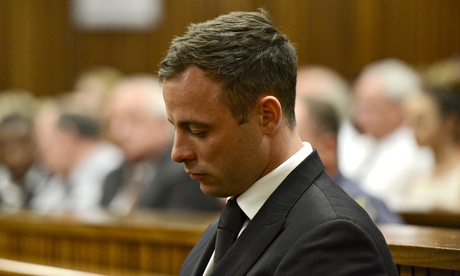
It is easy to grasp why the trial of Oscar Pistorius captured global public attention from its opening in March. All the way through to its closing scene on Tuesday, when the athlete was sentenced to a maximum of five years in prison for killing his girlfriend, this trial has had all the ingredients of a Hollywood thriller, and has often been treated largely as though it were one.
The drama is obvious: the spectacular downfall of a star who had overcome disability to become an Olympic champion, the emotional outbursts in the courtroom, the long painstaking descriptions of how bullets were fired through a door, causing the death of a woman. The case has been broadcast live to the world, sometimes for hours on end, reflecting the fascination that celebrities can inspire, especially when their lives plunge into tragedy and when the most minute details of their story can be instantly shared worldwide through new technologies.
It is also easy to understand why, under so much scrutiny, the Pistorius trial might have attracted doubts and criticisms. Though the judge rejected the argument that this was a case of domestic violence in favour of the finding that Pistorius thought he was shooting an intruder, the domestic relationship was a key backdrop that explains why so many think the sentence too lenient. In September, the ANC women’s league was shocked by the verdict of culpable homicide rather than murder in a country where violence against women remains a huge problem. The feeling that Pistorius got off easily will certainly become stronger if, as the athlete’s lawyers have asked, he is released from prison after 10 months behind bars. Other critical voices still ask how the police allowed the crime scene to be tampered with.
But, after all the emotion and suspense, the main lesson to take away may well be about South Africa itself. This has been a seminal trial in a country where major democratic and social transformations remain unfinished. Twenty years after the end of apartheid, and almost one year after the state funeral of Nelson Mandela – who started out as a lawyer, it is worth remembering – the Pistorius trial has been something of a mirror held up to the new South Africa.
There was no more striking illustration of this than the central figure of the judge, Thokozile Masipa, a black woman who presided over two Afrikaner colleagues. Judge Masipa has been a vivid symbol. Imprisoned during the struggle against apartheid, in 1998 she was only the second black woman to become a judge in South Africa. One of her final comments on Tuesday carried a message of reconciliation and mercy that may have deliberately echoed something of Mandela’s philosophy: “Righteous anger,” she said, “should not cloud judgment.”
South Africa still battles with issues of race, social inequality and difficult governance, but the spirit of seeking “mercy” and “achieving the right balance”, as expressed by Judge Masipa, is also testimony to the admirable path that the country has nevertheless travelled over the past two decades. The Pistorius trial has demonstrated this in a striking way. South Africa emerges from it with much credit.