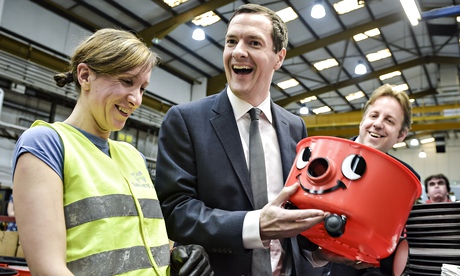
The productivity puzzle, the failure of output to return to growth in line with pre-recession trends, has now been identified by the chancellor as the government’s big challenge for the next five years. Meriting just one mention in the Conservative manifesto, by Wednesday’s budget speech the search for higher productivity had become the driving narrative. There are sound economic reasons for George Osborne’s new-found ambition. There are even more persuasive political ones.
British productivity is 28% lower than in France, 29% lower than in Germany and 30% behind the US. There is a case to make that the decisions Mr Osborne took in his first term as chancellor contributed significantly to the problem that he is now anxious to solve. In particular, slamming the brakes on infrastructure spending looks ever more misjudged. Most people agree that higher productivity is desirable – the green movement may get a boost from those who do not. But there is far less consensus about how to make it happen. Better rail connections, less congested roads, more homes near more jobs, and a higher-skilled workforce, all those are common ground and they were travelled once more by Mr Osborne and the business secretary Sajid Javid on Friday. Notably missing in the account of the significance of investment was any explanation of why, say, the upgrade to the TransPennine rail route was on hold and there was to be no decision on a third runway at Heathrow until the end of the year.
Mr Osborne also argued that there was a link between higher productivity and higher pay. In his unexpectedly statist intervention in Wednesday’s budget speech, when he trampled over the Low Pay Commission’s carefully guarded independence and mandated a “national living wage” of 60% of median earnings by 2020 – likely to be at least £9 an hour – Mr Osborne flourished in his support a reference to a paper by the LPC’s first chairman, Sir George Bain, for the left-of-centre Resolution Foundation. Mr Osborne, promising a higher-wage economy, said he was following its recommendations. Not quite, chancellor.
Sir George argued that the minimum wage’s first goal, eliminating poverty pay, had largely been accomplished and it was time to develop its ambition. With 20% of the workforce across the UK still only paid at the minimum wage, he warned of the danger of more and more workers being trapped rather than supported by it. He proposed a much broader approach to tackling low pay, with the LPC instigating research to identify blockages to routes out of low-paid, and by definition less-productive, work. He also suggested that the rate could be set in a different way.
One possibility was a regional minimum, which could deliver the kind of increase needed to make it an effective floor in London and the south-east, where it is less than 40% of the median, without raising it to unsustainable levels in other parts of the country, where it is often at or near 60%. Another proposal, which would deal with the huge challenge that the higher national rate will pose in areas such as care, where the bill is picked up by local councils, was the introduction of sectoral pay minimums.
None of these subtleties, which by investigating the detail of work in the real world could begin to unlock the link between pay and productivity, filtered through on Wednesday. That may be because rabbits pulled from hats only need to be rabbits, not rabbits with subclauses. But the obvious explanation is that the chancellor’s main concern was to find a bauble to distract from the raid he had launched on tax credits which will cut incomes of the in-work poor by up to £30 a week.
It is beyond doubt that, for millions of families, the higher minimum wage alone will not be a genuine living wage. Making ends meet will mean even longer hours and even harder work. For many, the hours will either not be available or not a practical option. In some sectors where the minimum wage plays an important role – food processing, for example – employers may find ways of increasing productivity. But in many low-paid jobs – in social care or hospitality or retail – productivity can only be increased by working more intensively. That means fewer, shorter breaks and more pressure.
The future of work in the 21st century lies at the heart of the productivity puzzle. Mr Osborne may really have a joined-up plan to tackle it. But everything he has said so far suggests he is thinking less about policy, and more about politics.