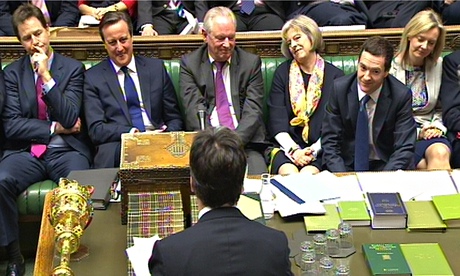
To the casual ear, it was one more Westminster slanging match – the two tribes baying across the aisle, reminding the country to be thankful that the election campaign is about to close down the Commons for a while. Ed Miliband today sought to trip up the prime minister on VAT, the tax he’d previously not wanted to talk about, but David Cameron growled out a surprise promise not to raise it. That put Mr Miliband on the back foot, and set the house into a frenzy. A few Labour posters on VAT may now need to be pulped, and excitable Tory MPs will go back to their constituencies with a bit more spring in their step.
Out in the real world few will have caught this end-of-season spectacular at the palace of varieties, and fewer still will have swallowed the eve-of-election pledges made. But this was nonetheless one of those rare dispatch box duels which could have enduring consequences – enduring and pernicious. For Mr Cameron’s crowd-pleasing one-liner concerned one of the UK’s three chief revenue raisers, and provoked a panicky promise from Labour’s Ed Balls, just a few minutes later, regarding one of the other two – national insurance. Within an hour, the politicians had cowed each other into declaring nearly half the tax base off limits. With spines this feeble, the obvious danger is that the next chancellor could be all out of taxing options by polling day, a position that can produce only one of two consequences. First, a further heightening of the dangerous cynicism about Britain’s democratic processes, the result if the tax promises are broken or wriggled out of with weasel words. Or, second, to lock the country into an extreme and unbalanced fiscal course – condemning the UK to public squalor even after private prosperity returns.
The first scenario, of promises broken, is the more familiar, especially with the Conservatives and VAT. Margaret Thatcher had “no plans” to jack it up before her election in 1979, but she certainly had them a few weeks later when she virtually doubled the rate, from 8% to 15%. Then, while John Major was campaigning to succeed her in 1990, he said little about it – only to increase it within months of getting into No 10. Mr Cameron is the third Tory prime minister of modern times, and in 2010 he too disavowed all intentions regarding VAT from opposition, but then also reached for this tax immediately on coming to power, with a rise to 20%. Whether or not he is serious about doing anything different this time, it’s no wonder that he has been driven to be more explicit: with this track record, the “no plans” formulation would never have washed.
On the other side of the aisle, Tony Blair’s pledge of “no rise in income tax rates” became a pathetic totem in successive New Labour manifestos. Its initial effect was to close down the rational discussion about paying for public investment which Britain was crying out for in 1997. Later, the pledge fuelled mistrust, as the spirit of the promise was broken with the income-tax-hike-in-all-but-name effected through national insurance in 2002’s budget. Then – at the fag-end of Gordon Brown’s term – the letter of the pledge was also broken, when top taxes rose.
If the pre-election noises are lacking in candour, that is depressing; if they reflect a genuine determination to do what George Osborne’s published plans suggest, and leave tax alone while pushing all pain on to the public realm, then that’s terrifying. A pragmatic government in a fiscal fix would not be diverted into shrinking the state’s share in the economy, but would instead go for an evenly balanced package of cuts and tax increases, which is in fact what the Major administration did in the 1990s. Messrs Cameron and Osborne have revealed themselves as ideologues by contrast. The Institute for Fiscal Studies calculates that belt-tightening over the next few years will come from a mix that is 98% spending cuts, and only 2% taxes.
This is an extreme imbalance, not only by the standards of UK history, but also in the light of what other governments overseas have done since the crisis. It is the chief reason why the Conservative plans for policing, culture and social care are entirely unsustainable. Labour should have called them out on their extremism. Today it blew the chance.



.jpg?w=600)