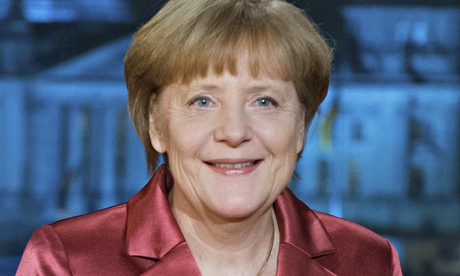
If politics were like boxing, meetings between national leaders would be arranged according to weight. In the asymmetrical world of international relations, however, disparity is the norm rather than the exception. So it is with Angela Merkel and David Cameron, who confer together in London on Wednesday. The chancellor is the heavyweight contender, while the prime minister would rate as middleweight at most. The difference, unfortunately, is not just a reflection of the strength and size of the two countries concerned. It is also a measure of the stature of these two politicians.
Mrs Merkel’s characteristics – her steadiness, her careful thinking through of problems, her solid control of her party, her reluctance to move until she is sure of the right course, her refusal to play to the gallery – enhance Germany’s influence in Europe and the world. With Mr Cameron, the reverse is true. He has charm and a certain decency, but he is too easily blown off course by adverse winds arising within his own party and outside it. This has led him to take positions on Europe and immigration that could have been expressly designed to reduce our influence on our neighbours, ones that could lead to Britain departing the European Union. That would leave the United Kingdom in an isolation which it can be guessed Mr Cameron does not want but which he could nevertheless end up having brought about.
So it is that, as our former Berlin correspondent argues, he looks to Germany for rescue, hoping that Mrs Merkel’s government will help craft changes in European regulations that Mr Cameron will then be able to present to his own party and to voters attracted by Ukip’s nostrums as helping Britain control the flow of immigrants. Whether such changes actually would have that effect in any longer term is another matter. Mr Cameron may not care too much about that, wanting only the appearance of concessions to help him out of the political corner into which he has painted himself. Contrast Mrs Merkel’s forthright remarks on the anti-Islamic demonstrations with which Germany is currently coping, with Mr Cameron’s skirting of the moral aspects of the immigration debate to see the difference.
Mrs Merkel has to manage a crammed portfolio of European problems. Britain’s difficulties are not at the top of the heap. The most important general issue she faces is whether to stick with an unalloyed austerity programme that is becoming more and more politically explosive in southern Europe. The most immediate specific question is how to cope with a possible change of government in Greece. A more fundamental problem, in terms of the dynamics of the union, is how to prop up the old partnership with France. And the most obvious external problem is how to manage Ukraine and Russia. Here, at least, Britain and Germany seem to be on the same page.
Mrs Merkel is the strongest and most important leader in Europe. She is hardly beyond reproach. The contradiction in her position is that at home she essentially governs as a social democrat, yet she operates as a neoliberal hawk abroad. Her austerity drive can be said, at the very least, to be causing as many problems as it solves. Her insistence on reform in Greece is vague when it should be detailed, leading to the suspicion that the problem is that, in German eyes, Greece can do nothing right.
Domestically, she often manages to “solve” political problems by simply sitting them out, while her parliamentarians squabble and everyone gets bored of the subject and moves on. That is how she dealt with the scandal of the NSA monitoring her mobile phone: she largely kept quiet when many were hoping that she would raise her voice more loudly. But in broader foreign policy matters, that is not a working strategy in the long run. Her dealings with Russia’s President Vladimir Putin over the past year show signs of a learning curve: she has been not just quiet but quietly firm. The world is still waiting for her to show similar leadership in the eurozone crisis.
But at least she is in a position to do so. Mr Cameron, however, has all but written himself out of the European script. He is not a problem-solver, as Mrs Merkel is or could be, but a problem in himself for Europe, and yet another cross for the chancellor to bear.